






Chip Tuning Hyundai i30
Up to 30% more power for your Hyundai i30
The Hyundai i30 (2007 →) is listed with 3 generations and 31 engines. For 20 turbo engines, choose the GAN GT or GAN GTL tuning module: the GAN GT adds +27 to +48 hp (GAN GT from 329 EUR, GAN GTL from 219 EUR). For 11 naturally aspirated engines, choose the GAN GA or GAN GA+: the GAN GA+ adds +12 to +19 hp (GAN GA+ from 189 EUR).
Which Hyundai i30 do you have?
Start with the model year and chassis code. Within a generation, choose your engine by the power output in your vehicle documents.
Hyundai i30 tuning: what the GAN module does and doesn’t do
More power and torque without an ECU remap or replacing any parts. The tuning module only adjusts the engine sensor signals.
- Bluetoothsmartphone mode control
- 18 mappingsfine tuning for your engine
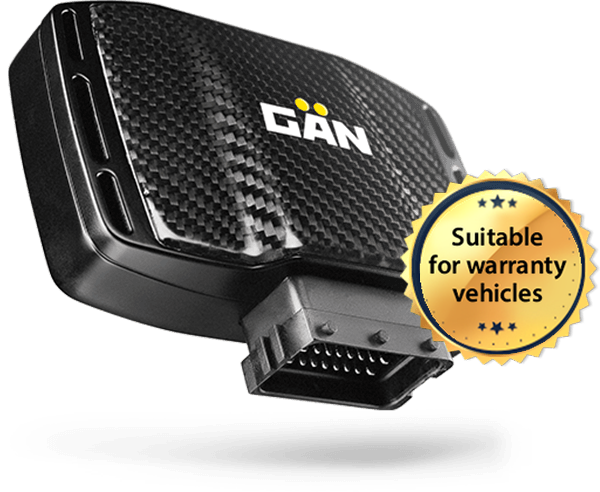
- 15 minutesfitted to the factory connectors
- IP67water and dust protection
- +48 hpwith the GAN GT on turbocharged engines
+27 to +48 hp across the Hyundai i30 range with the GAN GT or GAN GTL.
- +19 hpwith the GAN GA+ on naturally aspirated engines
Naturally aspirated Hyundai i30 engines: +12 to +19 hp.
- GAN APPpower control via smartphone
SPORT, DYNAMIC, ECO and STOCK modes in the GAN app.
- 50 daystest drive
Enhanced performance or your money back, excluding delivery costs.
Hyundai i30 chip tuning: engines and generations
i30 N tuning: one engine, three outputs
The i30 N has one engine in three outputs: 250 hp, 275 hp in the N Performance and 280 hp in the facelifted N Performance, built from 2021. All three come from the 2.0 T-GDI; T-GDI means a turbocharged petrol engine, so i30 N tuning with a tuning box uses the GAN GT. The 250 hp and the 275 hp versions have their own GAN GT figures, so choose by output. That leaves the 280 hp version, which is the facelifted N Performance built from 2021.
The rest of the i30 range
The small turbo petrol engines are the 1.0 T-GDI with 120 hp and the 1.4 T-GDI with 140 hp, which was built from January 2017 to May 2020. From 2020 the 1.5 T-GDI with 160 hp took over as a 48V mild hybrid. The i30 Turbo of the second generation had a 1.6 T-GDI with 186 hp from March 2015. The diesels run from the 2.0 CRDi with 140 hp in the first generation to the 1.6 CRDi with 110 and 136 hp in the later ones.
The petrol 1.4 and 1.6 MPI engines are naturally aspirated, like the 2.0 CVVT of the first generation and the 1.6 GDI of the second. Those engines work with the GAN GA+. For Hyundai i30 chip tuning the generation, the engine and the output together decide the right match.
Generation codes
The generations are known as FD, GD and PD, and the estate is called the CW or Wagon. The Fastback liftback came in 2018 with the third generation.
Hyundai i30 chip tuning: questions
What does a tuning box add to the i30 N?
The N Performance with 275 hp and 353 Nm reaches 322 hp and 453 Nm with the GAN GT. With the same module the 250 hp version adds 41 hp and 100 Nm. These are the stated gains for this engine type, not a dyno reading of your car.
What do the i30 CRDi diesels gain?
The 1.6 CRDi with 110 hp gains 33 hp and 77 Nm, the 136 hp version 40 hp and 81 Nm, and the 2.0 CRDi with 140 hp of the first generation 41 hp and 86 Nm. The CRDi diesels are turbo engines, where the GAN GT gives up to 30% more power.
Hyundai i30 chiptuning: what do the small turbo petrol engines gain?
The 1.4 T-GDI with 140 hp gains 41 hp and 70 Nm. The 1.6 T-GDI with 186 hp of the i30 Turbo gains 31 hp and 55 Nm.
What does a GAN GA+ add to the i30 1.4 and 1.6 MPI?
The 1.4 MPI with 100 hp gains 12 hp and 16 Nm, and the 1.6 MPI with 120 hp gains 14 hp and 19 Nm. The GAN GA+ gives up to 12% more power, the most a naturally aspirated engine can expect.
Is a tuning module the same as a Stage 1 tune?
Not quite. Stage 1 usually means an ECU remap without replacing any parts. The tuning module also works without replacing parts, but it does not change the ECU software: it adjusts the sensor signals, comes off in about a minute, and the OFF button in the app restores the factory settings.