






Chip Tuning Toyota Tundra
Up to 12% more power for your Toyota Tundra
The Toyota Tundra (2007 →) is listed with 2 generations and 9 engines. For 9 naturally aspirated engines, choose the GAN GA or GAN GA+: the GAN GA+ adds +22 to +30 hp (GAN GA+ from 189 EUR).
Which Toyota Tundra do you have?
Start with the model year and chassis code. Within a generation, choose your engine by the power output in your vehicle documents.
Toyota Tundra tuning: what the GAN module does and doesn’t do
More power and torque without an ECU remap or replacing any parts. Your manufacturer’s warranty is preserved: the ECU software is never changed, and the module can be removed at any time.
- Bluetoothsmartphone mode control
- 18 mappingsfine tuning for your engine
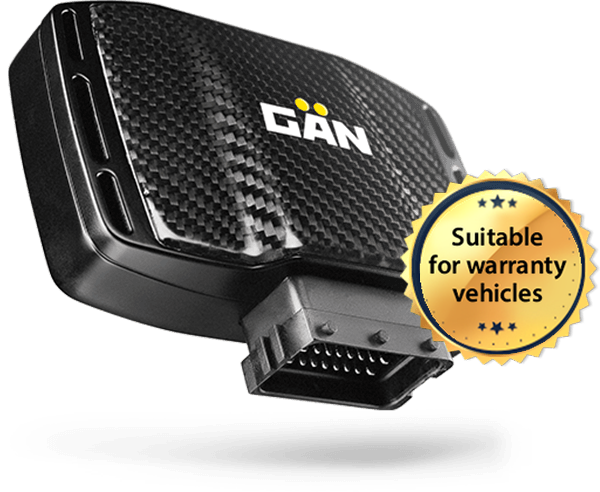
- 15 minutesfitted to the factory connectors
- IP67water and dust protection
- +30 hpwith the GAN GA+ on naturally aspirated engines
Naturally aspirated Toyota Tundra engines: +22 to +30 hp.
- up to +30%more power
GAN GT: up to 30%, GAN GTL: up to 25%, GAN GA+: up to 12%.
- GAN APPpower control via smartphone
SPORT, DYNAMIC, ECO and STOCK modes in the GAN app.
- 50 daystest drive
Enhanced performance or your money back, excluding delivery costs.
Toyota Tundra chip tuning: engines and generations
Toyota Tundra tuning: a truck built for North America
The Toyota Tundra has been built for North America since May 1999 and is not sold officially in Europe. In Europe you find it as a grey import, in Switzerland and Sweden for example. The catalogue figures for the Tundra are American SAE hp, not metric PS.
A Tundra V6, for example, is listed at 236 hp. It is a full-size pickup with no diesel, built as a Double Cab and a CrewMax (earlier also as a Regular Cab).
Chip tuning for the first two generations
The first generation (XK30 and XK40, 1999–2006) had a 3.4 V6 with 190 hp and a 4.7 V8 with 245 hp, later 282 hp. The 4.0 V6 with 236 hp arrived for the 2005 model year. The second generation (XK50, 2006–2021) offered the 4.0 V6 with 236 hp, the 4.7 V8 with 276 hp, the 4.6 V8 with 310 hp from 2010 and the 5.7 V8 with 381 hp. From the 2020 model year the 5.7 V8 was the only engine. The 2011 update raised the 4.0 V6 to 270 hp.
The 4.0 V6 with 270 hp is not in the Tundra catalogue under its own name: the same engine appears as the 4.0 V6 of the Lexus GX. The 5.7 V8 goes from 381 hp and 543 Nm to 411 hp and 586 Nm, a gain of 30 hp. The 4.0 V6 goes from 236 hp to 264 hp; both work with the GAN GA+, rated at up to 12% more power. The third generation (XK70, from 2022) has a twin-turbo 3.4 V6 and a hybrid.
Toyota Tundra chip tuning: questions
Tundra 5.7 V8 or 4.6 V8: which can be tuned, and how much more power does a GAN GA+ add?
Both can: the 4.6 V8 goes from 310 hp to 335 hp, a gain of 25 hp, and the 5.7 V8 gains 30 hp. These are the stated gains for this engine type, not a dyno reading of your car.
Are the Tundra figures SAE hp or PS?
SAE hp, as in the American specifications; the module gain is quoted in the same unit as the stock figure.
Is the Tundra III with the twin-turbo 3.4 V6 in the catalogue?
No, the catalogue covers the first two generations. The XK70's twin-turbo 3.4 V6, rated at 348 to 389 hp (SAE), and its i-FORCE MAX hybrid, rated at 437 hp (SAE), are not in the catalogue.
Tuning box or ECU remap on a Tundra?
A tuning box alters the sensor signals the ECU receives; an ECU remap changes the software inside the control unit. Nothing is written to the ECU, and the GAN module comes off in about a minute.
Is a tuning module the same as a Stage 1 tune?
Not quite. Stage 1 usually means an ECU remap without replacing any parts. The tuning module also works without replacing parts, but it does not change the ECU software: it adjusts the sensor signals, comes off in about a minute, and the OFF button in the app restores the factory settings.