


We build tuning modules and sell them remotely: cars don’t come to us — emails do. And among the thousands of support tickets, there’s a category our engineers call “rescue after tuning” among themselves: someone isn’t asking about our module — they’re describing a car that’s already been tuned somewhere else, and they want to know what’s wrong with it. We won’t install a module on top of a bad calibration, so these conversations always start the same way: sort out the tune first.
Answering “what’s wrong with it” is easier than it sounds: our team includes engineers who spent years writing tuning files themselves — usually the symptoms described in a ticket are enough for them to recognize the signature of a bad calibration before any scan tool gets involved. We’ve seen more than 30,000 tuned vehicles pass through our hands, and across that sample the pattern is unmistakable: a bad tune almost never kills an engine on day one. It gives itself away through a set of small symptoms that are easy to blame on fuel, weather, the car’s age — anything but the real cause. Here are the five signs that make this category of ticket instantly recognizable.
Five Signs
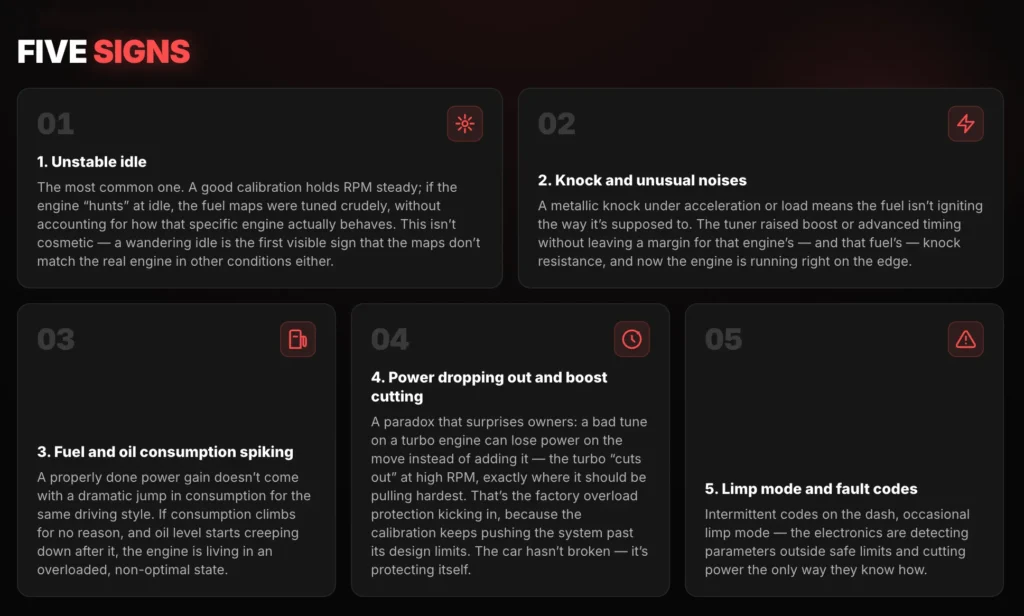
1. Unstable idle. The most common one. A good calibration holds RPM steady; if the engine “hunts” at idle, the fuel maps were tuned crudely, without accounting for how that specific engine actually behaves. This isn’t cosmetic — a wandering idle is the first visible sign that the maps don’t match the real engine in other conditions either.
2. Knock and unusual noises. A metallic knock under acceleration or load means the fuel isn’t igniting the way it’s supposed to. The tuner raised boost or advanced timing without leaving a margin for that engine’s — and that fuel’s — knock resistance, and now the engine is running right on the edge.
3. Fuel and oil consumption spiking. A properly done power gain doesn’t come with a dramatic jump in consumption for the same driving style. If consumption climbs for no reason, and oil level starts creeping down after it, the engine is living in an overloaded, non-optimal state.
4. Power dropping out and boost cutting. A paradox that surprises owners: a bad tune on a turbo engine can lose power on the move instead of adding it — the turbo “cuts out” at high RPM, exactly where it should be pulling hardest. That’s the factory overload protection kicking in, because the calibration keeps pushing the system past its design limits. The car hasn’t broken — it’s protecting itself.
5. Limp mode and fault codes. Intermittent codes on the dash, occasional limp mode — the electronics are detecting parameters outside safe limits and cutting power the only way they know how.
Why This Happens
It almost always comes down to one of two things.
A generic file instead of a real calibration. A tune “for the engine family,” loaded without diagnosing the specific car and without accounting for the fuel actually in the tank, predictably performs worse than an individual setup backed by real measurements. It’s cheaper — which is exactly why it’s so common.
Safety systems disabled for a bigger number. This category is more serious. Turning off knock and temperature protection makes the warning lights go away temporarily — it creates an illusion of everything being fine. But the engine is left without its built-in safety net, and the consequences don’t show up right away — they build up: localized overheating, burnt valves. Almost every car in the “rescue after” category traces back to this.
Symptoms vary by engine type, and it’s worth knowing the difference. A diesel’s first tell is black smoke under acceleration — more fuel is being injected than the air can burn; the second marker is a flat spot low in the rev range, where the engine used to pull cleanly from around 1,500 RPM: the tuner traded drivability for a bigger peak number to advertise. A turbocharged gas engine more often responds with knock — it’s more sensitive to premature ignition once boost is raised.
Good, Bad, and Outright Harmful: A Comparison
| Parameter | Good Tune | Bad Tune | Outright “Junk” Tune |
| Idle | Stable | Fluctuating RPM | Strong fluctuations, engine may stall |
| Power delivery | Smooth, predictable gain | Jerky, with flat spots | Spikes on top of overall degradation |
| Fuel & oil consumption | Normal or lower | Noticeably higher | Sharply higher, along with oil |
| Turbo | Smooth, no cutouts | Cuts out under load | Frequent protective cutouts |
| Fault codes | None | Intermittent, possible limp mode | Frequent, protective shutdowns |
Warranty and Emissions Inspections
With a warranty, the logic is standard: if a link between the tune and the failure is proven, that component is denied coverage. But a bad tune makes the dealer’s case noticeably easier — proving a failure is linked to an obviously botched calibration is a lot simpler than proving it against a clean one.
A bad tune with knock, visible smoke, and an overheating catalytic converter isn’t just a reliability issue — it’s a safety and emissions problem: with serious enough faults, it will show up as a failure at your next emissions inspection.
You Recognized Your Car — What To Do
Don’t wait for it to “sort itself out” — it won’t. Step one: go back to the shop that did the tune for a diagnosis, a correction, or a full rollback to factory settings. And don’t put it off: the longer an engine runs in a state of knock and protective shutdowns, the more damage accumulates in the bottom end.
From our support conversations: the difference between “reached out a week after the first symptoms” and “lived with it for six months” is the difference between a recalibration and a full rebuild. Same car, same underlying calibration defect — two completely different bills.
How to Avoid Ending Up in This Article in the First Place
Signs of a shop that does it right: a full diagnostic before tuning; before-and-after measurements — not just a verbal promise of extra horsepower; a calibration built for your specific car, not a generic file for the whole model line. If a shop dodges the technical details and only promises a number, that’s a reason to close the tab.
There’s also an architectural way to avoid this altogether: choose a solution where disabling factory safety systems isn’t technically possible. That’s exactly how our modules work — they adjust sensor signals, but the factory ECU keeps full control over knock, temperature, and boost pressure protection at all times. Every one of the five symptoms in this article comes from tampering with something that shouldn’t be touched. We built our modules so that we physically can’t do that — a deliberate engineering decision, not a technology limitation.
Myths About Bad Tunes
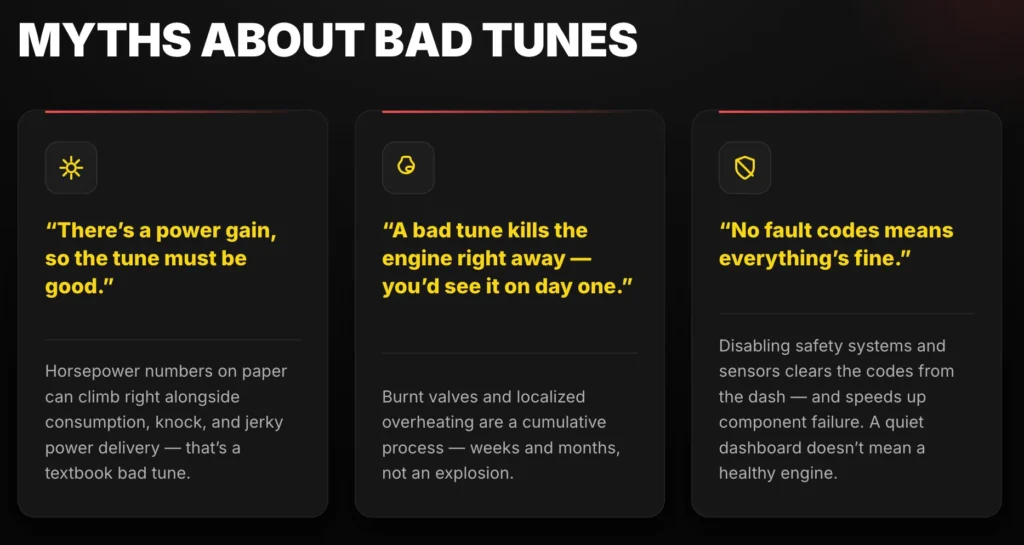
“There’s a power gain, so the tune must be good.” Horsepower numbers on paper can climb right alongside consumption, knock, and jerky power delivery — that’s a textbook bad tune.
“A bad tune kills the engine right away — you’d see it on day one.” Burnt valves and localized overheating are a cumulative process — weeks and months, not an explosion.
“No fault codes means everything’s fine.” Disabling safety systems and sensors clears the codes from the dash — and speeds up component failure. A quiet dashboard doesn’t mean a healthy engine.
FAQ
Can you spot a bad tune without a shop visit? Partially: idle stability, unusual noises, and predictable fuel consumption can be judged on your own. Only a proper scan-tool diagnosis with real measurements gives you the full picture.
How long does it take from a bad tune to an actual failure? It varies, but accumulated damage typically develops over weeks and months. That’s not a reason to relax — it’s a reason to act in time.
Should you trust a shop promising maximum gains at the lowest price? That’s a classic red flag: an individual calibration backed by real diagnostics objectively costs more than loading a generic file. A miracle price means a generic file.


Contact us via WhatsApp