


Water from exhaust in summer is, in most cases, completely harmless condensation — nothing to worry about as long as the vapour disappears after warm-up, coolant levels stay stable and there’s no sweet smell coming from the pipe. But if white smoke from exhaust persists on a fully warmed engine, or coolant keeps dropping without any visible leak, you could be looking at a blown head gasket — and a repair bill running anywhere from a few hundred to several thousand euros.
What actually causes water from exhaust — and why does it happen in July?
Most drivers associate this with winter: a small white puff at start-up, a few drops at the tailpipe. In December, nobody blinks. In the middle of summer it looks odd. The physics behind it, though, are exactly the same — season makes no difference.
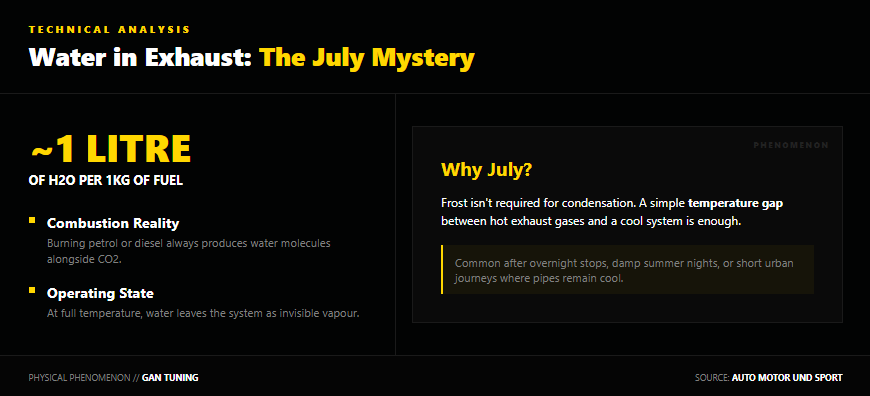
Burning petrol or diesel always produces water molecules alongside carbon dioxide. To put it simply: roughly one litre of water is generated for every kilogram of fuel burned. When the exhaust system is at operating temperature, that water leaves as invisible vapour. The issue arises when the pipework is still cold — after an overnight stop, a run of short urban journeys, or a prolonged period of the car sitting unused.
In those conditions, hot vapour condenses on the cold metal walls, collects in the rear silencer, and eventually starts dripping out. The point is: frost isn’t required for condensation in exhaust to form. A temperature gap between hot exhaust gases and a cool system is enough — and that can happen just as easily in August after a damp night.
According toauto motor und sport, a small white cloud at a cold start is not automatically a fault signal — it’s a physical phenomenon that relates directly to how the vehicle is being used.
When is water dripping from exhaust pipe completely normal?
There are clear signs that point to harmless condensation:
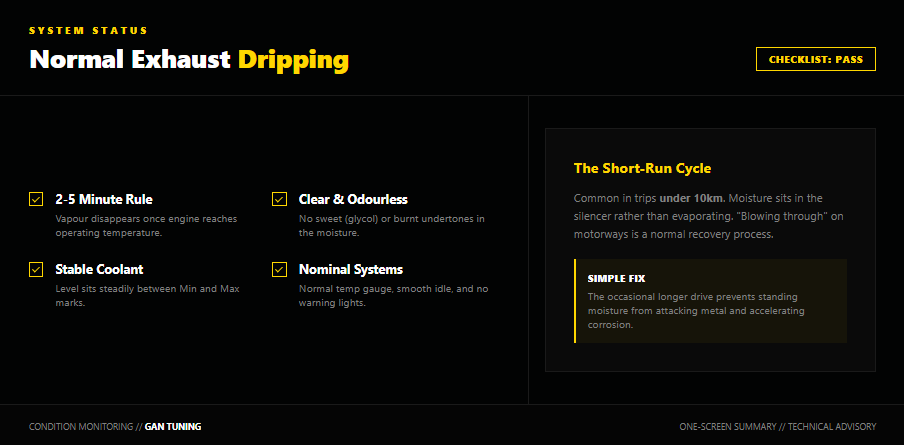
- The white vapour or drops disappear within two to five minutes once the engine reaches operating temperature
- The water is clear and odourless — no sweet or burnt undertone
- Coolant level in the expansion tank sits steadily between the Min and Max marks
- The engine temperature gauge behaves normally
- No warning lights, no rough idle, no difficulty starting
This is especially common in drivers who mostly do short runs — under ten kilometres — where neither the engine nor the exhaust system ever fully reaches operating temperature. The moisture sits in the silencer rather than evaporating off. If that same driver then takes a longer motorway trip, they’ll often notice the system “blowing through” — and very little dripping afterwards.
That’s not a fault. It is, however, a signal that the driving pattern is gradually doing damage: standing moisture attacks metal from the inside and accelerates corrosion. The simplest fix is the occasional longer drive.
When does water from exhaust become a warning sign?
This is where many drivers misjudge things — in both directions. Some ignore genuinely serious smoke because they put it down to the weather. Others panic over condensation that’s entirely normal.
The key principle: it’s not the weather that matters, it’s the behaviour of the smoke.
Warning signs that need immediate attention:
| Symptom | Likely cause | Urgency |
| White smoke on a warm engine | Coolant in the combustion chamber | High — go to garage immediately |
| Sweet smell from the exhaust | Burning coolant (glycol) | High |
| Coolant level dropping with no visible leak | Head gasket failure | High |
| Creamy, brownish residue under the oil filler cap | Oil-coolant emulsion | Very high |
| Rising engine temperature | Risk of overheating | Stop immediately |
| Bubbling in the coolant expansion tank | Combustion pressure entering cooling system | High |
| Water dripping from exhaust pipe on a warm engine | Coolant breakthrough | High |
The head gasket separates the combustion chamber, oil circuit and cooling system. When it fails, coolant enters the combustion process — it vaporises there and exits as dense, persistent white smoke from exhaust. A typical giveaway is a sweet smell caused by burning glycol compounds from the coolant. The fluid disappears without trace, leaks in the engine bay are often invisible — the loss only becomes apparent when topping up repeatedly.
According toherzfeld-akademie.de, a foamy, whitish-brown emulsion under the oil filler cap — often described as a “chocolate milkshake” effect — is a reliable indicator that coolant has entered the oil circuit. This condition requires immediate diagnosis and repair.
How to tell the difference between condensation and a real fault
This can be figured out on the spot with a simple step-by-step check — no tools needed, just observation.
Step 1 — Cold start observation Start the car from cold and watch. Is the smoke light and thin, disappearing within two to three minutes? If yes, that points to harmless condensation in exhaust.
Step 2 — Wait for warm-up Let the engine run for at least ten minutes, or take a short drive. Is white smoke from exhaust still visible after warm-up? That’s a clear warning sign.
Step 3 — Check coolant level Switch off the engine, wait at least five minutes. Open the expansion tank and check the level. Is it sitting between Min and Max? Or has it been dropping week by week without any visible puddles underneath? The latter strongly suggests a leaking head gasket.
Step 4 — Smell test Smoke from a faulty engine usually smells sweet — the result of burning glycol compounds from the coolant. Normal condensation from exhaust smells of nothing, or faintly of metal.
Step 5 — Check the oil filler cap Unscrew the cap. A creamy, brownish deposit underneath means oil and coolant have mixed — a definitive sign of a failed head gasket.
In practice: anyone who works through these five steps can usually judge for themselves whether a garage visit is needed. The combination of persistent smoke + coolant loss + sweet smell leaves very little room for doubt.
How much does a head gasket repair cost — and why acting quickly pays off?
This is the question that makes most drivers wince. The answer depends heavily on the vehicle type and how long the problem has been left unaddressed.
Based on current market data, repair costs typically range from a few hundred to several thousand euros — a significant spread, driven primarily by the degree of secondary damage. Caught early, it often means replacing the gasket and skimming the cylinder head. Continue driving with an overheating engine, though, and you risk a warped cylinder head or — worst case — cracks in the engine block. At that point the bill escalates sharply, or the vehicle becomes uneconomical to fix.
The most important cost argument is straightforward: don’t keep driving if the engine is overheating. On motorways or under sustained load, temperature and pressure in the cooling system rise quickly, turning a small fault into a major one. In such cases, the only right move is to stop immediately and let the engine cool down.
One more consideration: when buying a used car, persistent white smoke from exhaust combined with a falling coolant level is either a solid negotiating point or a clear reason to walk away entirely.
Short-trip drivers: this damages your exhaust more than rain does
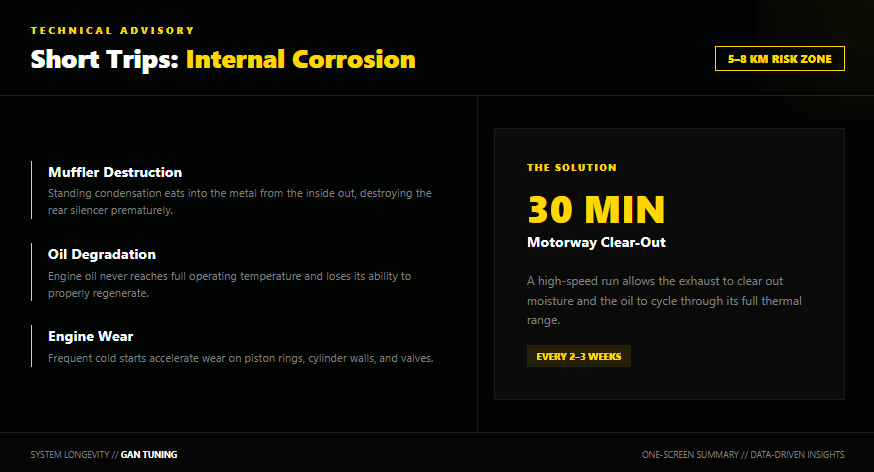
It’s an aspect that rarely gets attention. Anyone driving five to eight kilometres a day — commuting in town, supermarket runs — never gives the exhaust system a chance to fully heat up. Condensation builds, sits there, and eats into the metal from the inside out.
That sounds manageable. Over time, it isn’t:
- Standing condensation in exhaust triggers internal corrosion and destroys the rear silencer prematurely
- Short trips also stress the engine oil, which never reaches full operating temperature and can’t properly regenerate
- Frequent cold starts increase wear on piston rings, cylinder walls and valves
The simplest solution: plan a drive of at least thirty minutes on an open road or motorway every two to three weeks. The exhaust system gets a proper clear-out, the oil cycles through its thermal range — and the lifespan of the entire system improves noticeably.
What does chip tuning have to do with a healthy exhaust?
At first glance, an unexpected connection. But the logic is direct: an engine running optimally — with properly calibrated combustion parameters, correct injection pressure and efficient mixture formation — produces fewer residues that contribute to condensation in the exhaust tract. Tuning a turbocharged engine with an external module improves not just performance, but the quality of combustion itself.
That’s exactly where theGAN GT module from gantuning.com comes in. It works as an external unit connected to the air pressure and fuel rail pressure sensors, optimises signals for each operating condition, and delivers power gains of up to 25% on turbocharged petrol and diesel engines — with no intervention in the ECU software. At the same time, GAN offers fuel savings of up to 15%, which matters most for drivers doing regular short urban runs.
The GAN GT module installs in 10–15 minutes and can be removed without a trace in 60 seconds — no mechanical or electronic marks left in the control unit. That means: unplug before a service visit and the manufacturer’s warranty remains fully intact. Developed and manufactured in Germany, IP67-rated (waterproof to 30 minutes submersion), operating range from −40°C to +60°C.
Three things that separate GAN from the rest:
- Engine warranty with financial coverage: 2 years, up to €5,000 — the only protection of this kind in the industry
- 50-day return period — the longest trial window in the segment, no hidden conditions
- 5 free reprogrammes — the module transfers seamlessly to a new vehicle when you change cars
Find the right module for your car:Vehicle configurator at gantuning.com

Frequently asked questions (FAQ)
Q: Is water dripping from the exhaust pipe in summer normal? A: Yes — in most cases it’s condensation that forms during a cold start. The key question is whether the vapour disappears after warm-up and whether coolant levels remain stable. If both are true, no garage visit is needed.
Q: When should white smoke from exhaust send me straight to a mechanic? A: As soon as white smoke persists on a warm engine, a sweet smell is noticeable, or coolant is dropping without any visible leak — get the car checked promptly. Ignoring a failing head gasket leads to secondary damage that costs considerably more than the original repair.
Q: How much does a head gasket replacement typically cost? A: Depending on vehicle type and extent of damage, anywhere from a few hundred to several thousand euros. Caught early with no overheating damage, the cost usually sits in the lower range. Driving on with an overheating engine risks a write-off.
Q: What does more damage — short city trips or long motorway drives? A: For the exhaust system, frequent short trips are more damaging. The system never fully heats up, and standing condensation triggers corrosion. Regular longer drives noticeably extend its lifespan.
The bottom line: watch the clock, not the calendar
Whether water from exhaust is a problem has nothing to do with the month. The same rule applies in summer and winter: vapour disappears after warm-up, coolant is stable, no sweet smell — everything is fine. White smoke from exhaust lingers on a warm engine, coolant drops, or there’s a glycol smell — act quickly.
Anyone looking to protect their engine further and sharpen combustion quality will find that a tuning module like the GAN GT delivers not just performance gains and fuel savings, but also a two-year engine warranty up to €5,000 — a level of cover no other supplier in the segment provides. Full installation details and answers to common questions at the GAN FAQ.
Articoli utili sul chip tuning:

What does car detailing actually involve — and why does it matter? Car detailing is not a glorified car wash. It is a systematic approach to vehicle care that encompasses cleaning, paint correction, and the application of a protective layer. Professional car detailing has established itself as a distinct specialism across Europe — particularly among […]

An aerodynamic body kit starts delivering measurable technical effect at around 100–120 km/h. At motorway speeds, a properly engineered kit improves axle downforce, lane stability, and — in purpose-designed, CFD-calculated cases — reduces fuel consumption by up to ~5%. Most generic “wide-body” kits, however, increase drag and fuel consumption because they add frontal area without […]
The short answer: it depends on the type of chip tuning and whether dealers can prove it caused the problem. External modules like GAN’s? Removable with zero trace, so dealers can’t detect them if you unplug before service. ECU remapping? Leaves permanent traces dealers can spot immediately. Big difference. Let me break down what actually […]


Contact us via WhatsApp