


Short version: BMW’s B48 four-cylinder and B58 inline-six both respond well to a conservative Stage 1 tune. In our catalog that means 258 → 302 hp on a 330i and 340 → 416 hp on a 540i. (Those are European metric ratings; U.S. owners know the same cars as 255 and 335 hp.) The pattern behind the numbers matters more than the numbers themselves: the higher the factory rating, the less untapped headroom is left.
The best ad the B58 ever got came from Toyota
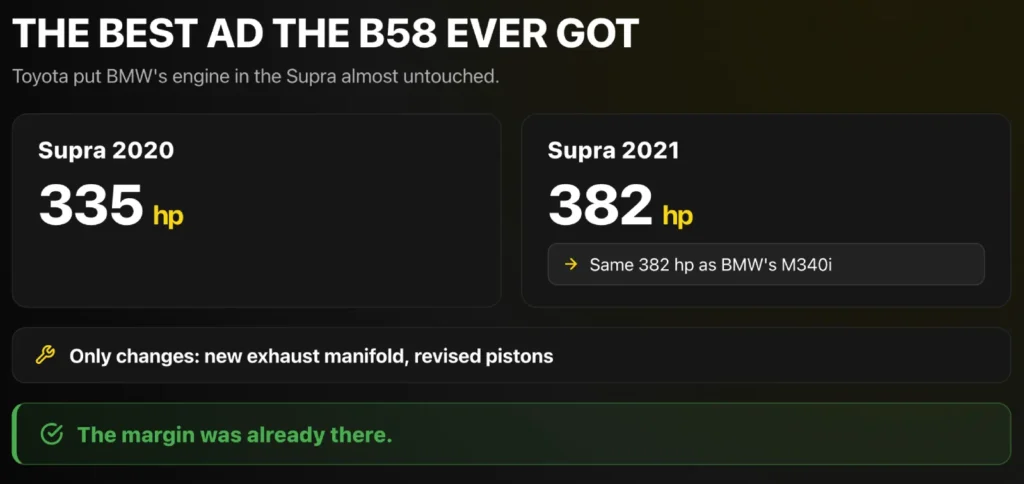
The strongest endorsement of a BMW engine didn’t come from BMW. It came from Toyota, which dropped the B58 inline-six into the GR Supra almost untouched. Yes, the Supra was a joint program with BMW. Toyota still had to sign off on the engine, and then put its own badge and its own warranty on it. This is a company whose whole reputation rests on reliability. It took someone else’s engine and barely changed it.
What happened next says even more. The Supra launched at 335 hp. For 2021, Toyota raised it to 382 hp and 368 lb-ft, the same 382 hp BMW quotes for the M340i. That version of the B58 also made the 2020 Wards 10 Best Engines list. Toyota’s own release credits a new exhaust manifold and revised pistons for the bump. The architecture didn’t change. You don’t pick up 47 hp from changes that small unless the margin was already there.
Several engineers on our team used to flash these engines themselves, before they started building modules. They still bring up the Supra in support chats, because it answers a BMW owner’s first question before it’s asked: yes, modern BMW engines have something to give. The real question is how you take it. The headroom is serious, but it isn’t endless.
B48 tuning: the most common engine, and the most predictable
The 2.0-liter B48 is BMW’s volume turbo engine. In the U.S. you’ll find it in the 230i, 330i, 430i, and 530i, in the X1 through X4, and across most of the MINI lineup. On many U.S. cars the engine code reads B46. That’s the same engine in stricter-emissions SULEV spec, with the same output.
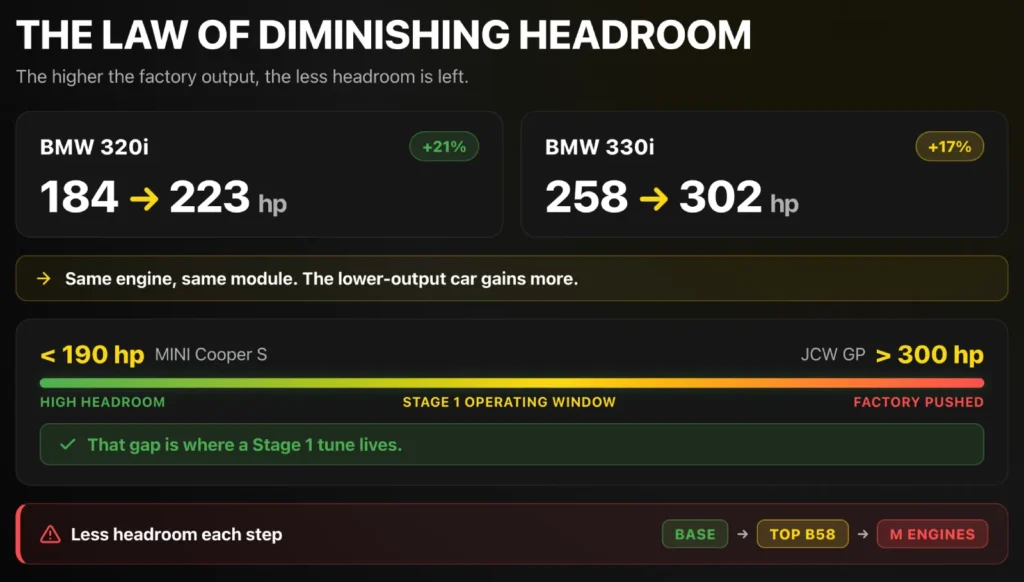
Our calibration engineers call the B48 an honest workhorse, because it responds predictably. The cleanest example of the pattern is a car BMW doesn’t sell here, the European G20 320i. In our catalog, the GT module takes a 320i from 184 to 223 hp, with torque up from 300 to 363 Nm (221 → 268 lb-ft). It takes a 330i from 258 to 302 hp, with torque up from 400 to 468 Nm (295 → 345 lb-ft). Our catalog uses European metric ratings: that 258 hp 330i is the car BMW USA rates at 255 hp and 295 lb-ft.
Now look at the percentages. The 320i gains about 21%. The 330i gains about 17%. Same engine family, same module, and the lower-output car gains more.
That’s no accident. BMW holds the lower-output B48s back largely in software. The 2.0-liter family stretches from under 190 hp in a MINI Cooper S to just over 300 hp in the John Cooper Works GP. For the GP, BMW fitted a reinforced crankshaft, specific pistons, and a new turbocharger. The versions below it never needed any of that, because they run well inside what the hardware can take. That gap is where a Stage 1 tune lives. We walked through the factory logic in Why Chip Tuning Works: The Truth About Factory Engine Detuning.
B58 tuning: the inline-six everyone came for
The 3.0-liter B58 is one of the best turbo engines of its generation, and the Supra story is the proof. On a 540i, our GT module moves it from 340 to 416 hp and from 450 to 550 Nm (332 → 406 lb-ft). U.S. owners know that car as the 335 hp G30 540i. The gain is about 22%, and daily-driver reliability doesn’t change if the tune is done right.
This is also where we bring up a rule the team calls the law of diminishing headroom: the higher an engine’s factory output, the less unused margin BMW left in the software. The top B58 variants leave less of it than the base ones, and BMW’s M engines leave less still. Chase a big percentage on those and you’re no longer spending software headroom. You’re spending durability.
You can almost always hit a bigger number. What’s left of the engine afterward is another question. That’s why the 500 and 600 hp B58 builds you see online come with downpipes, ethanol blends, upgraded fuel pumps, and sometimes a built transmission. Each of those is a fair trade if you’ve chosen it on purpose. None of it is Stage 1.
Our position hasn’t changed in years. If a seller promises the same percentage gain on an M engine as on a base four-cylinder, they’re selling a number, not looking out for your engine.
Module or flash: the question U.S. owners actually ask
Search for a B58 tune in the U.S. and you’ll mostly land on app-based flash platforms like bootmod3 and MHD, plus piggyback units like the JB4. So let’s be straight about where an external module fits.
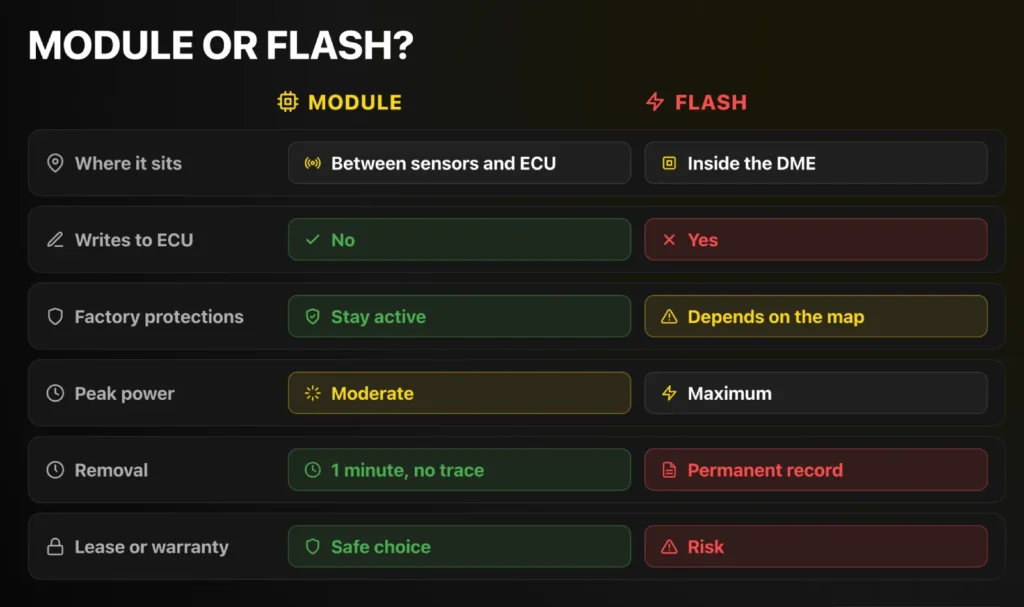
A flash rewrites the calibration inside the DME, BMW’s name for the ECU. Pair it with a good tuner and supporting parts and it will make more peak power than any module. If a full bolt-on build is the plan, a flash is the right tool.
A module works differently. Ours is a piggyback in the broad sense, the same product category as a JB4: it sits between the sensors and the ECU and never writes anything to the ECU’s memory. The factory software stays exactly as BMW shipped it. Knock control, temperature protection, and the rest of the strategies BMW’s engineers spent years refining stay active, and the stock ECU is still in charge.
For a leased car or one under warranty, that’s the deciding factor. Our GT module comes off in about a minute before a dealer visit. It has written nothing to the ECU, and once it’s unplugged, nothing is left on the car: no mechanical trace and no electronic one. A flash is a different story, and we covered it in detail in Does an ECU Tune Void Warranty? What a Flash Actually Leaves Behind.
What to check before you tune
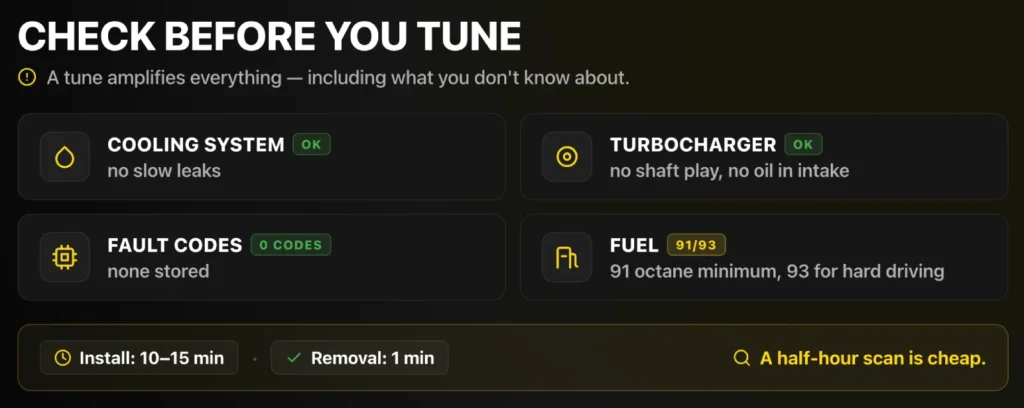
The module installs in your driveway in 10 to 15 minutes. But first we ask every customer for something we can’t do remotely: a diagnostic check at a shop you trust. This isn’t us being overcautious. One of our support engineers puts it this way: “A tune amplifies everything in the engine. Including the things you don’t know about.”
The minimum checklist:
- Cooling system. BMW turbo engines are hard on cooling systems, and slow leaks nobody notices are a classic failure.
- Turbocharger condition. Shaft play and oil in the intake tract both get worse under more boost.
- No stored engine fault codes. Fix what the car is already reporting before you add load.
- Fuel quality. Run 91 octane at a minimum, and 93 if you drive hard or live somewhere hot. U.S. premium runs from 91 to 94 at the pump. A conservative calibration doesn’t run at the edge of the knock margin, but it can’t repeal fuel chemistry either.
A half-hour scan is cheap. Tuning on top of a fault you didn’t know about isn’t.
Transmissions: mostly good news
BMW owners got lucky with transmissions. The ZF 8HP automatic in BMW’s rear-drive-based models, xDrive included, is one of the toughest units on the market. ZF builds the family to cover 220 to 1,000 Nm of torque, roughly 160 to 740 lb-ft. The version in your car sits somewhere inside that range, not at the top of it, but the 8HP has a long track record of living happily with Stage 1 torque on the street.
Front-drive-based models call for more care: the X1, the X2, the 2 Series Gran Coupe, and the MINIs. Depending on the year, they use an Aisin 8-speed automatic or a 7-speed DCT, and both have a slimmer margin than the ZF. On those cars, a conservative tune isn’t optional.
Emissions and legality: check your state first
A sensor-level module leaves every piece of emissions hardware in place, and we’d never suggest otherwise. Under the Clean Air Act, tampering with emissions controls is illegal, and we don’t sell anything designed to defeat them.
State rules go further. In California, an aftermarket part that can affect emissions needs a CARB Executive Order to be street-legal. GAN modules don’t carry one. If you live in California or another state that follows CARB rules, check your local requirements before you order. We’d rather lose a sale than have you find out at a smog check.
Outside the U.S.? BMW stopped selling diesels here after the 2018 model year, but elsewhere the 2.0-liter B47 is a popular engine to tune. The big gain is low-end torque, and the same emissions rule applies: tuning and deleting emissions equipment are two different things. The DPF and EGR stay on the car.
How we approach BMW engines
We build the GT module for turbocharged BMW engines, gas and diesel alike. It adds up to 30% more power and torque, depending on how much margin your engine variant has left. It connects at the sensors in 10 to 15 minutes, and you control it from your phone. It doesn’t alter the factory software, and it comes off in about a minute.
Two separate guarantees come with the GT: a 5-year warranty on the device itself, and a 2-year engine guarantee of up to €5,000. You also get 50 days to drive with it and send it back if you aren’t convinced.
To check your exact engine, whether B48, B46, or B58, find your car in the catalog: Select your car. Ordering takes a few minutes, and the steps are laid out here: How to order.
Three myths about tuning a BMW
“A modern BMW is already maxed out from the factory.” True only for M cars and the top trims. The mainstream models are held back in software. BMW built that margin in, and that margin is what a tune opens up.
“A tune will kill a B58.” What wears an engine out is the method, not the gain: aggressive maps with the protections switched off. A tune that stays inside the engine’s margin, with knock control still working, is a load the engine was designed to carry. The Supra is one more piece of evidence.
“The automatic won’t take it.” The ZF 8HP has years of Stage 1 cars behind it. The Aisin automatics and DCTs in front-drive-based models are the ones that need a conservative tune.
FAQ
Which BMW engine responds best to tuning?
The lower-output versions, because they carry the most software headroom. In our catalog a 184 hp 320i gains about 21%, while the 258 hp 330i built on the same B48 gains about 17%.
How much power does Stage 1 add to a B58?
On a 540i (340 metric hp, 335 hp in U.S. terms), our GT module adds 76 hp and 100 Nm (74 lb-ft), for 416 metric hp and 550 Nm (406 lb-ft). Bigger numbers are possible, but they need hardware: a downpipe, fueling upgrades, often ethanol.
Do I need 93 octane after tuning?
BMW calls for premium either way. Run 91 at a minimum. Use 93 if you drive hard or deal with summer heat.
What happens to my factory warranty?
A flash leaves a permanent record in the ECU, and BMW’s diagnostic systems log it. An external module writes nothing to the ECU’s memory and comes off in a minute. And remember how warranty disputes work: dealers can’t just void your warranty because they found a modification. They have to prove that modification caused the specific problem.
Is a tuning module legal in California?
California requires a CARB Executive Order for aftermarket parts that can affect emissions, and GAN modules don’t have one. Check your state’s rules before ordering.


Contact us via WhatsApp