


The parking brake keeps your car stationary when parked, holds it on slopes, and protects the gearbox from premature wear. On automatic transmission vehicles, it takes the load off the parking pawl — a mechanism that simply isn’t designed to hold the full weight of the car indefinitely on its own. Used consistently and correctly, the handbrake can save you a significant amount in repair costs over the years.
What is the parking brake — and why do you need it when there’s already a “P” mode?
Many drivers with automatic gearboxes assume: select “P” and the car is safely parked. Technically, that’s only partly true. In “P” mode, a locking pin engages with the toothed wheel on the driveshaft and blocks the wheels from rotating. But only up to a certain load.
Under heavy stress — on a steep incline, or from an impact in a car park — that pin can be overwhelmed. The mechanism simply isn’t built to bear the car’s full weight continuously and alone.
That’s exactly where the handbrake comes in: it acts directly on the brake pads. If a parked car sitting in “P” mode without the parking brake engaged gets struck by another vehicle, there’s a real chance the automatic transmission takes damage alongside the bodywork. A repair bill that one simple action could have prevented entirely.
The bottom line: “P” and the parking brake complement each other — neither replaces the other.
Want to get more out of your engine without touching the electronics? It’s worth looking into the GAN Tuning approach. Drawing on experience from tuning over 30,000 vehicles since 2015, GAN explains how an external tuning module works — and why it doesn’t affect your manufacturer’s warranty. →Learn more about GAN Tuning
When to use the parking brake — and when it’s not optional
There are situations where applying the parking brake isn’t a recommendation — it’s a necessity.
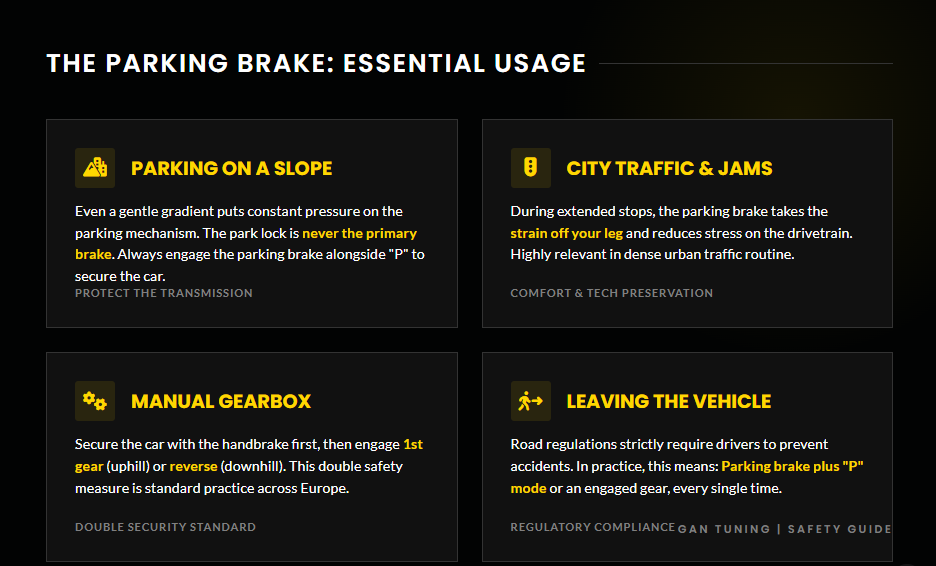
When parking on a slope. The obvious one. Even a gentle gradient puts constant pressure on the parking mechanism. Manufacturers are explicit about this: the park lock should never be used as the primary means of holding the vehicle — the parking brake must always be engaged alongside “P” to properly secure the car.
During extended stops in city traffic. Sitting in a traffic jam or at a red light with the engine running is exactly when the parking brake takes strain off your leg and reduces stress on the drivetrain. Particularly relevant in dense urban traffic, which is routine in most major European cities.
With a manual gearbox. Before switching off the engine, secure the car with the handbrake and engage first gear (pointing uphill) or reverse (pointing downhill). This double safety measure is considered standard practice by most driving instructors across Europe.
Every time you leave the vehicle. Road traffic regulations across Europe consistently require drivers to take all necessary steps to prevent accidents or traffic disruption when leaving a vehicle unattended. In practice: parking brake plus “P” mode, or an engaged gear.
How to use the parking brake correctly: the right sequence for each gearbox type
The order of operations matters more than most drivers realise. A very common mistake is selecting “P” first, then applying the handbrake. For the transmission, that’s the wrong way round.
Manual gearbox
- Bring the vehicle to a complete stop, keeping the brake pedal depressed.
- Engage first gear (uphill) or reverse (downhill).
- Pull the handbrake lever to a firm hold — typically 3–5 clicks.
- Only then release the brake pedal.
Automatic gearbox
The correct sequence is different here — and it matters for preserving the parking pawl, the locking mechanism inside the transmission.
Come to a stop with your foot on the brake → shift the selector to neutral “N” → apply the parking brake → only then shift to “P” and release the pedal. This way, the parking brake bears the vehicle’s weight rather than the transmission mechanism. When setting off: press the brake, release the parking brake, then shift into “D” or “R”.
Electronic parking brake (EPB)
In modern cars, a button or small toggle switch increasingly replaces the classic handbrake lever. On many models, the electronic parking brake engages automatically — when the engine is switched off or when the driver’s door is opened.
The Auto Hold function goes a step further: it stores the last braking pressure applied and keeps the car stationary while the driver moves their foot from brake to accelerator. Especially useful in stop-and-go traffic, at traffic lights, or at level crossings. The system releases the brake automatically when you pull away.
How to use the parking brake: 5 common mistakes and how to avoid them
Knowing when to apply the handbrake is half the battle. Equally important is understanding what you should never do.
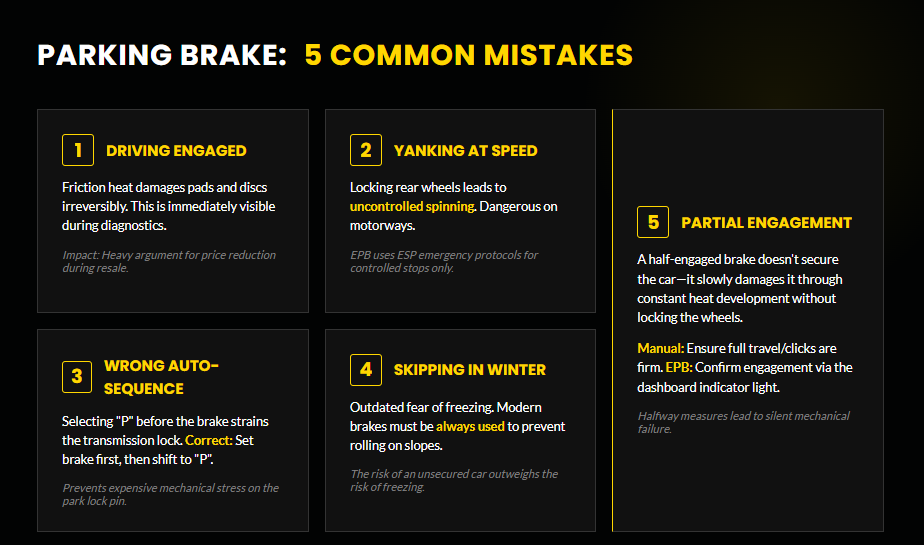
Mistake 1: Driving away with the parking brake still on. The most common — and costly — mistake. The friction heat drives brake pads and discs to critical temperatures. Overheating damage is immediately visible during a vehicle inspection or pre-sale diagnostic, and becomes a concrete argument against you when negotiating the price of a used car.
Mistake 2: Yanking the handbrake sharply at speed. On a motorway, this is particularly dangerous. Locking the rear wheels causes the car to spin. Manufacturers warn against this explicitly in their owner’s manuals. The electronic parking brake in emergency mode operates differently — it’s governed by the stability control system and therefore controlled — but that’s an exceptional scenario, not everyday use.
Mistake 3: Wrong sequence with an automatic gearbox. Select “P” first, then apply the handbrake — and the full weight of the car is already resting on the transmission mechanism. The correct order is the opposite: engage the parking brake first, then shift into “P”.
Mistake 4: Skipping the handbrake in winter out of fear it will freeze. This was a genuine problem in older cars with drum brakes. Today it’s technically outdated: on modern vehicles, the parking brake can and should be used even in winter. The risk of an unsecured car rolling on an icy slope is far more serious than any risk of the brake sticking.
Mistake 5: Only half-applying the handbrake. A parking brake that’s only halfway engaged doesn’t hold the car — it slowly damages it. The brake pads heat up without fully locking the wheels. If you hear clicks when engaging, make sure the lever has reached its full travel, or that the EPB button has been pressed until the indicator light confirms engagement.
Electronic parking brake: the technology changing driver habits
Over the past two decades, the electronic parking brake (EPB) has progressively replaced the classic handbrake lever. Instead of a mechanical cable, an electric motor operates the brakes on the rear axle — either via a central actuator or through motors integrated directly into the brake callipers, pressing the pads against the disc.
The key difference from the mechanical version: the EPB delivers consistent, repeatable braking force regardless of how hard the driver pulls. This improves reliability and reduces the scope for human error.
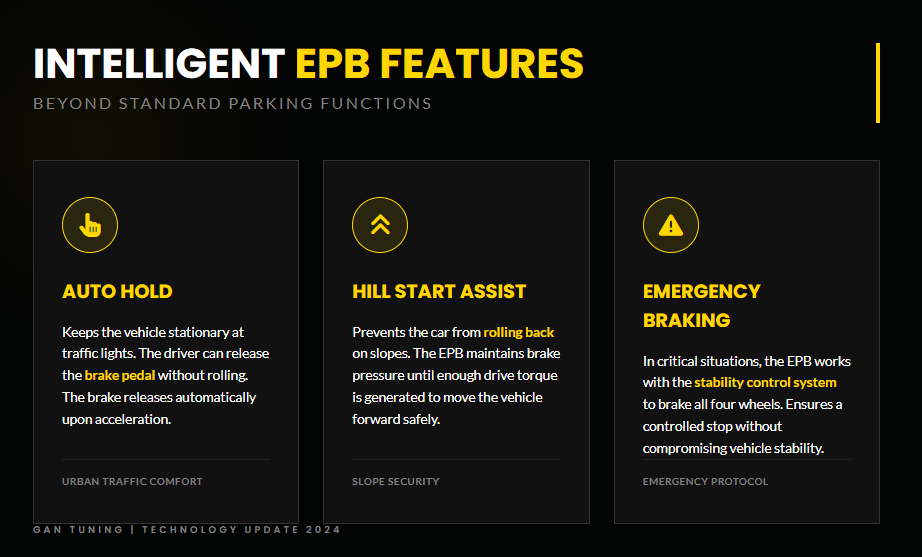
Additional functions of the EPB in modern vehicles:
- Auto Hold — keeps the car stationary at traffic lights without the driver having to hold the brake pedal.
- Hill start assist — prevents the car from rolling back on a slope until enough drive torque is available to move forward.
- Emergency braking while moving — in a critical situation, the EPB works in conjunction with the stability control system to brake all four wheels in a controlled manner, without compromising vehicle stability.
One practical note on maintenance: diagnosing an EPB requires specialist workshop equipment. If a warning light appears on the dashboard, don’t delay — visit a garage promptly.
If you’re driving your car hard — motorways, all weather conditions — it’s worth thinking beyond the paintwork and considering what your engine could do with the right support. GAN GT increases the power output of turbocharged engines by up to 25%, torque by up to 25%, and reduces fuel consumption by up to 15%. IP67 protection rating, 5 operating modes, smartphone control. Removed in 60 seconds — manufacturer’s warranty stays intact. Engine warranty up to €5,000 for 2 years. →Find out more about GAN GT
Parking brake and total cost of ownership: why it matters more than you think
How you use the parking brake has a direct effect on your total cost of ownership — the full running cost of a vehicle over time. European buyers are increasingly aware of this figure when choosing and maintaining a car.
Replacing worn brake pads and discs caused by routinely driving away with the handbrake on can run into several hundred euros. Repairing a damaged parking pawl in an automatic gearbox: several thousand. Loss of resale value due to visible overheating damage spotted during a vehicle inspection: real money, again.
In that sense, using the parking brake correctly isn’t pedantry — it’s rational behaviour. Particularly given how thoroughly used cars are inspected across European markets before sale.
For owners of modern turbocharged engines: protecting your engine and transmission through good parking habits is just as valuable a contribution to vehicle longevity as a smooth driving style on the road. This is exactly what comes up when discussing the preservation of the manufacturer’s warranty and the condition of critical drivetrain components.
Frequently asked questions about the parking brake
Q: Is it enough to just select “P” on an automatic?
The “P” position technically prevents the car from rolling away, but it continuously loads the transmission’s parking mechanism — particularly on slopes. Experts and manufacturers consistently recommend combining the parking brake with “P”. The sequence matters: apply the parking brake first, then shift into “P”.
Q: Should I use the handbrake in winter?
Yes. The old advice to skip the handbrake in freezing temperatures applied to older vehicles with drum brakes. On modern disc brake systems, the brake doesn’t freeze under normal conditions. The risk of an unsecured car on a slope in sub-zero temperatures is incomparably greater.
Q: What’s the difference between the electronic parking brake and Auto Hold?
The electronic parking brake (EPB) is the equivalent of the classic handbrake — activated by a button instead of a lever. Auto Hold is an extension of it: the system automatically keeps the car stationary at a standstill — at traffic lights or in a queue — without the driver having to keep their foot on the brake. After a few minutes at a standstill, the EPB takes over automatically.
Final thoughts
The parking brake is not an outdated control you can quietly ignore. It’s an active line of defence — for your transmission, your braking system, and your car as a whole. Drivers who follow the correct sequence when parking, especially with automatic gearboxes, protect critical components and meaningfully extend their service life.
This holds true across any market: the condition of a vehicle’s parking brake tells a story at every inspection, and evidence of misuse is a hard argument to counter when selling a used car.
Getting the fundamentals right is a good start — but it doesn’t have to stop there. The GAN GT module increases the power of turbocharged engines by up to 25%, can be removed without a trace in 60 seconds, and leaves the manufacturer’s warranty untouched. 50-day return window, engine warranty up to €5,000 for 2 years — developed and manufactured in Germany. →Try GAN GT risk-free
Articoli utili sul chip tuning:

Tint percentage is the single most misunderstood term in car window tinting. Across Europe, regulations permit significant darkening on rear windows — typically down to VLT 5 % — while prohibiting any additional film on the windscreen and front side windows. The minimum legal VLT for front glass is 70 % in most markets. Getting […]

A car vinyl wrap is one of the most popular ways to transform your vehicle’s appearance without any permanent consequences for the paintwork: a full colour change takes roughly a week, costs significantly less than a quality respray, and — when removed properly — leaves the factory paint almost untouched underneath. Full professional vehicle wrap […]

You’ve probably seen comments online claiming tuning boxes are scams. The argument usually goes something like this: «There’s nothing technically complex about these boxes. They just alter sensor signals. Zero innovation. No feedback. Pure deception.» Sounds damning, right? Except the people making these claims are usually OBD tuning shops trying to sell you ECU remapping […]


Contact us via WhatsApp