


What does P mean in automatic – and what actually happens inside the gearbox?
Think of the parking lock as a small bolt sitting deep inside the transmission. That bolt – technically called a parking pawl – drops into a toothed wheel (the parking gear wheel) and locks the output shaft in place by positive engagement. Once it’s engaged, the vehicle cannot be moved by the drivetrain.
What the engineering data confirms: the parking pawl is a precision-machined, hardened steel component. Its job is to hold a stationary vehicle under normal conditions – not to carry the full vehicle weight indefinitely on a steep incline.The fundamental principle of all transmission parking locks is that a spring-loaded pawl engages positively with a ratchet wheel, blocking the output shaft.
In practical terms: an SUV with a kerb weight of 2,100 kg parked on an 8° gradient places around 2,900 Newtons of continuous force on that pawl. A single instance is not a problem. What becomes a problem is when it happens every single day.
Parking position automatic – the difference between P and N
Many drivers confuse what P and N actually do. The difference is fundamental:
- P (Park): the gearbox output shaft is mechanically locked. The vehicle cannot roll freely.
- N (Neutral): the engine and gearbox are disconnected – but the output shaft is not locked. The vehicle rolls freely.
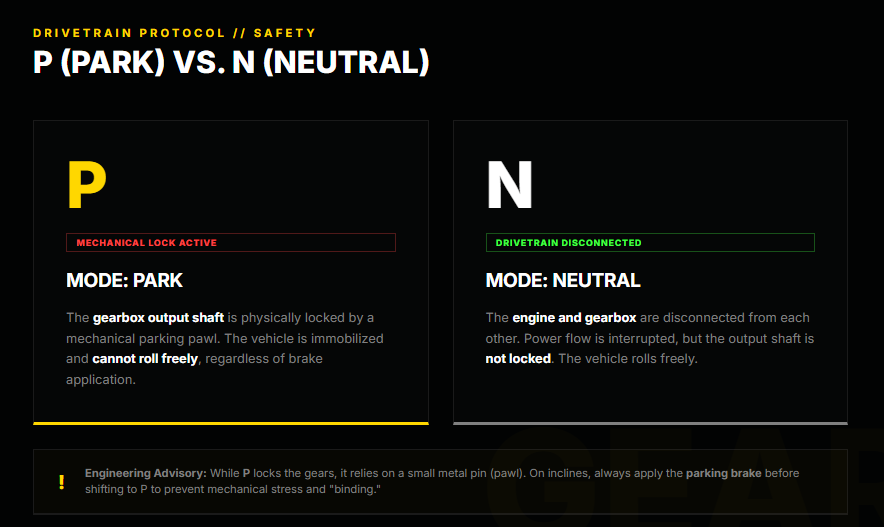
N makes sense when being towed (if the manufacturer permits it), going through a car wash, or during brief stops over 30 seconds at a traffic light. The parking position automatic – that is, P – is the right choice when you’re leaving the vehicle for good. But only with the correct sequence of steps.
Why the order you engage park mode on your automatic transmission matters
This is the point where habits diverge – and where you either protect your gearbox or quietly destroy it. The correct sequence when stopping:
- Bring the vehicle to a complete stop (keep your foot on the footbrake)
- Apply the handbrake – the vehicle is now held by the brake, not the gearbox
- Only now move the selector into P
- Release the footbrake
- Switch off the engine
Why this order? If you engage P first and apply the handbrake second, the car rolls slightly downhill after you lift the footbrake – just until the parking pawl catches the ratchet wheel. At that moment, the pawl takes the full load of the vehicle. This creates mechanical tension inside the gearbox.
“Apply the handbrake first – it unloads the parking pawl. You’ll also notice the selector moves out of P far more easily afterwards.”
This is not a driving school myth. It’s physics: when the handbrake engages first, there is zero force on the pawl when you select P. When you set off, release P first, then release the handbrake – and the selector will move noticeably more freely because the gearbox isn’t under tension.
What road traffic regulations say across Europe
Traffic regulations across European countries share one common requirement: drivers must secure the vehicle against rolling before leaving it. In most jurisdictions, this means engaging both the parking brake and the transmission lock. Insurers reinforce this – if a vehicle without an applied handbrake rolls away and causes damage, the policyholder can lose cover entirely.
Using park mode on the automatic transmission alone typically satisfies legal requirements on level ground. On a slope, however, relying solely on P – without the handbrake – can expose you to full liability for any resulting damage or accident.
Automatic transmission park mode: which gearbox types exist, and does it matter?
Not all automatic gearboxes are built the same way. This has a direct effect on how sensitive the parking lock is to misuse.
Torque converter automatic (traditional)
The classic torque converter automatic – fitted to vehicles like Toyota, Lexus, and many older executive saloons – has a robust parking lock that is mechanically linked directly to the selector lever. The pawl is comparatively large. Occasional misuse is less critical here than in more modern designs.
Dual-clutch gearbox (DSG / DCT)
In dual-clutch transmissions (used by Volkswagen, Audi, Skoda, Seat, BMW M models, various Ford performance cars), the packaging is tighter and the parking lock correspondingly more compact. Comparative data shows: the pawl in these gearboxes is more vulnerable to impact loading when P is engaged while the vehicle is still moving.
Volkswagen’s own owner’s manuals for DSG vehicles explicitly recommend securing the vehicle with the handbrake before selecting P.
Continuously variable transmission (CVT)
CVT gearboxes, as used in Toyota (Yaris, Corolla Hybrid), Nissan and Subaru models, have a similar parking lock construction – but react more sensitively to lateral forces when parked at an angle and to residual speed when P is engaged.
Shift-by-Wire (electronic selector)
Modern vehicles with an electronically controlled selector – including BMW models from 2018 onwards, the Mercedes-Benz EQS, and the Jaguar Land Rover Defender – automatically engage the automatic transmission park mode when the engine is switched off. A built-in guard prevents P from engaging above approximately 5 km/h. This eliminates the most common mistake – but it does not mean you can skip the handbrake.
Common mistakes when using the parking gear – and what they cost to fix
Mistake 1: selecting P while the vehicle is still moving
This is the most expensive mistake. The parking pawl drops towards the ratchet wheel while the car is rolling and is mechanically deflected – but above a certain speed, this protection does not work reliably on all vehicles.
On vehicles without an electronic guard – particularly pre-2010 models – engaging P at 3–5 km/h can cause immediate mechanical locking. The force involved is equivalent to a full emergency stop from that speed, concentrated entirely on a pawl just a few centimetres wide.
Typical repair costs for parking lock damage:
| Type of damage | Typical cause | Cost (indicative) |
| Worn parking pawl | Regular hill parking without handbrake | €800 – €1,800 |
| Broken ratchet wheel | P engaged while moving, or foreign object | €2,000 – €4,500 |
| Full gearbox failure | Extreme load, trailer use, steep ramp repeatedly | €4,000 – €12,000 |
| Shift-by-Wire actuator failure | Overload through incorrect use | €600 – €2,200 |
Mistake 2: relying entirely on P without the handbrake
When parked on a slope, the parking pawl and ratchet wheel bear significant, continuous load – for the entire duration of the stop, the parking lock carries the full vehicle weight.Using the handbrake takes that load off the transmission and protects the gearbox long-term.
This matters most for heavier vehicles: SUVs from 1,800 kg upwards, estate cars with loaded roof boxes, vehicles with tow bars. The parking pawl is engineered for everyday use – not as a permanent load-bearing component.
Mistake 3: towing a vehicle with P engaged
The rarest but most consequential mistake: having a vehicle towed with P selected. The locked output shaft transfers all forces directly into the gearbox casing. Damage to the shaft, differential, and gearbox housing follows – repair bills running into five figures are not unusual.
The correct approach: always select N before being towed, and follow the manufacturer’s guidance on maximum towing speed and distance (typically: no more than 50 km/h, no more than 50 km).
Using the parking gear in winter: what many drivers get wrong
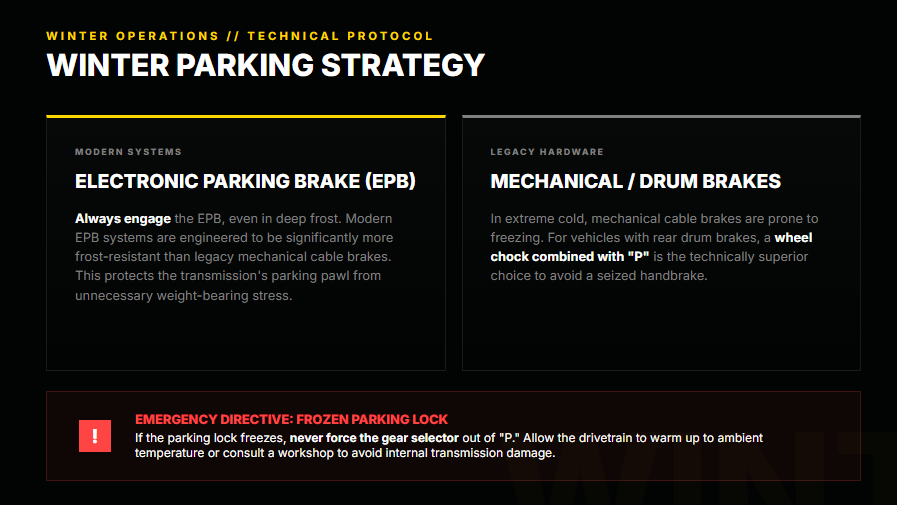
Winter places additional demands on the parking lock. At temperatures below −10 °C, the parking pawl can freeze in position – particularly in older vehicles with less well-protected gearbox housings. When this happens, the transmission simply will not move out of P.
At the same time, an older rule about the handbrake still circulates: that you should avoid applying it in freezing conditions because the rear brakes might seize. This applied to older vehicles with drum brakes and unprotected cable runs.On modern cars, this is no longer a technical concern – the handbrake can and should be used even in winter.
Practical winter recommendations:
- On modern vehicles with EPB (electronic parking brake): always engage, even in frost – EPB systems are more frost-resistant than mechanical cable brakes
- On older vehicles with rear drum brakes: in extreme cold, a wheel chock combined with P is preferable to the mechanical handbrake
- If the parking lock freezes: never force the vehicle out of P. Allow it to warm up or call a workshop
Park mode automatic transmission and modern electronics: what newer systems do differently
Newer vehicles take more decisions away from the driver. Shift-by-Wire systems in current models from multiple manufacturers engage park mode on the automatic transmission automatically when the engine is switched off. Electronic parking brakes (EPB) can be linked to trigger simultaneously – some models do this as standard.
That sounds convenient – and it is. But automatic P engagement does not mean you should depend on it entirely. Electronic systems fail. A manually applied handbrake works mechanically, independently of battery voltage or control unit status.
Quick FAQ on what P means in automatic and how to use it:
Q: Do I still need to use the handbrake on an automatic car? A: Yes – always. The parking gear is a supplement, not a replacement. The handbrake secures the vehicle directly through the wheels, independently of what the gearbox is doing. If another vehicle strikes your parked car, a failed parking lock significantly increases the damage – the handbrake absorbs those forces far better.
Q: Can I select P while still moving slowly? A: On vehicles with modern Shift-by-Wire electronics, a guard prevents this above approximately 5 km/h. On older vehicles without that protection: no, never. Even 2–3 km/h of residual speed is enough to generate a damaging impact load on the parking pawl.
Q: Why does my selector stick when I try to move it out of P? A: This is a classic sign that the vehicle is sitting in P under tension – the parking pawl is carrying the vehicle weight. The fix: next time, apply the handbrake first, then select P. The stiffness disappears immediately.
Automatic transmission and engine performance: why engine mapping matters too
Using the parking gear correctly protects the gearbox. But what if the engine itself is not running at its optimum?
Many vehicles with automatic transmissions – particularly turbocharged ones – come from the factory with performance reserves that manufacturers leave untapped for compatibility reasons. The interaction between the engine control unit (ECU) and the transmission control unit determines how the vehicle responds, when upshifts happen, and how torque builds.
GÄN Tuning Büro – a German engineering company whose team brings over 20 years of engine mapping experience – has optimised more than 30,000 vehicles across 8 countries since 2015. The GAN GT module for turbocharged engines increases power by up to 30% and torque by up to 30%, without touching the ECU directly. It corrects signals between the control unit and sensors (boost pressure, fuel rail pressure) in real time, remains fully reversible, and leaves no trace whatsoever.
For vehicles with automatic transmissions, this is particularly relevant: the transmission control unit reads the higher torque value and shifts up earlier – which, with a measured driving style, can deliver fuel savings of up to 15%. The gearbox is not put under additional strain because GAN GT respects the manufacturer’s built-in safety limits.
The GAN GA+ module for naturally aspirated engines (connected via OBD-II) delivers a power increase of up to 12% – also with no software intervention in the ECU.
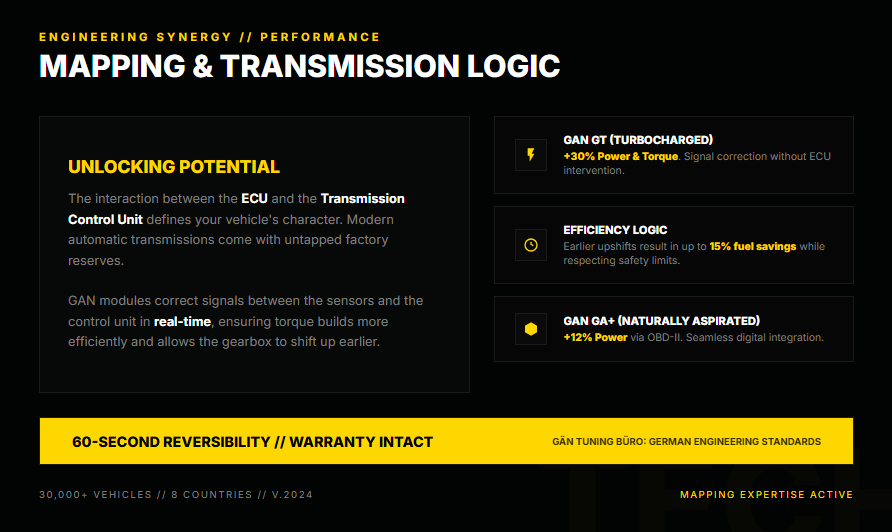
Both modules can be removed in 60 seconds without tools before the vehicle goes in for a service – the dealer sees nothing, and the manufacturer warranty remains fully intact.→ GÄN Tuning Büro: check compatibility for your vehicle
Summary: parking gear on automatic – the key rules at a glance
| Situation | Recommended approach |
| Parking on level ground | Hold footbrake → select P → apply handbrake → switch off |
| Parking on a slope (3° or more) | Hold footbrake → apply handbrake → select P → release footbrake |
| Parking in hard frost (older vehicles) | P + wheel chock; mechanical handbrake only if disc brakes fitted |
| Brief stop (traffic light, driveway) | Stay in D or N with foot on brake – never select P |
| Being towed | Select N, follow manufacturer guidance on max speed and distance |
| Car wash (drive-through) | Select N – P would lock the wheels and prevent movement |
Technical recommendations and real-world gearbox inspection data consistently show that following these rules substantially extends the life of the parking lock – and prevents repairs that can, in the worst case, exceed the market value of the car itself.
The core rule stays simple: handbrake first, parking gear second. Two extra seconds – and your gearbox will reward you with tens of thousands of additional kilometres.
GÄN Tuning Büro – German engineering for real-world performance gains. More than 30,000 vehicles optimised since 2015 · 8 countries · Engine warranty up to €5,000 · 50-day money-back trial.
→ Discover GÄN chip tuning for your vehicle ·→ GAN GT for turbocharged engines ·→ FAQ & warranty conditions
Articoli utili sul chip tuning:

Does AC use more gas — and by how much? That’s the central question. And it doesn’t have a single answer — it depends entirely on speed. Independent automotive tests show that running the AC in city traffic can add up to 1 litre per 100 km to your fuel consumption — roughly a 20% […]

What does car detailing actually involve — and why does it matter? Car detailing is not a glorified car wash. It is a systematic approach to vehicle care that encompasses cleaning, paint correction, and the application of a protective layer. Professional car detailing has established itself as a distinct specialism across Europe — particularly among […]

Tint percentage is the single most misunderstood term in car window tinting. Across Europe, regulations permit significant darkening on rear windows — typically down to VLT 5 % — while prohibiting any additional film on the windscreen and front side windows. The minimum legal VLT for front glass is 70 % in most markets. Getting […]


Contact us via WhatsApp