


What does car detailing actually involve — and why does it matter?
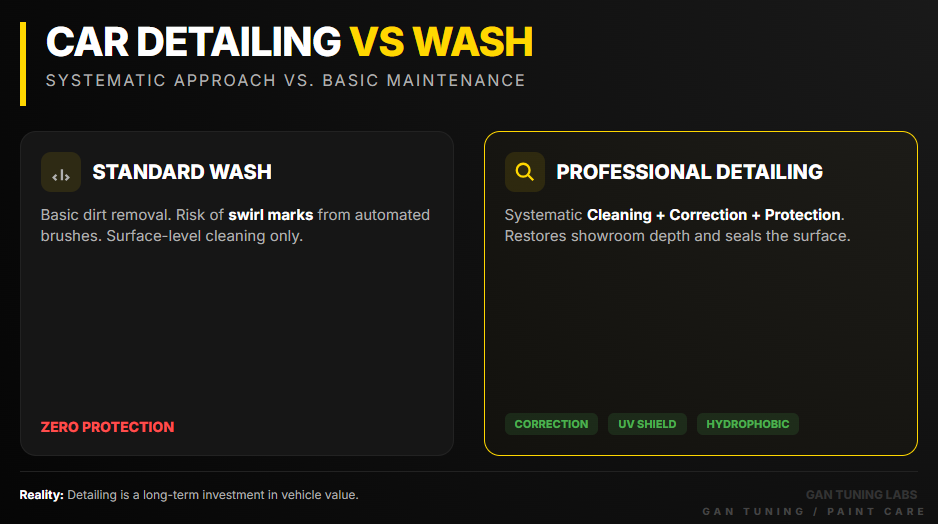
Car detailing is not a glorified car wash. It is a systematic approach to vehicle care that encompasses cleaning, paint correction, and the application of a protective layer. Professional car detailing has established itself as a distinct specialism across Europe — particularly among owners of premium and performance vehicles.
There is one fundamental distinction worth understanding from the outset:
Polishing works on the existing paint. It removes scratches, swirl marks, and dullness. This is restoration, not protection. Polished too frequently, the clearcoat thins faster than most owners realise.
Ceramic coating is a protective layer applied over the paint. It doesn’t fix existing damage — it prevents new damage from chemicals, UV radiation, and everyday grime. It requires a polish beforehand to seal the paint in its best possible condition.
Paint protection film (PPF) is a physical film laid over the paint. It protects against stone chips, scratches, and minor impacts. It is the only method that genuinely absorbs mechanical force.
Confusing these three approaches either costs you money on something unnecessary — or leaves you without protection where you actually need it.
Polishing: what it does and when it’s worth doing
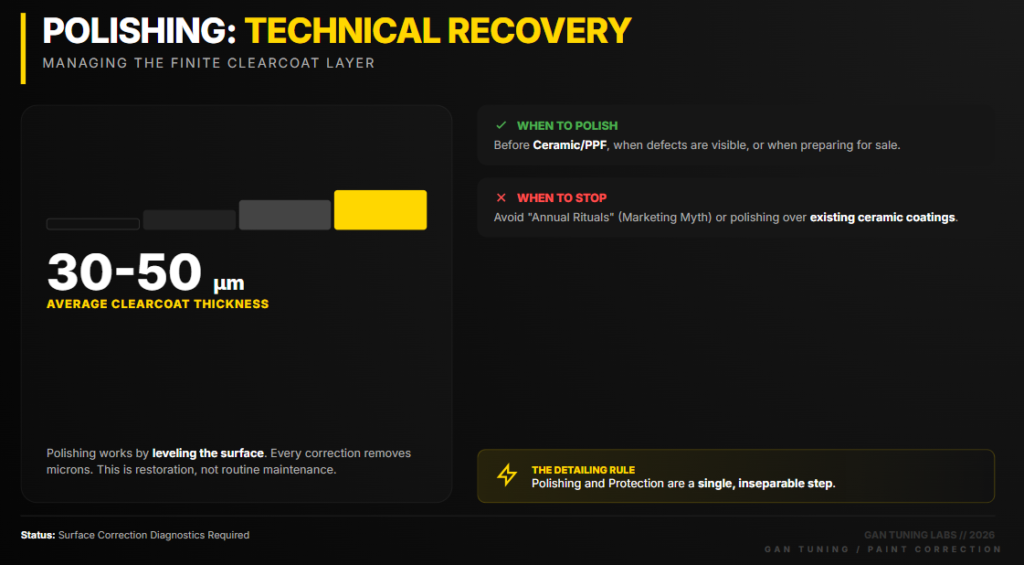
Polishing is the foundation of any serious car detailing process, and understanding it correctly matters. An abrasive compound removes an extremely thin layer of clearcoat, levelling the surface. The visible result: swirl marks, light scratches, dullness, and haziness disappear.
The catch: the clearcoat on most modern vehicles is only 30–50 µm thick. Every polish removes a few microns. That means polishing is not a routine annual ritual — it is a targeted correction carried out before applying a protective product, or when there is a genuine need.
When polishing makes sense:
- Before applying ceramic coating or paint protection film — to seal the paint in a clean, corrected state
- When swirl marks and dullness are visible after improper washing
- When preparing a vehicle for sale
When polishing is not necessary:
- As a standard annual treatment — that is marketing logic, not technical logic
- On paint that already has a ceramic coating applied — the coating absorbs the damage, not the clearcoat
After polishing without any follow-up protection, the paint is left open and vulnerable. This is precisely why professional car detailing treats polishing and ceramic coating as a single, inseparable step.
Ceramic coating: what it is and what it genuinely delivers
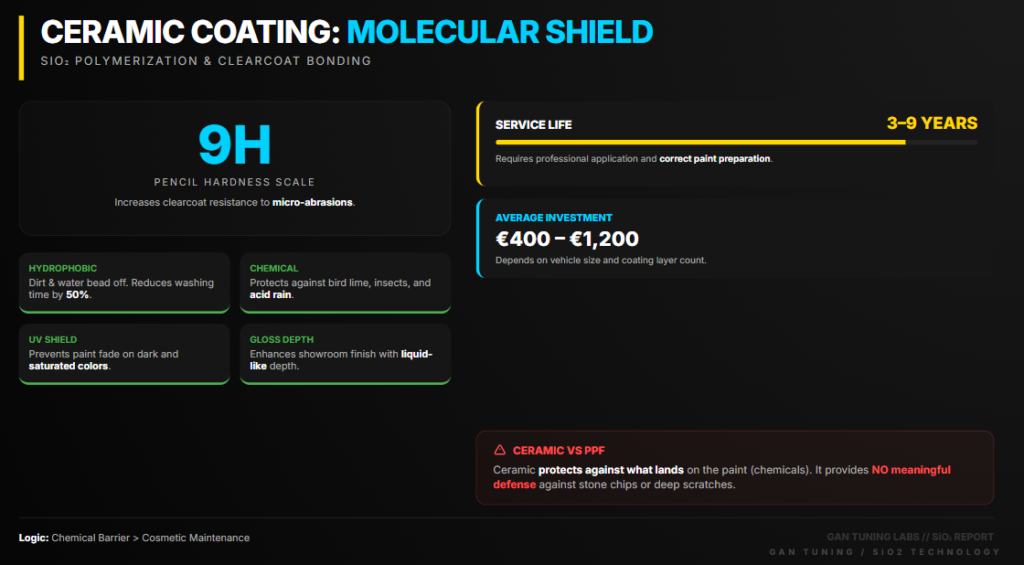
Ceramic coating is a liquid polymer based on silicon dioxide (SiO₂) that bonds chemically with the vehicle’s clearcoat. Once cured, it forms a hard, hydrophobic layer. This is not a wax that washes off after a few weeks — it is a fully bonded car paint protection layer that lasts for years.
What ceramic coating actually does:
— Hydrophobicity. Water and dirt bead off the surface. Washing takes roughly half the time, and everyday grime does not bond to the paint.
— Chemical resistance. Bird droppings, acid rain, dried insects — all of these aggressively attack clearcoat. Ceramic coating creates a chemical barrier. One important nuance: the longer an aggressive substance sits on the surface, the greater the risk of damage. The coating does not make paint invulnerable — but it meaningfully extends the safe window before damage occurs.
— UV protection. Slows down paint fade caused by ultraviolet light — particularly relevant for dark and saturated colours.
— Surface hardness. Quality products increase hardness by several steps on the pencil hardness scale, with some reaching 9H. This does not make the paint scratch-proof, but it does reduce microabrasions from everyday contact.
What ceramic coating does not do:
This is the critical point in any PPF vs ceramic coating comparison. Ceramic coating is a layer of 1–6 µm. It protects against what lands on the paint — PPF protects against what hits the paint. Stone chips, physical scratches, dents — ceramic coating provides no meaningful defence against these. That is the job of paint protection film.
Longevity: Professionally applied coatings last 3–9 years. The typical result without proper surface preparation: 1–2 years.
Cost: Professional ceramic coating application costs roughly €400–€1,200 depending on vehicle size and product quality. Adding a ceramic coating over PPF can extend the film’s service life from 5–7 years to 7–10 years.
A well-protected exterior is part of the logic of a properly maintained car. If you’re considering a broader performance upgrade — GÄN Tuning Büro has been delivering engine tuning since 2015, with over 30,000 vehicles tuned across 8 countries. Curious what’s possible for your car’s performance? →Find the right GÄN tuning module for your vehicle
Paint protection film (PPF): physical defence against mechanical damage
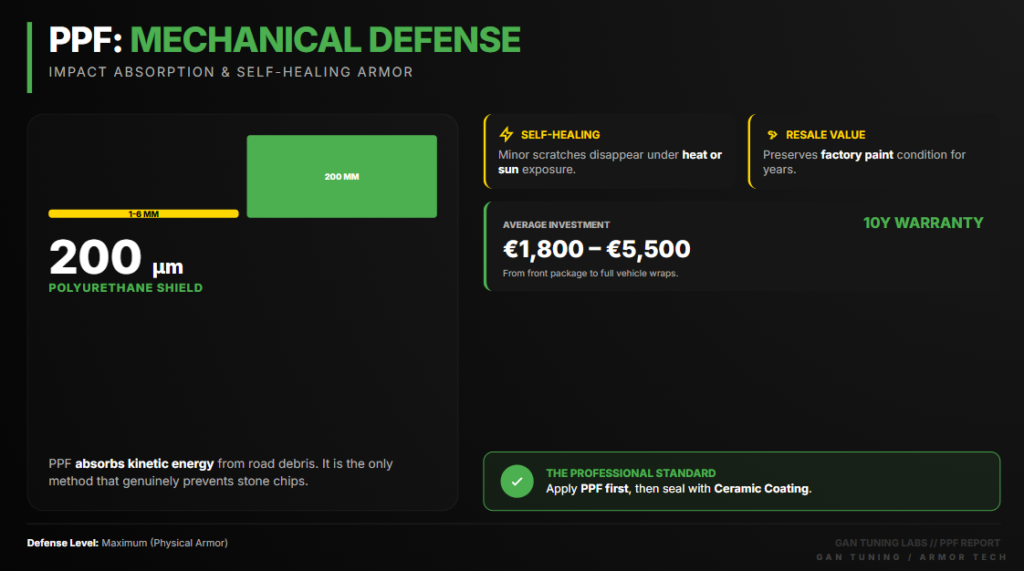
Paint protection film is a transparent thermoplastic polyurethane film approximately 150–200 µm thick, applied directly over the paint. Its working principle is fundamentally different from ceramic coating: the film does not create a chemical barrier — it absorbs impact energy. A stone from the road hits the PPF, not the paint beneath it.
What paint protection film delivers:
— Stone chip protection. The only method that genuinely stops road debris from damaging the paint. Particularly critical for the front end: bonnet, front bumper, wings, and mirrors.
— Self-healing. Modern premium films — XPEL, SunTek, STEK — feature a self-healing topcoat. Light scratches disappear under heat (sunlight or warm water). This is not marketing language — it is a real and measurable property, though it has limits: deep damage will not self-repair.
— Protection from insects and bird droppings. Aggressive contaminants attack the film, not the paint underneath. When a damaged section of film is replaced, the original paint remains untouched.
— Resale value. A paint inspection at point of sale will reveal every concealed defect. Paint protected by PPF looks as it did on the day it left the factory.
PPF application options:
Full vehicle wrap provides maximum protection at maximum cost. A front package — front bumper, bonnet, wings, mirrors — delivers the most practical balance of protection and cost for the majority of vehicles.
Typical costs: A front package starts from approximately €1,800; partial front coverage including A-pillars from around €2,100; full vehicle wraps from €5,500 or more depending on vehicle size and complexity. Premium brands such as XPEL back their film with a 10-year manufacturer’s warranty.
What paint protection film does not do:
Without a ceramic coating applied on top, the film gradually loses its gloss and becomes harder to maintain — dirt adheres more readily to the surface. The professional standard for serious car paint protection is the combination: PPF first, ceramic coating over the top.
PPF vs ceramic coating: comparison table
| Parameter | Paint Protection Film (PPF) | Ceramic Coating |
| Thickness | ~150–200 µm | 1–6 µm |
| Stone chip protection | ✅ Yes — primary function | ❌ No |
| Scratch protection | ✅ Yes (self-healing) | ⚠️ Partial (micro-abrasions only) |
| Chemical / bird dropping protection | ✅ Yes | ✅ Yes — primary function |
| UV protection | ✅ Yes | ✅ Yes |
| Hydrophobicity | ⚠️ Lower without additional coating | ✅ High |
| Paint depth / gloss | Neutral | ✅ Enhances paint depth |
| Longevity | 5–10 years | 3–9 years |
| Cost (partial) | from ~€1,800 | from ~€400 |
| Cost (full vehicle) | from ~€5,500 | ~€400–€1,200 |
| Removable without damage | ✅ Yes, residue-free | ❌ No (requires abrasive polishing) |
| Best suited for | Motorway driving, new cars, performance models | Any vehicle as a baseline car paint protection |
The right combination: PPF and ceramic coating together
Combining both methods is not excessive — it is logical. The optimal approach: PPF on high-risk zones first (the front end), then ceramic coating over the entire vehicle, including the film itself. The result is a two-layer system: the film absorbs mechanical impacts, the coating provides chemical protection and ease of maintenance.
One critical point: ceramic coating goes over the paint protection film, never underneath. If you apply the coating first and then attempt to apply the film, adhesion will be poor and edges will lift. The correct sequence is always: PPF → ceramic coating.
The practical outcome of the combination: the film’s service life extends from 5–7 to 7–10 years, and routine maintenance becomes noticeably easier — dirt does not work its way into the film’s surface.
If the car is going to be driven hard after detailing — motorway miles, all weather — it’s worth thinking about the engine as well as the paint. GÄN GT increases turbocharged engine power by up to 25%, torque by up to 25%, and reduces fuel consumption by up to 15%. IP67-rated housing, 5 operating modes, smartphone control. Removes in 60 seconds — manufacturer warranty remains fully intact. Engine warranty up to €5,000 for 2 years. →Learn more about GÄN GT
Common myths about car paint protection that cost you money
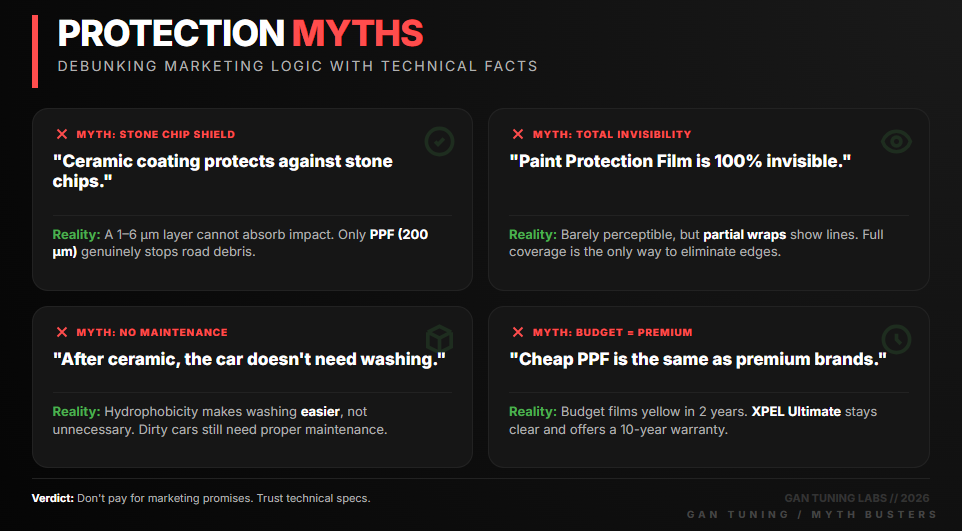
Myth: “Ceramic coating protects against stone chips”
The reality: a layer 1–6 µm thick does not absorb the impact of road debris. It is marginally harder than the clearcoat — and that is the extent of it. The only effective car paint protection against stone chips is paint protection film. Anyone promising stone chip resistance from a ceramic coating is being misleading.
Myth: “PPF is completely invisible”
The reality: with professional installation, the film is barely perceptible on gloss surfaces. However, at transition zones — for example, between a wrapped front bumper and an unwrapped wing — the boundary is visible. Full vehicle coverage eliminates this issue; partial coverage does not.
Myth: “After ceramic coating, the car doesn’t need washing”
The reality: the coating makes washing easier, it does not make washing unnecessary. Hydrophobicity means dirt bonds less readily and rinses off more easily — not that dirt doesn’t attach at all. Incorrect washing with abrasive products or stiff brushes damages a ceramic coating just as it damages unprotected paint.
Myth: “Cheap PPF is the same as premium PPF”
The reality: unbranded budget films yellow within 2–3 years, lose clarity, and begin to lift at the edges. Investing in a premium brand with a manufacturer’s warranty represents a genuine difference in both longevity and appearance. Professional films like XPEL Ultimate Plus maintain their clarity and resist yellowing from environmental exposure, bird droppings, and UV — backed by a 10-year manufacturer’s warranty.
Frequently asked questions
Question: Is polishing required before applying ceramic coating?
Answer: Yes, without exception. Ceramic coating seals the surface in exactly the state it finds it. If swirl marks, scratches, or staining are present beneath the coating, they remain visible — simply preserved rather than corrected. At a minimum, a single-stage polish is required; for new vehicles with visible defects, a two- or three-stage paint correction is appropriate.
Question: Can paint protection film be removed later if needed?
Answer: Yes. This is one of the key practical advantages of PPF — it can be removed cleanly without damaging the original paint. This is particularly relevant for leased vehicles: the film is removed before return, and the paint underneath looks exactly as delivered. Ceramic coating, by contrast, cannot be removed without polishing.
Question: What is the right choice for different vehicles?
Answer: For a new or high-value vehicle with a long ownership plan — PPF on the front end from day one, then ceramic coating over the full car. For an everyday mid-range vehicle — ceramic coating after polishing is the sensible baseline. For a leased vehicle or one planned for sale in 2–3 years — PPF on vulnerable zones protects the paint’s resale value directly.
Summary: how to choose car paint protection in 2026
Four questions determine the right answer:
- New car or premium model? — PPF on the front end from the first day. Ceramic coating on top immediately after.
- Regular motorway driving? — PPF is essential. Road debris at speed is unavoidable.
- Limited budget? — Ceramic coating over the full car after polishing. The rational minimum.
- Leased vehicle or planning to sell in 2–3 years? — PPF pays for itself through retained paint condition at resale or return.
The correct sequence for maximum car paint protection: polishing → PPF on risk zones → ceramic coating over the entire vehicle.
A well-maintained exterior and a properly tuned engine are two independent but logically connected steps. GÄN Tuning Büro offers a 50-day test period for its tuning module with a full money-back guarantee — the longest return window in the segment. Engine warranty up to €5,000 for 2 years. Developed and manufactured in Germany since 2015. →Try GÄN risk-free for 50 days
Articoli utili sul chip tuning:
You’ve probably seen comments online claiming tuning boxes are scams. The argument usually goes something like this: «There’s nothing technically complex about these boxes. They just alter sensor signals. Zero innovation. No feedback. Pure deception.» Sounds damning, right? Except the people making these claims are usually OBD tuning shops trying to sell you ECU remapping […]

A car vinyl wrap is one of the most popular ways to transform your vehicle’s appearance without any permanent consequences for the paintwork: a full colour change takes roughly a week, costs significantly less than a quality respray, and — when removed properly — leaves the factory paint almost untouched underneath. Full professional vehicle wrap […]

An aerodynamic body kit starts delivering measurable technical effect at around 100–120 km/h. At motorway speeds, a properly engineered kit improves axle downforce, lane stability, and — in purpose-designed, CFD-calculated cases — reduces fuel consumption by up to ~5%. Most generic “wide-body” kits, however, increase drag and fuel consumption because they add frontal area without […]


Contact us via WhatsApp