


An aerodynamic body kit starts delivering measurable technical effect at around 100–120 km/h. At motorway speeds, a properly engineered kit improves axle downforce, lane stability, and — in purpose-designed, CFD-calculated cases — reduces fuel consumption by up to ~5%. Most generic “wide-body” kits, however, increase drag and fuel consumption because they add frontal area without reducing turbulence.
What an Aero Body Kit Actually Does: Physics Without the Marketing
A front splitter, side skirts, and a rear diffusor all interact with the airflow around the car’s body. The goal is to reduce axle lift, lower aerodynamic drag, or manage pressure beneath the floor. But this only works under specific conditions.
According todata from Bussgeldkatalog, a noticeable gain in downforce and stability begins at around 100 km/h. Below that threshold, the difference between “with a body kit” and “without” is barely perceptible to the driver. At sustained motorway speeds of 160–200+ km/h, the picture changes: front axle lift decreases, directional stability improves, and steering response becomes more precise.
Three conditions under which body kit benefits genuinely work:
- Speed — consistently above 120 km/h; below that, the aerodynamic effect is minimal.
- Completeness — a front splitter paired with a sealed undertray and diffusor produces results; a standalone wing on an otherwise open underbody has a dubious effect at best.
- Engineering — CFD simulation or wind tunnel testing for the specific vehicle model. A universal kit “fits all cars” is a styling exercise, not an aerodynamics solution.
On carefully engineered kits — notably Tesla aero kits and specialised eco-bodykits —a fuel and range improvement of up to ~5% has been documented through reduced drag. That is the exception, not the rule — and it requires a wind tunnel, not just wider sills.
Which Body Kit Components Actually Work — and Which Just Look Good
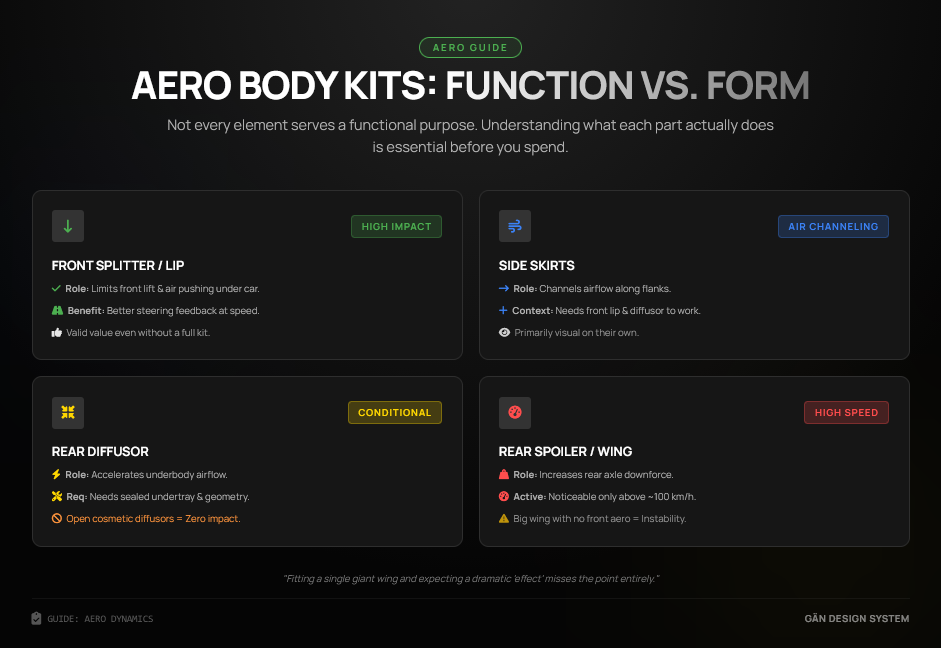
Not every element of an aero body kit serves a functional purpose. Understanding what each part actually does is essential before you spend.
Front splitter / front lip — reduces the air mass pushing under the car and limits front axle lift. Delivers a real benefit at motorway speeds: better lane stability, more responsive steering feedback. One of the few elements where the value-for-money holds up even without a complete kit.
Side skirts — help channel airflow along the car’s flanks. The effect is moderate and is most noticeable in combination with a front lip and diffusor. On their own, they’re primarily visual.
Diffusor — accelerates airflow under the car and draws air rearward. Only effective with an at least partially sealed undertray and correct geometry. A cosmetic diffusor with an open underfloor has close to zero aerodynamic impact.
Rear spoiler / wing — increases rear axle downforce, improves stability through fast corners and under braking. Standard aftermarket spoilers produce a noticeable effect only above ~100 km/h. A large wing without balancing the front end increases both drag and instability.
Every component in a body kit for car solves a specific aerodynamic problem — and only when there’s sufficient speed, the right body geometry, and the remaining elements of the kit. Fitting a single wing and expecting a dramatic “effect” misses the point entirely.
If you’ve already done engine tuning and are now asking “how do I sharpen the handling to match?” — that’s the logical next step. GÄN Tuning Büro has been tuning cars since 2015 and has optimised over 30,000 vehicles across 8 countries. Want to know whether engine performance tuning is right for your car before committing to a body kit? →Find your GÄN module
Homologation and Roadworthiness: The Legal Side of Fitting a Body Kit
This section matters wherever you drive in Europe. Any external modification beyond factory specification can technically affect your vehicle’s roadworthiness approval — until the changes are inspected and, in many countries, officially registered in your vehicle documents.
Most European countries operate a periodic technical inspection (PTI) — equivalent to the German TÜV, UK MOT, French Contrôle Technique, Italian Revisione, Spanish ITV, and so on. Modifications that haven’t been approved through the relevant national process can result in a failed inspection, insurance complications after an accident, or fines.
Three broad categories of legal status for aftermarket parts:
Type-approved parts — the component holds official certification for road use in the relevant market, often requiring no individual inspection. Best-case scenario: buy it, fit it, drive it.
Parts supplied with an expert assessment — the component comes with manufacturer documentation that makes the inspection process standardised and predictable. Most reputable European brands supply this as standard.
No documentation (no-name, unbranded, no marking) — failed PTI, potential insurance refusal after a collision, fines. If your car is still under manufacturer warranty, there’s a direct risk of voiding it.
The practical takeaway for any car body kit guide for Europe: the first question when buying isn’t “how does it look?” — it’s “does it come with the right certification for my country?” Without that paperwork, the part legally doesn’t exist on the road.
Materials matter here too. Carbon and quality GRP (glass-reinforced plastic) with clean geometry and factory-spec mounting points pass technical inspections more reliably. Cheap fibreglass with uneven panel gaps cracks easily, can detach at speed, and regularly fails inspection.
Who Should Buy an Aerodynamic Body Kit — and Who Shouldn’t
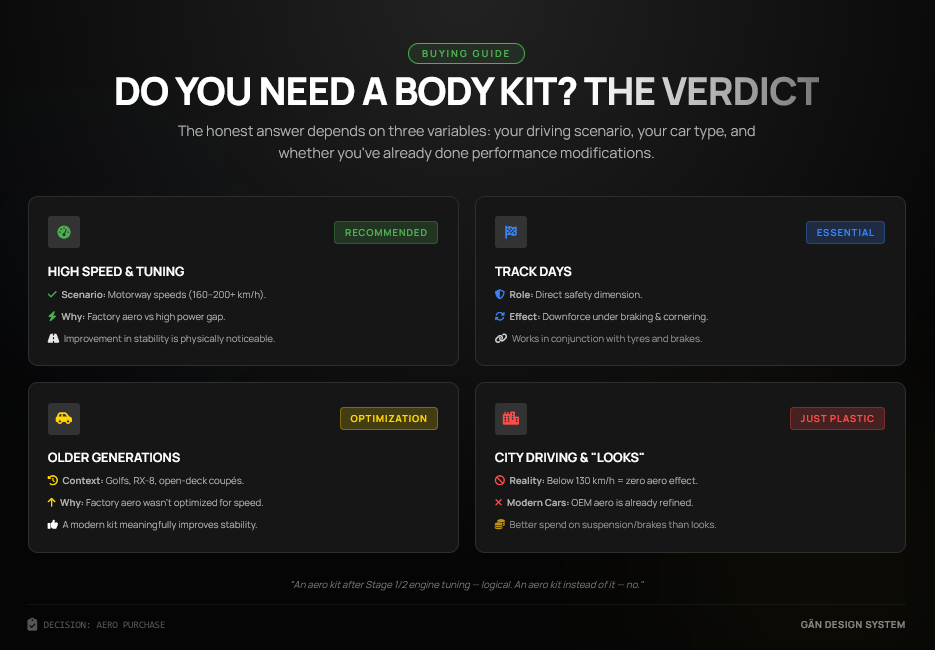
The honest answer depends on three variables: your driving scenario, your car type, and whether you’ve already done performance modifications.
When a body kit makes sense
First case: your car regularly covers motorway distances at 160–200+ km/h. The improvement in stability and directional control is physically noticeable. This is especially relevant after engine tuning: power has gone up, but the factory aerodynamics haven’t changed — a well-chosen body kit closes that gap.
Second case: your car sees track days. Here aerodynamics has a direct safety dimension — downforce under braking and through corners works in conjunction with tyres and brakes.
Third case: older or aerodynamically “open” body shapes — cars like the RX-8, earlier Golf generations, or open-deck coupés. A thought-through aero package can meaningfully improve stability on these platforms precisely because the factory aerodynamics were never optimised for sustained high-speed driving.
When a body kit is just expensive plastic
If the car is primarily a city car that rarely exceeds 130 km/h and the goal is to “look sporty” — the aerodynamic effect at that usage profile is essentially zero. On modern BMW, Audi, or Mercedes models, the factory aerodynamics are already refined; a randomly selected aftermarket body kit more often degrades the car’s characteristics than improves them.
If the budget is limited and the choice is between a body kit and engine tuning,the performance, brakes, and suspension improvements deliver far more tangible benefit on everyday roads. An aero kit after Stage 1/2 engine tuning — logical. An aero kit instead of it — no.
The combination of engine performance tuning + a street-legal aero package is a proven setup for motorway cruisers and hot hatches. The GÄN GT tuning module for turbocharged engines increases power by up to 25% and torque by up to 25%, while reducing fuel consumption by up to 15%. IP67 housing (−40°C to +60°C), smartphone control, 5 driving modes. The module is removable in 60 seconds with no trace left in the ECU — manufacturer warranty preserved. →Explore GÄN GT
Comparison Table: Body Kit Benefits by Component and Use Case
| Component | Actual effect | Speed threshold | Certification needed | Best suited for |
| Front splitter / lip | Front axle downforce, stability | ~100 km/h | Type approval or inspection doc | Motorway, track |
| Side skirts | Airflow along flanks, moderate | ~120 km/h | Inspection doc | Complete kit builds |
| Diffusor | Underfloor airflow management | ~120 km/h + sealed floor | Inspection doc | Track, optimised builds |
| Rear spoiler | Rear axle downforce | ~100 km/h | Type approval or individual inspection | Motorway, track |
| Rear wing | Maximum rear downforce | ~80 km/h (track) | Individual inspection | Track only |
| Full kit | Comprehensive aerodynamic effect | ~100–120 km/h | Type approval or individual inspection | Motorway + track |
Common Myths About Aerodynamic Body Kits
Myth: “Any spoiler reduces fuel consumption”
Reality: Most universal body kits increase aerodynamic drag rather than reduce it. Only purpose-engineered kits backed by CFD data deliver a genuine fuel saving — and only above 120 km/h.
Myth: “Fitting a body kit will immediately cause issues with the annual inspection”
Reality: Not if the component carries the relevant type approval or has been individually inspected and entered into the vehicle documentation. Problems arise only with undocumented parts. Reputable manufacturers supply inspection documentation precisely to make the process routine and predictable.
Myth: “A bigger wing always means more downforce, so bigger is better”
Reality: A wing without balancing the front end creates an imbalance — the rear axle is pressed down harder while the front becomes relatively lighter. Under braking and turn-in, this worsens handling rather than improving it. Wing size needs to be matched to a front splitter or lip for the geometry to work.
Questions and Answers
Q: Does a body kit need to be officially registered if it’s only fitted temporarily?
A: Yes. Your vehicle’s roadworthiness certificate covers the car in the condition it’s in when driven on a public road. “Temporary” fitment doesn’t exempt you from national vehicle modification regulations. In the event of a roadside check or an insurance claim, documentation will be requested.
Q: Does it make sense to add a body kit after engine tuning?
A: It’s a logical sequence for motorway-focused driving. After a power increase, the car’s behaviour at high speed changes: more thrust, same factory aerodynamics. A properly certified street-legal kit complements the engine tuning — it doesn’t replace it.
Q: Which material is best — carbon, GRP, or ABS?
A: Carbon is the lightest and stiffest, but harder to repair and more expensive. Quality GRP (fibreglass) offers a good balance of cost, repairability, and inspection compliance. ABS is the most affordable and works for visual elements. Cheap, unreinforced fibreglass is prone to cracking and detachment at speed — a risk both for technical inspections and for safety.
The Practical Decision Framework: A Car Body Kit Guide for European Drivers
- Define your use case — mostly city driving under 130 km/h, or regular motorway runs at 160+? The first scenario is purely aesthetic. The second is where aerodynamics earns its keep.
- Check the paperwork — type approval or inspection documentation. Without it, the component isn’t legally valid on the road in most European countries.
- Choose the right material — carbon or quality GRP with certification. Avoid unbranded parts with no markings.
- Match components to the job — front lip for stability, diffusor for underfloor airflow management, rear spoiler for rear axle downforce. Without engineering data, only buy a complete kit from a single manufacturer whose parts are designed to work together.
- Sequence it against engine tuning — a body kit after Stage 1/2 engine work is sound logic. A body kit instead of it is not.

To put it plainly: a good aerodynamic body kit is an engineering tool with certified documentation — not a wide plastic catalogue item.
If the engine is already ready for motorway performance, it’s time to think about the handling to match. GÄN Tuning Büro offers a 50-day test drive of the tuning module with a full money-back guarantee — the longest trial period in the segment. Engine warranty up to €5,000 for 2 years — the only financially backed coverage in the industry. Engineered and manufactured in Germany since 2015. →Start your 50-day GÄN trial, risk-free
Articoli utili sul chip tuning:

A proper car audio upgrade is built in three stages: front speakers with door sound deadening, then a subwoofer, then a DSP amplifier. This sequence delivers results — random component swaps do not. In 2026, it’s critical to preserve the manufacturer warranty and the full functionality of factory systems like BMW iDrive, VW MIB, and […]
Most chip tuning articles are written by companies selling tuning services. They highlight benefits and downplay risks because they want your money. This article is different. I’m going to explain what chip tuning actually does, compare the two main methods honestly, and discuss the real risks to warranties and engine longevity. What you do with […]
Your car’s ECU is basically a small computer that runs your engine. That’s it. Everything else – all the power increases, fuel mapping, sensor reading – flows from that one fact. Understanding what an ECU actually does makes it way easier to understand how chip tuning works and why it’s even possible. So let’s break […]


Contact us via WhatsApp