


No, not on its own — and not because the tune is invisible. A flash leaves three things behind: a calibration verification number that stops matching, a programming record with a date, and a counter that goes up on every write, including the one that puts stock back. What matters is who reads them, and when.
This is the question our support team hears more than any other, and it almost always arrives in the wrong order — after the car has already been flashed. The pattern in our inbox barely changes: someone gets a tune at a third-party shop, something fails months later, the dealer pulls the ECU history, and a routine warranty repair turns into an argument.
We’re in an unusual position to answer it. A number of GAN engineers wrote custom calibrations for a living years before this company existed. They know what a flash leaves behind because, in a previous professional life, they were the ones leaving it. So here’s the mechanism, without the forum mythology: what’s actually stored, what a dealer can read, and what none of it means for your warranty on its own.
What a Dealer Actually Sees at a Routine Service
Usually nothing, and the reason is dull: nobody looks.
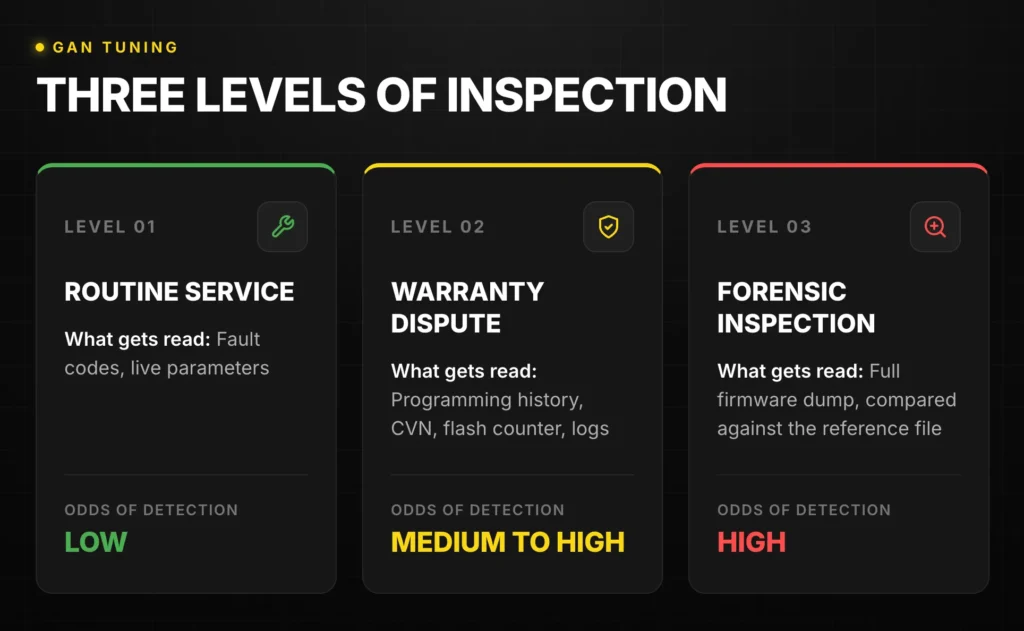
Standard service equipment doesn’t pull a firmware dump. It reads fault codes and live parameters, and it does that against a checklist written for oil changes and brake wear, not for forensics. Reading the ECU’s identity data is trivial — but reading it and checking it against the manufacturer’s reference values are two different jobs, and only the first one is part of a routine visit.
The economics do the rest. A deep look at programming history costs a technician’s time that nobody has budgeted, so it gets triggered by a reason, not by a schedule: a serious warranty-covered failure, or a complaint about how the engine behaves. That’s why owners go years without a single question, and why the “sudden” check tends to start the moment something expensive breaks. The scrutiny concentrates exactly where it’s worth spending.
What Gets Checked in a Warranty Dispute: CVN, the Flash Counter, and Logs
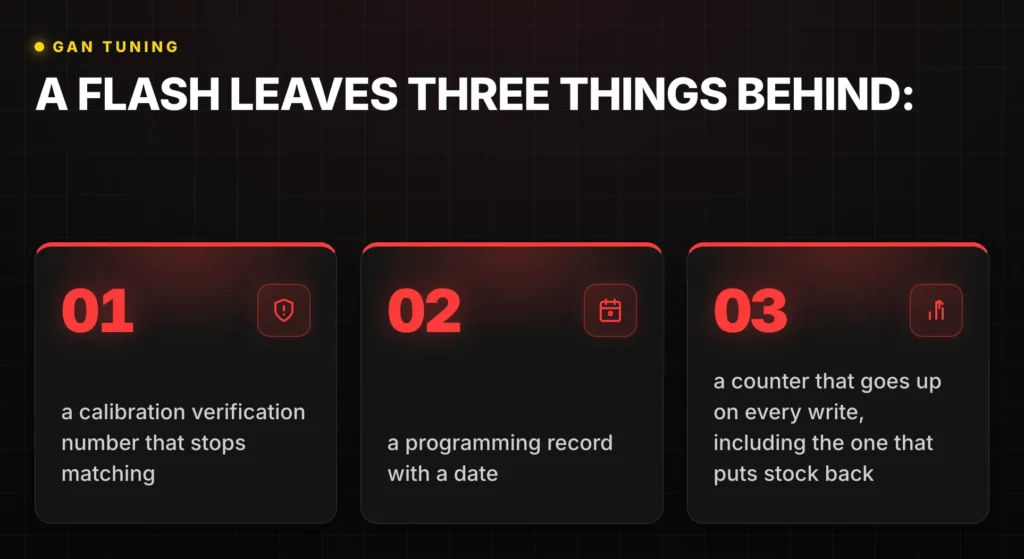
A dispute is a different job with different tools. What gets read is specific: the date of the last programming event, the flash counter (how many times the ECU has been written over the car’s life), the checksum of the software currently loaded, and the CVN — the calibration verification number.
The CVN is where most forum arguments quietly fall apart, because it isn’t a manufacturer’s private trick. On any US-market car from 2005 onward it’s a legal requirement. California’s OBD-II regulation — which federal EPA rules adopt by reference for vehicles certified nationwide — requires that every vehicle “use an algorithm to calculate a calibration verification number (CVN) that verifies the on-board computer software integrity.”
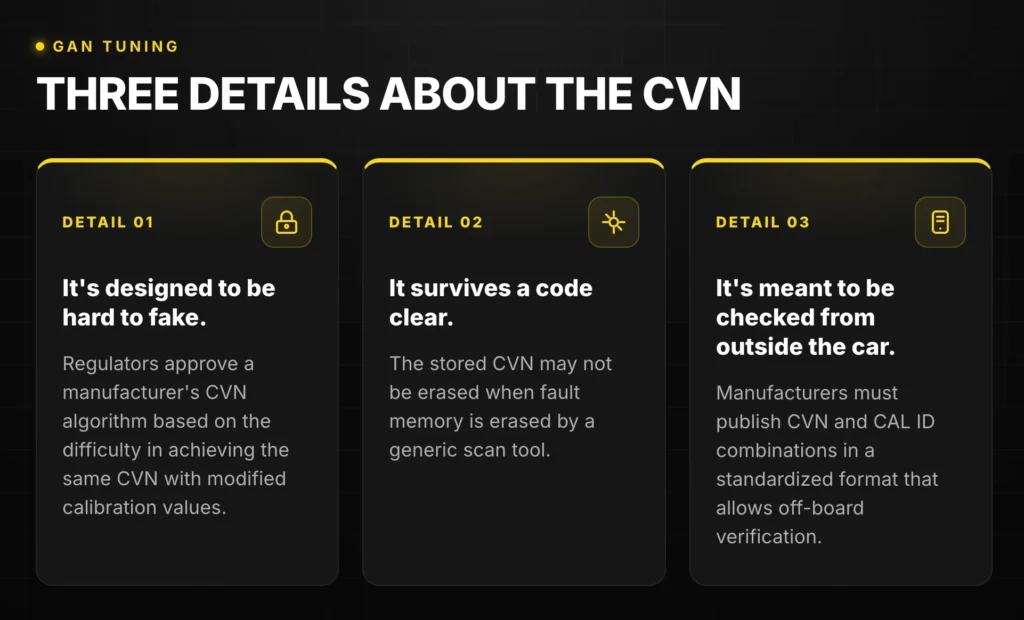
Three details in that regulation matter more than anything a tuner will tell you.
- It’s designed to be hard to fake. Regulators approve a manufacturer’s CVN algorithm based on “the difficulty in achieving the same CVN with modified calibration values.” Resistance to modified calibrations is the design goal, not a side effect.
- It survives a code clear. The rule states the stored CVN “may not be erased when fault memory is erased by a generic scan tool” or at normal shutdown. Clearing codes before a service visit does nothing to it.
- It’s meant to be checked from outside the car. For emissions inspection purposes, manufacturers must publish CVN and CAL ID combinations in a standardized format that allows off-board verification that the number is valid and appropriate for that specific vehicle. The comparison infrastructure exists by design.
So the picture isn’t “magic traces.” It’s architecture. A modern ECU keeps a protected service area separate from the working fuel and ignition maps, and every programmer session is recorded there regardless of what gets written — if you want the groundwork first, here’s what an ECU actually is. From the counter’s point of view, an aggressive Stage 2 file and a factory calibration are the same event: a write.
Our former calibrators are skeptical of any shop promising a tune with “no trace,” and it isn’t a comment on anyone’s skill. The trace isn’t a question of how careful the installer was. It’s a question of what the ECU was built to record.
Can Tuning Boxes Be Detected?
Different hardware, different answer. A tuning box or piggyback module doesn’t write to the ECU at all — it sits between the sensors and the ECU and alters signals on the way in. Nothing about the factory software changes, so the CVN still matches, the flash counter doesn’t move, and the programming history stays empty.
That leaves exactly one way to find one: seeing it. A module that’s physically plugged in when a technician opens the hood is visible the way any added component is visible. A module that isn’t there when the car arrives leaves nothing behind to read, because nothing about it was ever written down.
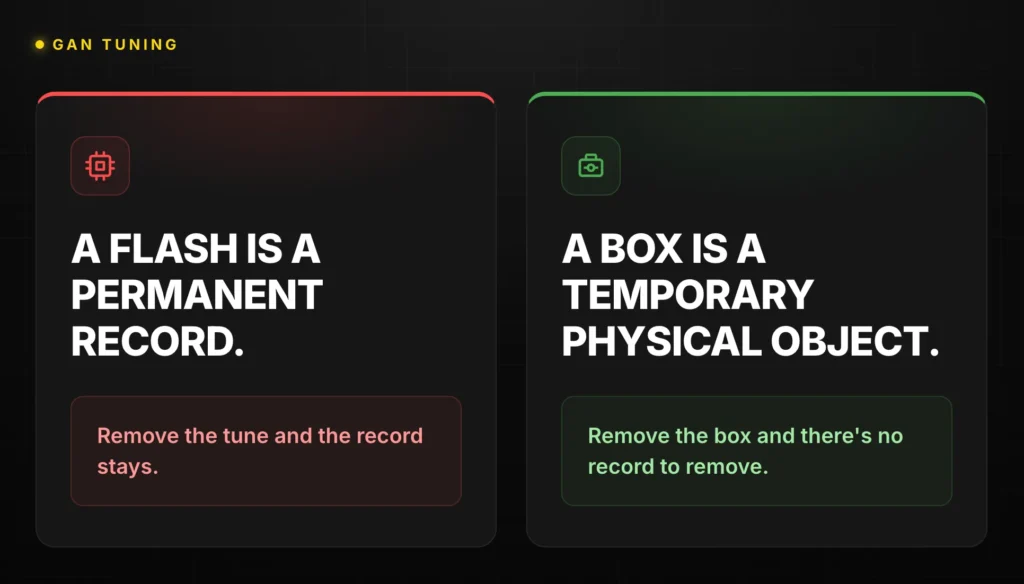
This is the cleanest split in the whole subject, and it’s worth stating plainly:
- A flash is a permanent record. Remove the tune and the record stays.
- A box is a temporary physical object. Remove the box and there’s no record to remove.
TD1 on VAG Cars: What the Marker Actually Means
Volkswagen, Audi, and Škoda owners ask about TD1 more than any other single term. It’s a service-system marker set when the control unit’s parameters don’t line up with the factory calibration — in practice, the group’s internal shorthand for “this car’s software has been touched.”
Two things get lost in forum threads.
- What it covers. TD1 puts engine and transmission claims under scrutiny. It does not flip a switch that voids the warranty on the whole car, and it isn’t a legal finding about anything.
- What it proves. The marker records that the software doesn’t match. It says nothing about whether that mismatch caused the failure someone is now claiming for — and causation, not the marker, is what a denial has to rest on.
One caveat, and it matters: TD1 is a manufacturer’s internal service flag, not a published standard. Unlike the CVN, there’s no public regulation defining it. What we can tell you about it comes from engineers who worked with these systems, not from a document you can look up.
Three Levels of Inspection
The same car looks different depending on who is looking at it and why.
Why Reverting to Stock Isn’t a Fix
Putting the factory calibration back lowers your risk. It doesn’t erase the history, and the reason is almost boring: writing the stock file is itself a write. The counter records it, the programming log gets another dated entry, and the car now reads as a vehicle that has been flashed twice rather than never.
The CVN will match again — that’s real, and it matters. But a matching CVN sitting on top of a counter that says this ECU has been written to more than once tells its own story to anyone who looks at both.
That architecture is the reason our product exists in the form it does. When we worked out how to build it, the question came down to one line: if any write to the ECU leaves a permanent record, then don’t write to the ECU. So the module sits between the sensors and the ECU and corrects signals from the outside. The factory calibration, the flash counter, and the checksums stay exactly as they left the plant, for the life of the car. Before a dealer visit the module comes off in about a minute — and there’s nothing to find at a routine service or under a forensic check, because nothing was ever recorded.
What US Law Says About Modifications and Warranty Claims
Detection and denial are not the same event, and the gap between them is where most owners lose an argument they could have won.
Under the Magnuson-Moss Warranty Act, the FTC’s guidance for vehicle owners is direct: “Your warranty stays in effect if you use aftermarket or recycled parts,” and if a dealer wants to refuse a repair, “the manufacturer or dealer must prove the aftermarket or recycled part caused the damage before they can deny warranty coverage.”
This isn’t theoretical. In April 2018 the FTC sent warning letters to six companies over warranty language that tied coverage to the use of authorized parts and service, noting that firms “can’t void a consumer’s warranty or deny warranty coverage solely because the consumer uses a part made by someone else.”
Read the other half too, because the FTC states it in the same breath: companies may still “disclaim warranty coverage for defects or damage caused by the use of unauthorized parts or service.” A tune that overloaded a turbo is a causation case a dealer can make. A tune that has nothing to do with a failed infotainment screen isn’t.
Which warranty covers what, and what to do when a dealer refuses anyway, is a subject of its own — we covered it separately in Does Chip Tuning Void Your Warranty? The Honest Answer.
Myths About Tune Detection
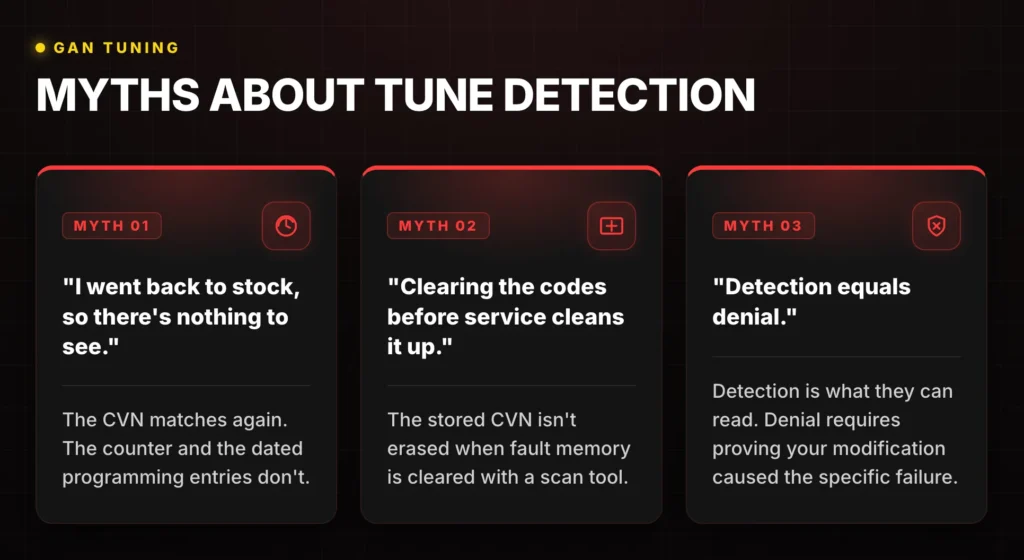
- “I went back to stock, so there’s nothing to see.” The CVN matches again. The counter and the dated programming entries don’t care.
- “Clearing the codes before service cleans it up.” The regulation specifically prevents that: the stored CVN isn’t erased when fault memory is cleared with a scan tool.
- “A dealer spots a tune at every service.” A routine service isn’t a forensic exam. The targeted check starts when there’s a claim worth checking.
- “TD1 means the warranty is gone.” It means engine and transmission claims get scrutiny. It isn’t a denial, and it isn’t causation.
- “Detection equals denial.” It doesn’t. Detection is what they can read. Denial requires proving your modification caused the specific failure.
The Practical Takeaway
If your car is already flashed, stop counting on luck. Go back to stock before scheduled visits — it’s an improvement even though it isn’t a cure. Keep every record from day one: the FTC’s own advice to owners is that a warranty company can ask for maintenance records, and that “the records will be helpful if you have to use your warranty.” And stay with shops that calibrate conservatively, because the closer a tune runs to the edge of safe operation, the more likely something breaks — and a breakdown is what starts the inspection in the first place.
If you’re still choosing a method and want the question off the table entirely, the honest answer is that the only way to leave nothing behind is not to write anything. Check what your engine supports here: Select your car.
FAQ
Can car dealerships tell if you’ve modified the ECU?
Yes, if they look. The CAL ID and CVN are readable through the standard OBD connector on any 2005-or-later US-market car, and a mismatch against the manufacturer’s reference is what flags a modification. What varies isn’t their ability to read it — it’s whether anyone runs the comparison, which usually happens only once there’s a claim.
Does an ECU remap void warranty?
Not by itself. A remap is detectable, but a denial has to rest on causation for the specific failure being claimed, not on the existence of a modification.
Will a Stage 1 tune void my warranty?
The stage number doesn’t change the rule. A Stage 1 file still writes to the ECU, so it still moves the flash counter and changes the CVN, and it still has to be linked to a specific failure before a claim can be refused. What the stage does change is mechanical risk — and mechanical risk is what triggers the inspection.
Is there any real difference between VW, Audi, and Škoda here?
No. VAG brands share ECU architecture and the same service-marker system, so TD1 behaves the same way across the group. The differences are in ECU version and model year, not in the badge.
If I remove a tuning box before service, can they tell it was there?
No. A box doesn’t write to the ECU, so there’s no calibration change, no counter movement, and nothing in the programming history. If it isn’t physically installed when they look, there’s no record of it.
Articoli utili sul chip tuning:
We build tuning modules and sell them remotely: cars don’t come to us — emails do. And among the thousands of support tickets, there’s a category our engineers call “rescue after tuning” among themselves: someone isn’t asking about our module — they’re describing a car that’s already been tuned somewhere else, and they want to […]
Your car’s ECU is basically a small computer that runs your engine. That’s it. Everything else – all the power increases, fuel mapping, sensor reading – flows from that one fact. Understanding what an ECU actually does makes it way easier to understand how chip tuning works and why it’s even possible. So let’s break […]
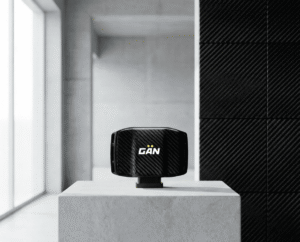
The short answer: it depends on the type of chip tuning and whether dealers can prove it caused the problem. External modules like GAN’s? Removable with zero trace, so dealers can’t detect them if you unplug before service. ECU remapping? Leaves permanent traces dealers can spot immediately. Big difference. Let me break down what actually […]


Contact us via WhatsApp