


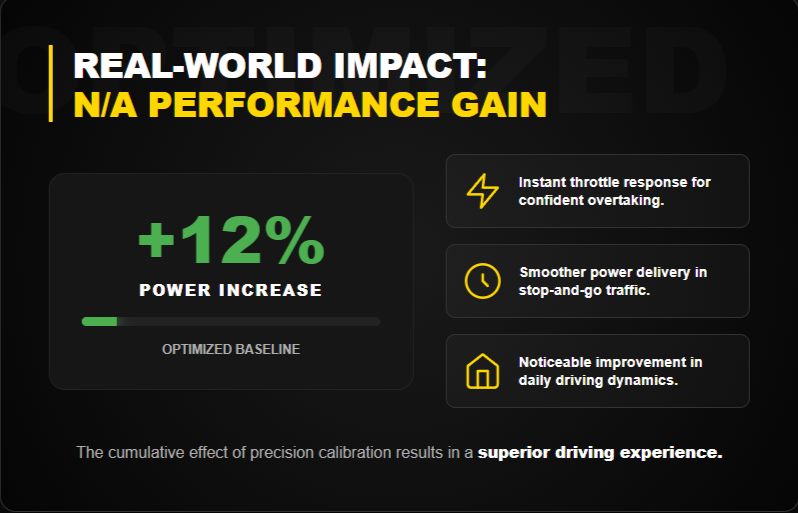
Naturally aspirated engines gain less from chip tuning than turbocharged engines. That’s just physics. You’ll see around 10-12% power increase, maybe 15% torque increase at best.
But that 10-12% is still worth having. Let me explain what’s actually possible with naturally aspirated engines and why the gains are limited compared to turbocharged motors.
What Makes an Engine «Naturally Aspirated»
A naturally aspirated engine (sometimes called atmospheric or NA) relies on normal atmospheric pressure to fill the cylinders with air. No turbocharger forcing air in, no supercharger compressing it – just pistons moving down and creating vacuum that sucks in outside air.
How it works:
Piston moves down on the intake stroke, creating low pressure in the cylinder. Atmospheric pressure (about 1.0 bar at sea level) pushes air through the intake valve to equalize the pressure. That air mixes with fuel and combusts on the power stroke.
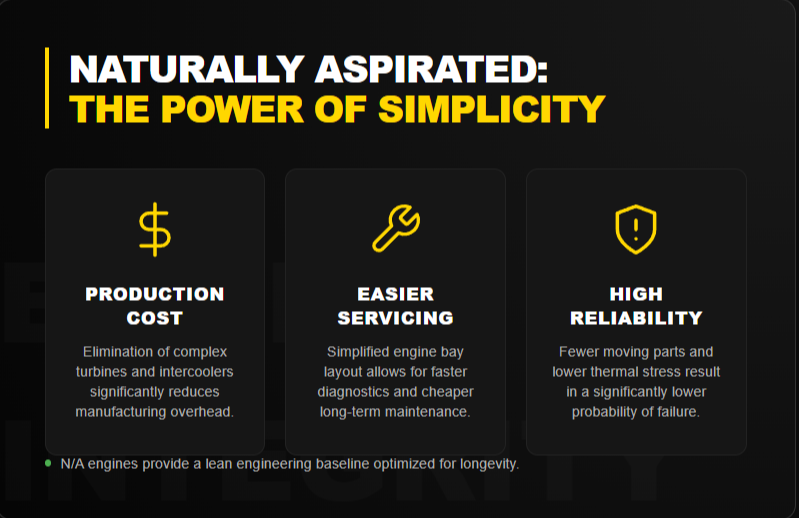
This is the original engine design from the late 1800s. It’s mechanically simple, reliable, and still used in the majority of cars on the road today. Why? Because naturally aspirated engines are cheaper to manufacture, easier to maintain, and have fewer components that can fail compared to forced induction setups.
Why NA Engines Have Limited Tuning Potential
The fundamental limitation is air. To make more power, an engine needs to burn more fuel. To burn more fuel, you need more oxygen. With a naturally aspirated engine, you’re stuck with atmospheric pressure – you can’t force more air into the cylinders without adding a turbocharger or supercharger.
The math:
Your 2.0-liter engine draws in 2.0 liters of air per complete rotation at atmospheric pressure. That’s fixed by the laws of physics. You can optimize how efficiently the engine uses that air, but you can’t increase the total amount without forced induction.
Turbocharged engines don’t have this limitation. A turbo can push 1.5 bar, 1.8 bar, even 2.0 bar of air into the same 2.0-liter engine. Now you’ve got 3.0-4.0 liters worth of air molecules in a 2.0-liter space, which means you can burn twice as much fuel and make twice as much power. That’s why turbocharged engines see 20-40% gains from tuning while naturally aspirated engines max out around 10-12%.
| Engine Type | Typical Power Gain | Typical Torque Gain | Why |
| Naturally aspirated | +10-12% | +12-15% | Limited by atmospheric pressure |
| Turbocharged gasoline | +20-30% | +25-30% | Boost pressure increase possible |
| Turbocharged diesel | +25-30% | +30-35% | High boost headroom, strong internals |
These numbers come from GAN’s testing on over 30,000 vehicles since 2015.
What Chip Tuning Actually Changes on NA Engines
Since you can’t add more air, chip tuning for naturally aspirated engines focuses on optimizing what you’ve got.
- GAN GA+ module modifications:
Throttle response optimization. The module accesses more aggressive throttle maps in the factory ECU. Manufacturers program these maps in but restrict access to them. When you press the throttle 30%, the ECU might only open the throttle body to 25% with stock programming. After tuning, that same 30% pedal input opens the throttle body to 30% or even 32%, giving sharper response.
Fuel delivery tuning. The module optimizes fuel injection timing and duration for better combustion efficiency. This doesn’t mean dumping in more fuel randomly – it means injecting at the optimal moment in the combustion cycle and atomizing it better for more complete burning.
Ignition timing advance. The module allows more aggressive ignition timing (firing the spark plugs earlier in the compression stroke) when conditions are safe. This extracts more energy from the same amount of fuel.
Variable valve timing optimization (if your engine has it). Many modern NA engines use VVT to change valve opening/closing timing. The module can access more aggressive VVT maps for better cylinder filling and exhaust scavenging.
All these changes combined give you that 10-12% power increase. It’s not huge, but it’s noticeable in daily driving.
Where You’ll Actually Feel the Difference
That 10-12% power increase translates to real-world improvements, especially in specific situations.
- Mid-range torque improvement: Stock NA engines often have a narrow torque peak – maximum torque available in a small RPM range. After tuning, the torque curve flattens and widens. You’ll have better pull from 2,000-5,000 RPM instead of just at 3,500 RPM.
- Throttle response: This is where you’ll notice the biggest difference. The engine responds more immediately to throttle inputs. Press the gas and the car accelerates right now, not half a second later after the ECU thinks about it.
- Air conditioning impact reduction: Running A/C on a stock NA engine can rob 5-10 HP, which you definitely feel. After tuning with that extra 12-15 HP, the A/C impact is less noticeable because you’ve got power to spare.
- High-gear acceleration: Before tuning, pulling away from 1,500 RPM in fifth gear feels sluggish. After tuning, the improved torque curve means the engine pulls adequately even from low RPM in high gears.
Real-world example from GAN testing:
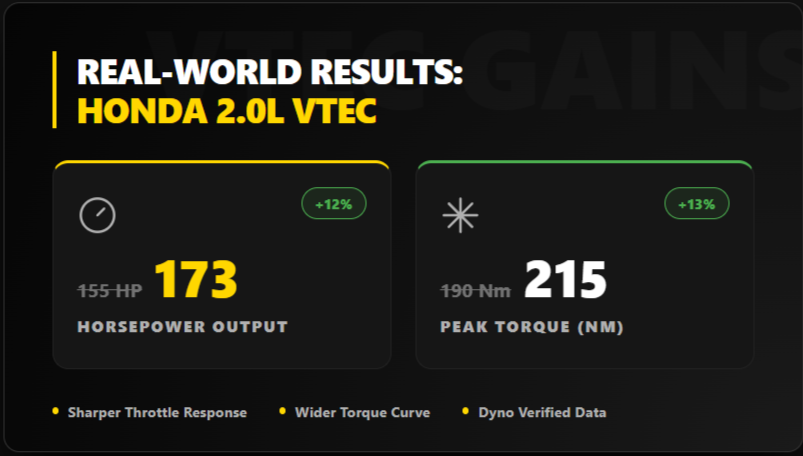
- Honda 2.0L VTEC naturally aspirated (155 HP stock):
- After GAN GA+: 173 HP (+18 HP / +12%)
- Torque increase: 190 Nm to 215 Nm (+25 Nm / +13%)
That extra 18 HP doesn’t sound like much, but the wider torque curve and sharper throttle response make the car feel significantly more responsive in normal driving.
- Question: Why can’t naturally aspirated engines gain as much as turbocharged engines?
- Answer: Physics. A naturally aspirated engine is limited to atmospheric pressure for air intake – you can’t force more air into the cylinders without adding forced induction. Turbocharged engines can increase boost pressure, which means more air molecules in the same space, which allows burning more fuel and making more power. NA engines can only optimize how efficiently they use the fixed amount of air available at atmospheric pressure.
- Question: Will 10-12% more power be noticeable in daily driving?
- Answer: Yes, especially for throttle response and mid-range pull. You won’t suddenly have sports car acceleration, but passing on highways becomes easier, merging into traffic feels more confident, and the engine doesn’t bog down with A/C running. The improvement is most noticeable in the 2,000-4,000 RPM range where you spend most of your driving time.
Fuel Economy on Naturally Aspirated Engines After Tuning
NA engines typically see modest fuel economy improvements after chip tuning, assuming you drive the same way you did before.
The improvement comes from better throttle response and a flatter torque curve. You spend less time at high RPM because the engine pulls adequately at lower RPM. Less high-RPM operation = less fuel consumption.
Realistic fuel economy changes:
- Highway driving (steady speeds): 5-10% improvement
- Mixed city/highway: 3-7% improvement
- City driving: 0-5% improvement
- Aggressive driving: 5-10% increase in consumption
The fuel economy benefit is smaller than with turbocharged engines because you’re not gaining the efficiency advantage of staying in higher gears at lower boost. But conservative drivers do see measurable savings.
GAN GA+ Installation and Features
GAN GA+ connects via your OBD-II port and takes about 10-15 minutes to install. No special tools required, no permanent modifications.
- Features specific to naturally aspirated engines:
Five driving modes accessible via smartphone app – Sport (maximum power), Dynamic (balanced), Eco (fuel economy priority), Custom (adjust parameters yourself), Stock (module disabled).
Five free reprogramming sessions. If you sell your car and buy another naturally aspirated vehicle, just reprogram the same module for the new car. You might need a different connection cable (costs about €50-80) but the module itself transfers.
Two-year engine guarantee up to €5,000. GAN backs the module with warranty coverage because they’re confident it won’t cause engine damage.
50-day test drive period. Try the module for almost two months. Don’t like it? Return for full refund.
Complete reversibility. Unplug the module and the car returns to stock behavior immediately. No trace in ECU memory, no software changes, nothing for dealers to detect.
Why Manufacturers Limit NA Engine Performance
If naturally aspirated engines can safely handle 12% more power, why don’t manufacturers tune them that way from the factory?
- Model lineup differentiation: The same basic engine might appear in economy and sport trim levels. Manufacturers use ECU programming to create power differences and justify price gaps. A 2.0L engine making 155 HP in the base model and 165 HP in the sport model? Same engine, different software.
- Emissions compliance: More aggressive tuning can increase emissions slightly. Manufacturers tune conservatively to meet emissions standards with margin for variability and component aging.
- Warranty cost reduction: Conservative tuning means fewer warranty claims. Program the engine to maximum power and you’ll see more failures from drivers who abuse it.
- Global market compatibility: One engine has to work with varying fuel quality across different markets. Conservative tuning ensures reliability everywhere.

These factors mean manufacturers typically use 85-90% of an NA engine’s capability, leaving 10-15% headroom that chip tuning can unlock.
Setting Realistic Expectations
Don’t expect dramatic transformation. A naturally aspirated engine with chip tuning won’t suddenly feel like a turbocharged engine. The laws of physics prevent that.
What you will get: noticeably sharper throttle response, better mid-range pull, less power loss when running accessories like A/C, and slightly better fuel economy if you drive conservatively.
What you won’t get: the massive 30-40% power gains possible with turbocharged engines, or the ability to keep up with cars that have significantly more displacement or forced induction.
GAN’s testing on 30,000+ vehicles shows that naturally aspirated engine owners are generally satisfied with the improvements – as long as they have realistic expectations going in. The 10-12% gain is enough to make daily driving more enjoyable without fundamentally changing the character of the car.
The Bottom Line on NA Engine Chip Tuning
Naturally aspirated engines gain less from chip tuning than turbocharged engines because physics limits how much air they can ingest. But 10-12% more power with improved throttle response and a flatter torque curve makes a noticeable difference in daily driving.
GAN GA+ optimizes what’s already there – throttle maps, fuel delivery, ignition timing, valve timing – to extract the performance headroom manufacturers deliberately left unused. The module is completely reversible, preserves your warranty (when removed before service), and comes with a 50-day trial period to verify the gains yourself.
If you’re driving a naturally aspirated engine and want modest but meaningful improvements, chip tuning delivers. Just don’t expect turbo-level gains from an atmospheric engine.
Articoli utili sul chip tuning:

Your car’s engine isn’t running at full capacity. Never has been. Manufacturers deliberately program engines to produce less power than they’re actually capable of, and there are some pretty specific reasons why. This isn’t some conspiracy theory – it’s basic automotive economics and engineering. Let me show you what’s really going on. What Actually Happens […]
You’ve probably seen comments online claiming tuning boxes are scams. The argument usually goes something like this: «There’s nothing technically complex about these boxes. They just alter sensor signals. Zero innovation. No feedback. Pure deception.» Sounds damning, right? Except the people making these claims are usually OBD tuning shops trying to sell you ECU remapping […]
You want more power from your car. Fair enough. There are basically two ways to get it: mechanical modifications or electronic tuning. One costs thousands and takes weeks. The other costs hundreds and takes 15 minutes. Let me explain what each method actually involves and what you can realistically expect. What «Tuning» Actually Means Tuning […]


Contact us via WhatsApp