


You’ve probably seen comments online claiming tuning boxes are scams. The argument usually goes something like this: «There’s nothing technically complex about these boxes. They just alter sensor signals. Zero innovation. No feedback. Pure deception.»
Sounds damning, right? Except the people making these claims are usually OBD tuning shops trying to sell you ECU remapping instead. Let me break down what’s actually happening, because there’s a lot of confusion mixed with some legitimate points.
The «It’s Just Simple Electronics» Argument
Yeah, the hardware in a tuning box isn’t rocket science. Any decent electronics specialist could design the circuit board. The box sits between your sensors and your ECU, modifies the signals, sends them along. Not complicated from a hardware perspective.
But here’s what that argument misses: the hardware is basically irrelevant. What matters is the software running on that hardware.
Think about your phone. The physical components – screen, processor, camera – aren’t particularly revolutionary. What makes your phone useful is the software. Same concept with tuning boxes. The circuit board is just the delivery mechanism for sophisticated calibration algorithms.
- What actually determines quality in a tuning module:
The calibration maps – thousands of hours of dyno testing across different engines, temperatures, fuel qualities, and driving conditions. GAN’s tested over 30,000 vehicles since 2015 to build these maps. That’s not simple.
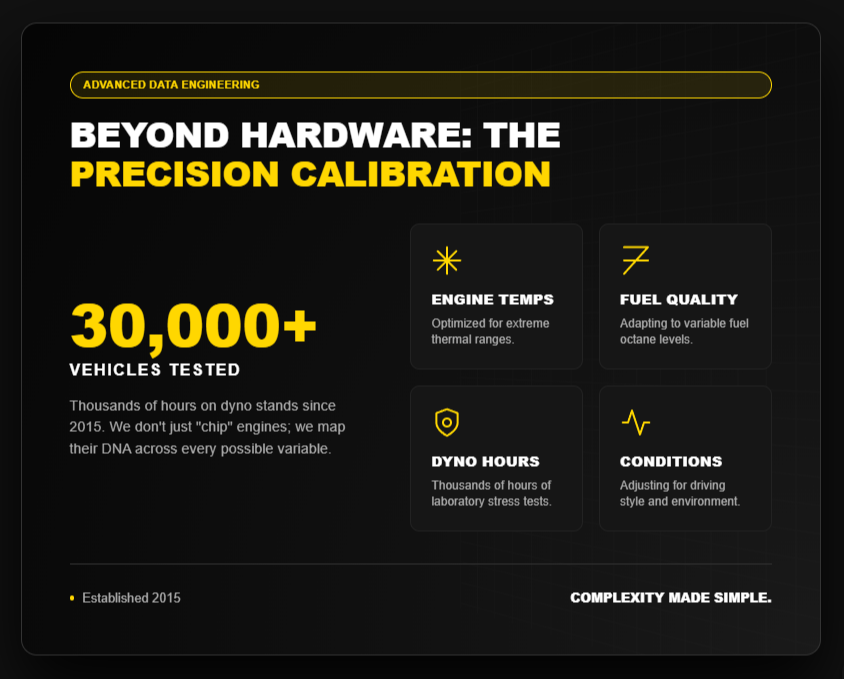
Real-time adjustment algorithms that modify sensor signals based on current operating conditions. Engine cold? Different adjustments than when it’s at operating temperature. Low fuel quality detected? Different fuel mapping than premium fuel.
Safety parameters that prevent the module from requesting power increases when conditions aren’t safe. Oil temperature too high? Throttle the power back. Coolant temperature spiking? Reduce boost pressure.
None of that shows up in the physical circuit board. It’s all software, and that software represents years of engineering work.
The «Deception» Claim Is Meaningless
Critics love to say tuning boxes «deceive» the ECU. Well, yeah. So does OBD tuning. So does literally every form of performance modification.
All chip tuning works by changing what the ECU thinks is happening. OBD tuning rewrites the parameters stored in ECU memory. External modules modify sensor signals before they reach the ECU. Different methods, same fundamental approach – making the engine behave differently than the factory intended.
The word «deception» makes it sound shady, but it’s just how engine tuning works. Your factory ECU is programmed with conservative fuel maps that prioritize warranty claims and global market compatibility over performance. Tuning changes those parameters to unlock what the hardware can actually handle.
- ECU remapping: Changes parameters inside the ECU
- External module: Changes sensor inputs that determine parameters
Both methods «deceive» the stock system into running differently. That’s the whole point. The question isn’t whether deception happens – it’s which method does it more safely and reversibly.
| Factor | External Module (GAN) | ECU Remapping |
| Factory ECU modified | No | Yes |
| Warranty preservation | Yes (removable, no trace) | No (detectable by dealers) |
| Safety systems active | Yes (factory protection intact) | Often disabled or modified |
| Reversibility | 100% (unplug and done) | Risky (reflashing can brick ECU) |
| Adjustability | Multiple modes via app | Fixed tune (changes need paid reflash) |
Based on testing more than 30,000 vehicles, external modules actually maintain more safety features than ECU remapping because the factory ECU keeps running its protection algorithms.
The Feedback Question Actually Supports External Modules
Here’s where the critics really get it wrong. They claim tuning boxes don’t receive feedback, implying the ECU is operating blind. That’s backwards.
The factory ECU continues managing the engine exactly like it always did. It receives all the same feedback from all the same sensors – oxygen sensors, knock sensors, temperature sensors, pressure sensors. The ECU is still monitoring everything and making constant adjustments.
What changed? The sensor values it’s receiving are modified by the tuning module. But the ECU’s response algorithms – the ones the manufacturer spent millions developing – are still active and still working.
Actually, this is safer than ECU remapping, where those protection algorithms often get disabled or modified. With an external module, if your engine starts knocking, the factory ECU detects it and pulls timing. If oil pressure drops, the factory ECU limits power. All the safety systems that manufacturers built in? Still functioning.
The tuning module does receive feedback – it sees real-time sensor signals and adjusts its modifications based on current conditions. Modern modules from GAN use closed-loop control, meaning they constantly adapt based on what’s actually happening in the engine.
- Question: Why don’t manufacturers just tune engines this way from the factory?
- Answer: They could, but they won’t. Conservative factory tunes protect against warranty claims from drivers who abuse their cars, allow one engine to work in markets with terrible fuel quality, and create power differentiation between model tiers. Manufacturers leave 25-35% power headroom in turbocharged engines intentionally – it’s not that they can’t access it.
- Question: Can a tuning module damage my engine if it’s not receiving direct ECU feedback?
- Answer: The factory ECU is receiving feedback and will protect the engine just like it always did. Plus, quality modules like GAN’s include their own safety limits based on extensive testing. That’s why they can offer a €5,000 engine guarantee for 2 years – the module won’t request dangerous power levels, and the factory ECU still has veto power.
What the Software Actually Does
Let’s get specific about what happens inside a tuning module’s software, because this is where the real engineering lives.
The module reads sensor signals in real-time – boost pressure, air temperature, throttle position, fuel pressure. It compares these values against its calibration maps (built from thousands of hours testing that specific engine). Based on current conditions, it calculates optimal modifications to unlock more power while staying within safe mechanical limits.
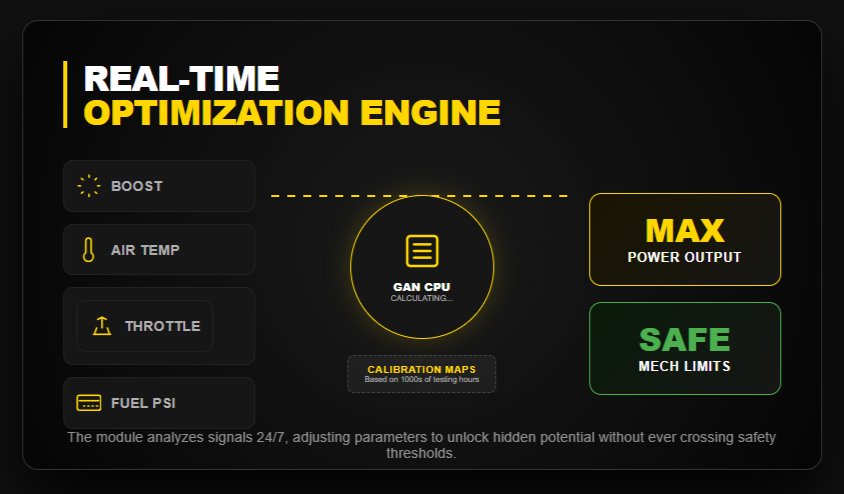
For example: your turbocharger is capable of 2.0 bar boost pressure, but the factory limits it to 1.5 bar. The module reads the boost sensor showing 1.5 bar, modifies the signal to tell the ECU it’s reading 1.3 bar, which causes the ECU to request more boost (since it thinks there’s headroom). The actual boost rises to 1.8 bar, still well below the turbo’s mechanical limit.
But here’s the critical part: if oil temperature climbs too high, or coolant temperature spikes, or fuel quality drops (detected by knock sensors), the module’s algorithm reduces how much it modifies the signal. Less modification = less power increase = engine protection.
Engineers with over 20 years of calibration experience spent years developing these algorithms. Calling that «simple» or «not innovative» completely misses what’s actually happening.
The Real Question: Which Method Works Better for You?
OBD tuning advocates love to trash-talk external modules because they’re competing for the same customers. But the actual comparison comes down to what you value.
If you’re building a heavily modified race car with upgraded turbos, bigger injectors, and custom exhaust – ECU remapping might make sense. You’re so far past stock that the factory ECU’s parameters don’t apply anymore.
For everyone else driving a street car? External modules offer better warranty protection, complete reversibility, adjustable power levels, and preserved safety systems. Plus you avoid the risk of bricking your ECU during the flashing process.
GAN modules tested on 30,000+ vehicles show the same performance gains as good ECU remapping (up to 30% on turbocharged engines), but you can remove the module before dealer visits with zero trace. Can’t do that with a reflashed ECU.
The «deception» argument is just marketing from competitors. Both methods change how the engine runs. One does it reversibly while keeping factory protections active. The other does it permanently and often disables safety systems.
Pretty clear which one makes more sense for most people.
Articoli utili sul chip tuning:
Everyone asks this question before installing a tuning module: will my fuel consumption go up or down? The honest answer is – it depends entirely on how you drive. Install a chip and keep driving like you did before? You’ll probably use 10-15% less fuel. Install the same chip and start using all that extra […]
Most chip tuning articles are written by companies selling tuning services. They highlight benefits and downplay risks because they want your money. This article is different. I’m going to explain what chip tuning actually does, compare the two main methods honestly, and discuss the real risks to warranties and engine longevity. What you do with […]
You want more power from your car. Fair enough. There are basically two ways to get it: mechanical modifications or electronic tuning. One costs thousands and takes weeks. The other costs hundreds and takes 15 minutes. Let me explain what each method actually involves and what you can realistically expect. What «Tuning» Actually Means Tuning […]


Contact us via WhatsApp