


A car vinyl wrap is one of the most popular ways to transform your vehicle’s appearance without any permanent consequences for the paintwork: a full colour change takes roughly a week, costs significantly less than a quality respray, and — when removed properly — leaves the factory paint almost untouched underneath. Full professional vehicle wrap cost typically ranges from €1,200 to €4,000 depending on vehicle size and material choice. That said, the gap between a well-executed wrap project and a cheap film that starts peeling within a few months is enormous — and it’s a gap worth understanding before you sign anything.
Two types of vinyl film: the distinction that decides everything
The single most important thing to understand about the vinyl wrap market is the technological split between calendered and cast films. This determines lifespan, how the material behaves on the bodywork, and the quality of the final result.
Calendered films are made by pressing a PVC compound through steel rollers. The formula contains plasticisers that gradually evaporate over time — which is where the so-called “memory effect” comes from: the material tries to return to its original flat shape. On complex body transitions, deep character lines and tight radii, a calendered film slowly but inevitably pulls back. Edges lift, raised areas develop creases. You can work with them, but their sensible application is limited to flat panels, promotional graphics and short-term wraps lasting one to two years.
Cast films are produced in an entirely different way: liquid PVC is poured in a thin layer onto a carrier and cured in a controlled environment. The finished material is significantly more elastic, thinner, and free of any meaningful memory effect. It conforms to the three-dimensional geometry of the bodywork — doors, wheel arches, bumpers — without the built-up tension that causes shrinkage. Leading brands: 3M, Avery Dennison, Oracal 970 RA, Hexis, Mactac. Professional studios use cast films exclusively for full, long-term vehicle wraps.
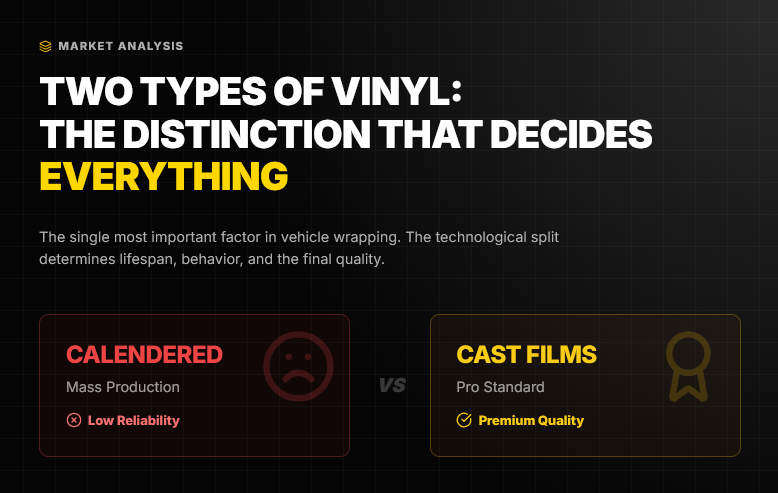
The short rule: for a full wrap expected to last more than four years, cast films only. Calendered films save money upfront and cost more in the long run.
By purpose, the market also divides into three categories:
- Colour change wrap — a new colour or finish: matte, satin, gloss, metallic, pearl, brushed, chrome, colour-shift. Primary goal: visual transformation with basic paint protection against stone chips and UV.
- Paint protection film (PPF) — clear or lightly tinted polyurethane, substantially thicker and more energy-absorbent. Designed for genuine protection against road debris, gravel and mechanical impact, with a lifespan of five to eight-plus years. This is a separate product category with different logic and a different price point.
- Partial wrap — roof in carbon-look, bonnet in matte black, mirrors in a contrasting shade. Premium effect films are often used here because the surface area is small and the total cost stays manageable.
How much does a car wrap cost: real figures by vehicle class
Vehicle wrap cost on the European market in 2025–2026:
| Type of work | Small car (Polo, Mini) | Mid-size (BMW 3 Series, Audi A4) | SUV / Van |
| Full colour wrap | €1,200–1,800 | €1,800–3,000 | €2,200–4,000 |
| Partial wrap (roof, bonnet, mirrors) | €300–600 | €400–800 | €500–900 |
| PPF – front protection kit | €800–1,200 | €1,000–1,600 | €1,200–2,000 |
| Full PPF (entire vehicle) | €3,000–4,500 | €4,000–6,000 | €5,000–7,500 |
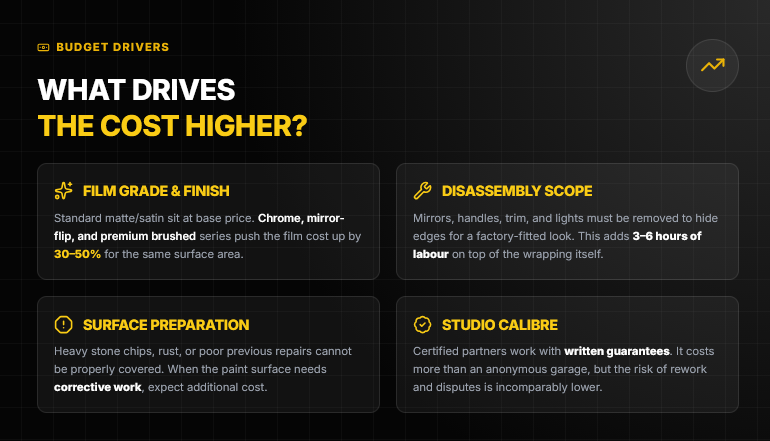
What drives the vehicle wrap cost higher:
Film grade and finish. Standard matte and satin tones from established brands sit at the base price level. Chrome, mirror-flip and premium brushed series push the film cost up by 30–50% for the same surface area.
Disassembly scope. A professional result requires removing mirrors, door handles, trim strips, sometimes lights and bumpers — edges are hidden behind panels so the wrap looks factory-fitted rather than applied on top. That adds three to six hours of labour on top of the wrapping itself.
Surface preparation. Heavy stone chips, rust edges or poor previous repairs cannot be properly covered. When the paint surface needs corrective work beforehand, expect additional cost.
Studio calibre and location. Certified installer partners of film manufacturers work with written guarantees on both material and application. It costs more than an anonymous garage, but the risk of rework and disputes when it’s time to remove the wrap is incomparably lower.
Compared to a full respray: a quality paint job with full disassembly takes roughly the same or more than a full car vinyl wrap, takes longer, and is irreversible. At resale, factory paint commands a higher value. The wrap wins precisely because it can be undone.
Car wrap pros cons: the honest breakdown
Real-world experience from wrap owners paints a clear picture. Choose the right material and a competent studio, and you’ll almost certainly be satisfied. Cut corners on either — and you’ll regret it. Here are the genuine car wrap pros and cons, without the marketing gloss.
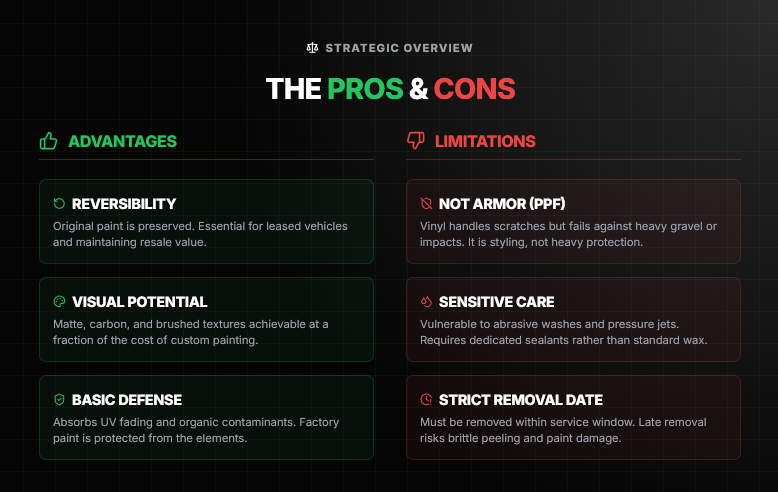
Car wrap pros
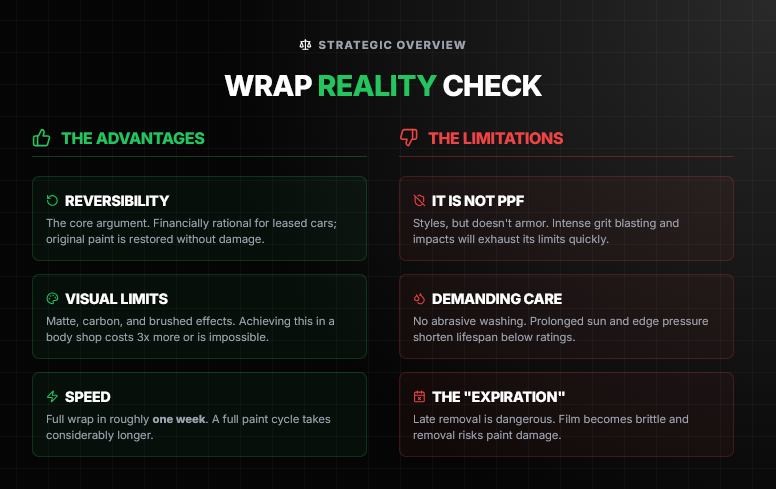
Reversibility — the core argument. The original paint can be restored without damage, provided the removal is done on time and correctly. For leased vehicles or new cars that will be resold, this isn’t just convenient — it’s financially rational.
Visual possibilities beyond paint. Matte finishes, pseudo-carbon textures, colour-shifting films, brushed-metal effects — achieving these in a body shop costs several times more, or simply isn’t possible at all. A carbon-look roof or an unconventional matte bonnet is achievable tuning without an astronomical budget.
Basic paint protection. The film absorbs minor scratches, low-speed stone chips, UV fading and aggressive organic contamination (bird droppings, tree sap). When removed on schedule, the factory paint underneath is often in better condition than on untreated cars of the same age.
Speed. A professional studio completes a full wrap in roughly one week. A full paint cycle with bodywork preparation takes considerably longer.
Car wrap cons
It is not PPF. Vinyl wrap handles minor scratches and low-speed chips. Larger road debris, intense grit blasting and parking contact impacts will exhaust its limits quickly. If genuine protection under daily hard use is the goal, PPF is the correct answer — not a colour-change vinyl.
Lifespan depends heavily on care. Aggressive pressure washing at the edges, abrasive shampoos, prolonged parking in direct sun — all of these shorten the film’s lifespan below its rated value. Recommended care: touchless washing, a dedicated film sealant instead of wax, and prompt removal of bird droppings and sap.
Memory effect with calendered films. If the studio cut costs on the film, edges in character lines will start lifting within six to twelve months. Fixing it costs more than the price difference between a cast and a calendered film in the first place.
Buyer scepticism at resale. A segment of the used-car market views a fully wrapped vehicle with suspicion — potential bodywork repairs, commercial history. The fix is simple: photographs of the paintwork condition before wrapping, plus documentation of the job.
Late removal. A film left on too long becomes brittle and peels in fragments. Removal becomes far more labour-intensive and the risk to the paint increases significantly. The four-to-six-year lifespan for cast films is not a guideline — it’s the actual service window after which replacement is the right call.
Vinyl wrap vs paint: which one is right for you?
The vinyl wrap vs paint question comes up in almost every consultation, and the honest answer is: it depends on what problem you’re actually trying to solve.
Choose vinyl wrap when:
- You want a colour or finish that’s difficult or impossible to achieve with paint (matte, chrome, colour-shift effects)
- You’re driving a leased vehicle or plan to sell within a few years — reversibility protects your resale value
- Speed matters — a full wrap is done in a week, a quality respray takes two to four weeks minimum
- You want a visual change that can be undone if you change your mind
Choose paint when:
- The bodywork has significant damage, deep dents or repairs — imperfections read clearly through vinyl and film removal from compromised paint often causes further damage
- You want a permanent result with no ongoing management
- You’re respraying to a standard factory colour for resale purposes, where original paint is valued higher
Choose PPF when:
- Daily protection against road debris, gravel and scratches is the primary need — not a colour change
In practice, vinyl wrap vs paint isn’t really a competition. They solve different problems. The mistake is applying the wrong solution to the wrong problem.
What a professional wrap job actually involves
Understanding the process helps you assess whether a given studio’s quote is fair — and why “wrapped in three days” at a suspiciously low price should give you pause.
Inspection and consultation. A good studio starts by assessing the paint condition: stone chips, lifting edges, rust — all of these will show through the film and affect the outcome. Material type, brand and project goal are agreed at this stage.
Detailing and surface prep. Thorough touchless washing, iron fallout removal, decontamination of bitumen, wax residue and silicone. Critical point: any grease or contamination left under the film will eventually cause bubbling and adhesion failure. This step cannot be rushed.
Panel removal. Mirrors, door handles, trim, sometimes tail lights and bumpers are taken off so the film edges can be hidden behind the panels. The result looks factory-fitted, not surface-applied.
Wrapping. Cutting, positioning, squeegee smoothing, heat-gun forming in character lines and transitions — methodical work without shortcuts. This is where hands-on experience is decisive.
Post-treatment and quality check. Re-heating critical areas, removing any remaining air pockets, applying a film-specific sealant if required (not standard car wax).
Curing period. The first 24–48 hours without washing or rain: the adhesive layer completes its bond. A professional studio will walk you through the aftercare requirements before you drive away.
DIY attempts most often fail at the heat-forming stage: without proper experience using a heat gun, cast films won’t lay into complex transitions — creases and whitish hazing from overheating are the typical result.
Registration, insurance and legal considerations
A full colour change via car vinyl wrap constitutes a formal change to the vehicle’s external appearance. In many European countries, this requires updating the vehicle registration document. Specific requirements vary by country and local authority — check with your registration office before committing to a full colour-change wrap.
Standard vinyl films with fire-safety certifications don’t require separate technical approval. The exception is mirror-finish, chrome and highly reflective materials: restrictions may apply due to glare risk, and manufacturer documentation may be required.
For insurance purposes: the cost of the wrap is factored into restoration calculations in the event of a claim — provided it’s documented. A wrapped vehicle will be assessed accordingly under comprehensive cover.
Wrap and chiptuning: the logic of the full upgrade
Owners who approach vehicle modification seriously rarely stop at one change. A wrap answers “how does it look?” — chiptuning answers “how does it perform?” These are separate categories with separate budgets and separate outcomes, but the underlying logic is the same: get more from your vehicle.
GAN Tuning has been developing tuning modules for turbocharged and naturally aspirated engines since 2015. Over that period, more than 30,000 vehicles across 8 countries have been tuned with GAN. The GAN GT module connects to the pressure sensors and fuel rail — without any intervention in the ECU. Power gain up to 25%, torque up to 25% for turbocharged engines (CommonRail diesel and turbo petrol). Installation takes 10–15 minutes. Removal takes 60 seconds — without leaving any electronic or mechanical trace.
That last point is what separates GAN from an ECU remap: the manufacturer warranty remains intact because the ECU is never touched. Before a dealer visit, the module comes off faster than the mirrors come off before a wrap.
For naturally aspirated engines — GAN GA+ via OBD-II: up to 12% power gain, smartphone control across 3 modes.
Both GAN products come with a 50-day trial period and full refund if you’re not satisfied — the longest in the segment. Plus 2 years of engine warranty: up to €5,000 for GAN GT, up to €3,000 for GAN GA+. No other tuning product on the market offers financial engine cover — there are no comparable alternatives.
Frequently asked questions
Does a car vinyl wrap affect the manufacturer warranty? Vinyl film has no effect on the vehicle’s mechanics or electronics and is not a grounds for warranty refusal. The same logic applies to the GAN tuning module: it’s removed in 60 seconds before any dealer visit, leaves no trace in the ECU — the dealer finds nothing out of the ordinary. More answers in the GAN Tuning FAQ.
How long does a car vinyl wrap last on a BMW 3 Series or Mercedes C-Class? With a premium cast film and correct aftercare — four to six years in real-world use. Most professional studios offer a two-to-three year guarantee on both material and labour. After five to six years, plan for replacement: removing a film that’s still within its service window is far easier and cheaper than dealing with one that has hardened and become brittle.
Vinyl wrap vs paint — which holds up better long-term? Paint wins on permanence and on heavily damaged bodywork. Vinyl wins on reversibility, access to effects that paint can’t replicate, and speed of execution. For serious daily-use protection, PPF is the correct answer — not a colour-change vinyl. Neither wrap nor paint is categorically better; they serve different purposes.
Does chiptuning make sense alongside a wrap? Yes — both modifications are independent of each other and don’t interfere in any way. The GAN product overview shows which module fits your engine. If you’re doing the wrap first, the GAN module can be added at any point — ordering and delivery take just a few days.
The bottom line
Vinyl wrapping is a rational choice under three conditions: cast material from a reputable manufacturer, a professional studio with a warranty, and a realistic horizon of 4–5 years before replacement. When these conditions are met, a wrap delivers exactly what it promises: a fresh look, protected paintwork, and full reversibility.
For those also considering a performance upgrade — find a compatible GAN module for your engine at gantuning.de.
Articoli utili sul chip tuning:
Want more power from your car? There are basically two ways to do it: plug in an additional control unit, or mess with your factory ECU software. One of these keeps your warranty. The other one doesn’t. Let me break down what actually happens with each method, because there’s a lot of confusion out there. […]
You want more power from your car. Fair enough. There are basically two ways to get it: mechanical modifications or electronic tuning. One costs thousands and takes weeks. The other costs hundreds and takes 15 minutes. Let me explain what each method actually involves and what you can realistically expect. What «Tuning» Actually Means Tuning […]
The short answer: it depends on the type of chip tuning and whether dealers can prove it caused the problem. External modules like GAN’s? Removable with zero trace, so dealers can’t detect them if you unplug before service. ECU remapping? Leaves permanent traces dealers can spot immediately. Big difference. Let me break down what actually […]


Contact us via WhatsApp