


You want more power from your car. Fair enough. There are basically two ways to get it: mechanical modifications or electronic tuning. One costs thousands and takes weeks. The other costs hundreds and takes 15 minutes.
Let me explain what each method actually involves and what you can realistically expect.
What «Tuning» Actually Means
Tuning just means modifying your car to improve performance or appearance. Could be suspension upgrades for better handling, brake upgrades for better stopping, body modifications for looks, or engine modifications for more power.
Engine tuning is what most people mean when they talk about tuning. It’s modifying the engine to produce more power output than it did from the factory.
Modern engines are controlled by the ECU – a computer that manages fuel injection, ignition timing, boost pressure (if turbocharged), and dozens of other parameters. Change what the ECU does, and you change how the engine performs.
Mechanical Engine Modifications (The Expensive Way)
Traditional engine tuning involves physically changing engine components to increase displacement or improve airflow.
- Common mechanical modifications:
Boring and stroking – increasing cylinder diameter and piston stroke to increase displacement. A 2.0L engine becomes 2.2L, producing proportionally more power. Cost: €3,000-8,000 depending on complexity.
Forced induction – adding a turbocharger or supercharger to naturally aspirated engines. Compresses intake air to force more oxygen into cylinders. Cost: €4,000-10,000+ for quality kits with proper tuning.
Camshaft upgrades – changing valve timing to improve airflow at specific RPM ranges. Usually increases high-RPM power at the expense of low-RPM torque. Cost: €1,500-4,000 including installation.
Intake and exhaust modifications – larger throttle body, less restrictive air filter, free-flowing exhaust. Improves airflow but gains are modest (5-10% typical). Cost: €800-2,500.
Head porting and polishing – reshaping intake and exhaust ports for better flow. Labor-intensive, requires engine disassembly. Cost: €2,000-5,000.
- Reality check on mechanical modifications:
Big power gains require combining multiple modifications. Just adding an exhaust won’t do much. You need exhaust + intake + camshaft + ECU tuning to see meaningful results, which means €5,000+ investment.
Reliability decreases. You’re putting more stress on components that weren’t designed for higher power levels. Expect shorter engine lifespan and more frequent maintenance.
Resale value often decreases. Most buyers don’t want a heavily modified engine with unknown reliability.
Warranty completely void. Dealers won’t touch anything powertrain-related once they see modifications.
Makes sense for: dedicated track cars, project builds where cost isn’t the primary concern, or specific applications requiring power levels that can’t be achieved through tuning alone.

Electronic Engine Tuning (The Efficient Way)
Modern engines produce way less power than their hardware can handle. Manufacturers deliberately program conservative limits into the ECU for various reasons – global market compatibility, warranty cost reduction, emissions compliance, and model differentiation.
Example of manufacturer detuning:
VW’s 2.0 TDI diesel appears in multiple models with power outputs ranging from 115 HP to 190 HP. Same physical engine, same turbocharger, same fuel injectors. The only difference is ECU programming. They’re using software to create an entire model lineup from one engine design.
Electronic tuning unlocks this artificially restricted performance by changing ECU parameters – either by reprogramming the ECU software (ECU remapping) or by using an external module that modifies sensor signals (chip tuning).
Two approaches to electronic tuning:
ECU Remapping (OBD Tuning)
Connect to the ECU via diagnostic port, extract the factory software, modify calibration parameters on a computer, write the modified software back to the ECU.
- What gets changed:
Fuel maps, ignition timing maps, boost pressure limits, torque limiters, speed limiters. Basically complete control over how the engine operates. - Advantages:
Maximum possible power gains (can remove hard limits that external modules can’t bypass), can optimize for heavily modified engines, can remove speed limiters. - Disadvantages:
Voids warranty immediately – dealers can easily detect modified software in ECU logs. Permanent modification unless you pay for reflashing again (€300-500). Risk of ECU damage during flashing process (€800-2,000 ECU replacement if it goes wrong). Often disables safety systems to maximize power. - Cost: €400-1,000 typically, more for specialized tuners or rare vehicles.
- Makes sense for: heavily modified engines that need custom tuning, competition vehicles where warranty doesn’t matter, or situations where maximum possible power is the only goal.
External Chip Tuning Modules
Install a separate device between engine sensors and the factory ECU. Module intercepts sensor signals, modifies them based on programmed algorithms, sends altered signals to the ECU.
- How it works (example with turbo engines):
Boost sensor reads 1.5 bar. Module changes signal to 1.3 bar before sending to ECU. ECU thinks boost is low, requests more. Actual boost climbs to 1.8 bar. More air allows burning more fuel, producing more power. - Advantages:
Factory ECU and software completely unmodified. All manufacturer safety systems stay active. Totally removable – unplug and car returns to stock instantly with zero trace. Warranty preserved if removed before service. Multiple power modes adjustable via smartphone app. No risk of ECU damage during installation. - Disadvantages:
Slightly lower maximum power than ECU remapping (typically 2-3% less at the absolute top end). Can’t remove hard ECU limits like speed limiters. Limited effectiveness on heavily modified engines. - Cost: €300-800 typically for quality modules like GAN.
- Makes sense for: street-driven cars under warranty, drivers wanting reversible modifications, anyone concerned about preserving safety systems, or people who want adjustable power levels.
Realistic Power Gains by Method
Let me give you actual numbers from GAN’s testing on over 30,000 vehicles since 2015, because marketing materials always exaggerate.
| Engine Type | Chip Tuning Module | ECU Remapping | Mechanical Mods |
| Turbocharged gasoline | +20-30% | +22-32% | +40-100%+ |
| Turbocharged diesel | +25-30% | +27-33% | +40-100%+ |
| Naturally aspirated | +10-12% | +11-13% | +15-50%+ |
- Why turbocharged engines gain more:
Factory turbochargers typically have significant headroom. A turbo rated for 2.0 bar might be limited to 1.4 bar by software. Tuning removes this artificial restriction. Naturally aspirated engines are limited by atmospheric pressure – you can’t force more air in without adding forced induction. - Why mechanical mods have huge ranges:
A basic intake + exhaust might give 10% gains. Adding a turbocharger to a naturally aspirated engine could double the power. The range depends on how much money you spend and how far you’re willing to go.
What Makes Sense for Most People
If you’re driving a turbocharged street car under warranty and want 20-30% more power, chip tuning with an external module gives you 95% of the maximum possible gains with none of the permanent consequences.
- Cost: €400-600 typically
- Installation time: 15 minutes
- Reversibility: instant
- Warranty impact: preserved if removed before service
- Safety: factory systems stay active
If you’re building a dedicated track car or heavily modified street car, ECU remapping gives you the control needed to tune for upgraded components.
- Cost: €500-1,000 for initial tune, €300-500 for revisions
- Installation time: 1-3 hours
- Reversibility: requires paid reflash
- Warranty impact: completely void
- Safety: depends on tuner quality
If you want power levels that exceed what tuning alone can achieve, mechanical modifications are necessary.
- Cost: €5,000-20,000+ for significant gains
- Installation time: days to weeks
- Reversibility: basically none (you’re not uninstalling a turbo kit)
- Warranty impact: completely void
- Safety: significantly reduced reliability expected
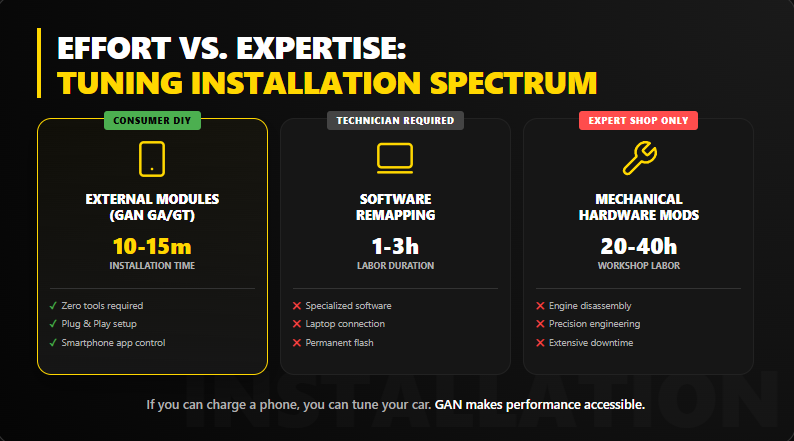
Installation Reality Check
- External modules (GAN example):
Connect via OBD-II port or directly to specific sensors. Takes 10-15 minutes with zero tools required. Instructions included, smartphone app provides guidance. If you can plug in a phone charger, you can install a tuning module. - ECU remapping:
Technician connects laptop to OBD port, runs tuning software, reflashes ECU. Takes 1-3 hours depending on vehicle. Requires specialized equipment and software. Not a DIY job unless you’re experienced. - Mechanical modifications:
Requires engine disassembly, specialized tools, professional installation. Turbo kit installation might take 20-40 hours of labor. Absolutely not DIY unless you have serious mechanical experience and equipment.
Warranty Reality
- External modules:
Technically preserves warranty because factory ECU is never modified. Remove before service appointments and dealers literally cannot detect anything in diagnostic logs. No software changes, no traces.
Reality from GAN’s experience: most warranty claims get honored if the module isn’t physically installed during inspection.
- ECU remapping:
Immediately voids powertrain warranty. Dealers detect software modifications through diagnostic equipment – software version doesn’t match factory specs, calibration dates show recent changes, sometimes specific anti-tuning flags appear.
Reality: dealers will refuse any powertrain-related warranty claim once they see the ECU has been modified.
- Mechanical modifications:
Completely voids entire warranty. Physical modifications are visible during any inspection.
Reality: expect zero warranty coverage for anything after installing mechanical modifications.
What GAN Actually Offers (Without Marketing Hype)
GAN provides external tuning modules tested on 30,000+ vehicles since 2015 across 8 countries.
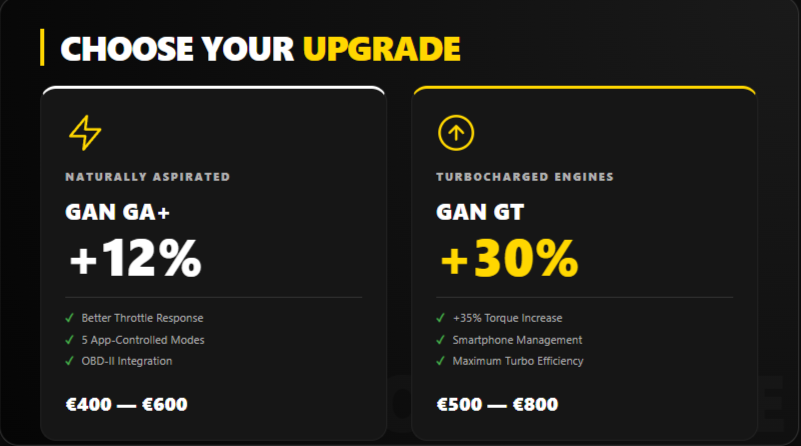
GA+ module (naturally aspirated engines):
Up to 12% power increase, improved throttle response, multiple modes via app. €400-600 typical pricing.
GT module (turbocharged engines):
Up to 30% power increase, up to 35% torque increase, smartphone control with 5 modes. €500-800 typical pricing.
Standard features:
- 50-day trial period with full refund if unsatisfied
- 2-year engine guarantee up to €5,000
- 5 free reprogramming sessions (transfer to different vehicles)
- Complete reversibility in under 2 minutes
- IP67 waterproof military-grade housing
Vehicle requirements:
Year 2000 or newer, fuel-injected engines (naturally aspirated, common-rail diesel, or turbocharged gasoline). Works with automatic and manual transmissions.
The Honest Bottom Line
Most people wanting 20-30% more power from a street car should start with chip tuning using an external module. You get 95% of the maximum possible gains for 20% of the cost of mechanical modifications, with complete reversibility and warranty preservation.
ECU remapping makes sense if you need custom tuning for heavily modified engines or don’t care about warranties.
Mechanical modifications make sense if you need power levels beyond what tuning can achieve (50%+ gains) and accept significantly reduced reliability and resale value.
Don’t believe anyone promising 50% power gains from chip tuning alone – that’s not physically possible on most stock engines. Real gains on turbocharged engines top out around 30%, naturally aspirated around 12%.
Based on testing 30,000+ vehicles, these are realistic numbers you can actually achieve.
Articoli utili sul chip tuning:
Most chip tuning articles are written by companies selling tuning services. They highlight benefits and downplay risks because they want your money. This article is different. I’m going to explain what chip tuning actually does, compare the two main methods honestly, and discuss the real risks to warranties and engine longevity. What you do with […]

Your car’s ECU is basically a small computer that runs your engine. That’s it. Everything else – all the power increases, fuel mapping, sensor reading – flows from that one fact. Understanding what an ECU actually does makes it way easier to understand how chip tuning works and why it’s even possible. So let’s break […]

Turbo-diesel engines respond to chip tuning better than any other engine type. You can see gains up to 30% power and 35% torque – significantly more than naturally aspirated or even turbocharged gasoline engines. Why? The way turbo-diesels work makes them particularly suited for tuning. Let me explain what’s actually happening. Quick History. How Turbo-Diesels […]


Contact us via WhatsApp