


Your car’s ECU is basically a small computer that runs your engine. That’s it. Everything else – all the power increases, fuel mapping, sensor reading – flows from that one fact.
Understanding what an ECU actually does makes it way easier to understand how chip tuning works and why it’s even possible. So let’s break down what’s happening under your hood.
The ECU Is Your Engine’s Computer (Literally)
ECU stands for Electronic Control Unit. Some people call it ECM (Electronic Control Module) or CCM (Central Control Module). Same thing – a microprocessor-based computer that manages engine operation.
The first ECU showed up in 1939 when BMW engineers installed a basic electronic control system. Modern ECUs are obviously way more sophisticated, but the core concept hasn’t changed: read sensor data, make calculations, control engine components.
What your ECU does every second:
- Reads inputs from 20-50+ sensors throughout the engine
- Processes that data using fuel maps (lookup tables) stored in memory
- Sends commands to actuators (fuel injectors, ignition coils, turbo wastegate, etc.)
- Monitors everything for faults and adjusts in real-time
All of this happens thousands of times per second while you’re driving. Your throttle input is just one variable the ECU considers when deciding how much fuel to inject and when to fire the spark plugs.
How the ECU Actually Controls Your Engine
Think of the ECU as constantly answering one question: given current conditions, what should the engine do right now?
Current conditions include: throttle position, engine speed (RPM), intake air temperature, coolant temperature, boost pressure (turbocharged cars), oxygen sensor readings, knock sensor readings, vehicle speed, gear position, and about 30 other variables depending on your car.
The ECU takes all those inputs, looks them up in its fuel maps – which are basically massive tables saying «at X RPM and Y throttle position with Z air temperature, inject this much fuel» – and outputs commands to make it happen.
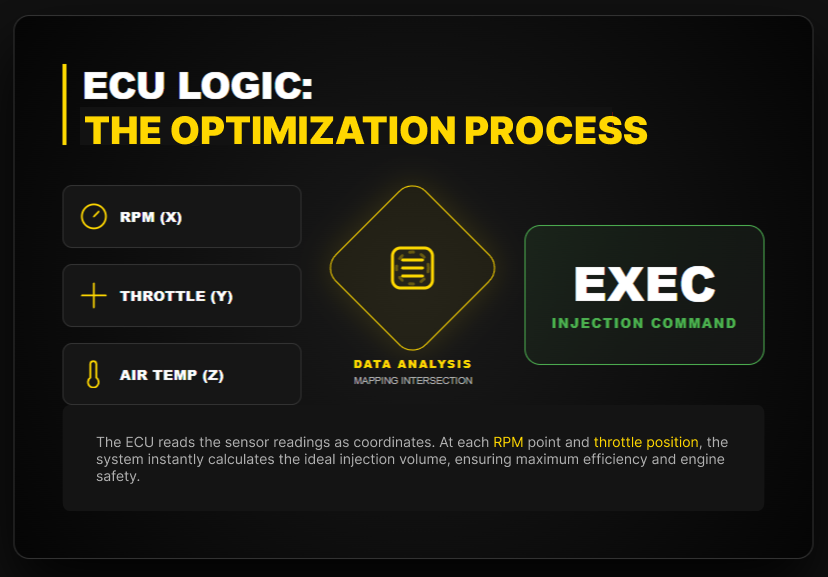
- Example of ECU decision-making:
You’re cruising at 2000 RPM, coolant at 90°C, and you push the throttle 30% open. The ECU reads: throttle position sensor (30%), MAF sensor (15 g/s of air flowing), coolant temp (90°C), RPM (2000). It looks up the fuel map for those conditions and calculates: inject 8.5 milliseconds of fuel per cylinder, fire spark plugs 12 degrees before top dead center. Engine produces smooth acceleration.
Now you floor it. Throttle sensor jumps to 100%, air flow spikes to 60 g/s, turbo boost climbs to 1.5 bar. ECU recalculates: inject 22 milliseconds of fuel, advance timing to 8 degrees, maximum power output.
This happens continuously as conditions change. The ECU is basically running a real-time simulation of optimal combustion thousands of times per second.
Why Fuel Maps Matter for Chip Tuning
Fuel maps are where manufacturers build in all their safety margins and restrictions. These tables define how aggressive or conservative your engine runs.
A fuel map might say: «At 3000 RPM and full throttle, inject enough fuel for 1.2 bar boost pressure.» But your turbocharger could safely handle 1.6 bar. Manufacturers program conservative limits to protect against bad fuel, extreme temperatures, and drivers who never do maintenance.
That’s the gap chip tuning exploits. The hardware can handle more than the software allows.
| ECU Parameter | Factory Setting | Hardware Capability | Tuning Unlocks |
| Max boost pressure | 1.4 bar | 2.0 bar | 1.7-1.8 bar |
| Fuel injection duration | 18 ms | 25 ms | 22-23 ms |
| Ignition timing advance | 10° BTDC | 15° BTDC | 12-13° BTDC |
| Torque limiter | 350 Nm | 480 Nm | 450 Nm |
These numbers come from GAN’s testing on 30,000+ vehicles. The pattern holds across manufacturers – conservative factory programming leaves significant performance headroom.
Two Ways to Change ECU Behavior
There are two approaches to making the ECU run your engine differently: modify the ECU itself, or modify the signals going into the ECU.
Option 1: ECU remapping (OBD tuning)
Connect to the ECU via the diagnostic port, pull the factory software, modify the fuel maps and parameters, write the new software back. Now the ECU is running different programming.
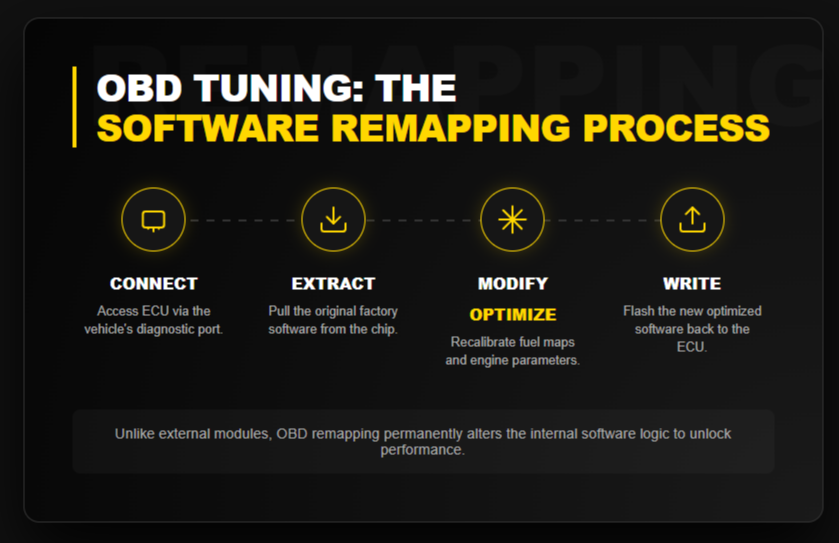
This works, but it’s permanent (until you reflash again), voids warranties because dealers can detect the changes, and often disables safety systems because tuners remove the limits manufacturers programmed in.
Option 2: External control module (chip tuning)
Install a separate device between your sensors and ECU. This module reads sensor signals, modifies them, sends altered data to the ECU. The ECU thinks it’s seeing different conditions and adjusts accordingly.
Your factory ECU and its safety systems stay completely intact. The module is fully removable with zero trace.
- Question: Why don’t manufacturers just program ECUs for maximum power from the factory?
- Answer: Global market requirements. One engine has to work with terrible fuel in developing markets and premium fuel in Europe. It has to survive drivers who never change oil and drivers who maintain perfectly. Manufacturers program for worst-case scenarios, which means conservative limits for everyone. That leaves 20-35% performance headroom in the hardware.
- Question: Can the ECU tell if I’ve installed an external tuning module?
- Answer: No. External modules modify sensor inputs before they reach the ECU. From the ECU’s perspective, it’s just receiving sensor data and responding normally. There’s no trace in ECU memory, no software version change, nothing for dealers to detect when you remove it.
Why External Modules Are Safer Than ECU Reprogramming
When you reprogram the ECU, you’re typically disabling or modifying the safety limits manufacturers spent millions developing. Common changes in ECU remapping: disable torque limiters, remove boost pressure safeties, increase maximum injection duration beyond safe levels, advance ignition timing into knock territory.
These changes extract maximum power but remove the safety net. If something goes wrong – bad fuel, carbon buildup, failing sensor – the ECU won’t protect the engine because you disabled the protection systems.
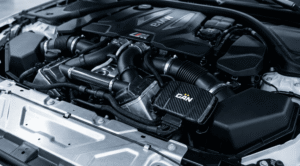
External modules like GAN’s work differently. They request more power by modifying sensor signals, but the factory ECU’s safety systems stay active. If knock sensors detect detonation, the factory ECU still pulls timing. If oil pressure drops, the factory ECU still limits power. All the manufacturer’s protection algorithms keep running.
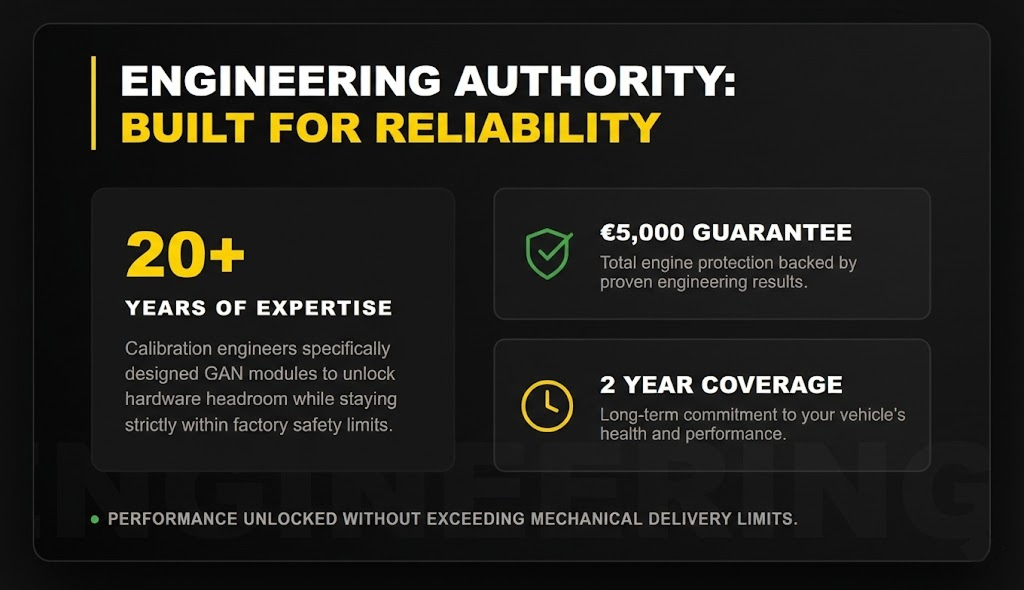
Engineers with over 20 years of calibration experience designed GAN modules specifically to work within factory safety limits while unlocking the performance headroom in the hardware. That’s why they can offer a €5,000 engine guarantee for 2 years – the modules don’t ask for anything the engine can’t safely deliver.
What Happens When You Install a GAN Module
The module connects via your OBD-II port or directly to specific sensors depending on your engine type. Installation takes 10-15 minutes.
- For naturally aspirated engines (GAN GA+):
Module optimizes throttle response and fuel delivery by accessing the ECU’s high-performance maps (which exist in factory programming but are restricted). You get up to 12% more power with improved fuel economy in eco-mode. - For turbocharged engines (GAN GT):
Module modifies boost pressure sensor signals (gasoline) or fuel rail pressure sensors (diesel). ECU thinks pressure is lower than actual, so it requests more boost to compensate. You get up to 30% more power while staying within turbocharger mechanical limits.
Your factory ECU keeps managing everything – coolant temperature, oil pressure, knock detection, emissions controls. Nothing gets disabled. You just get access to performance the manufacturer deliberately restricted.
The module is completely reversible. Unplug it before a dealer visit, plug it back in after. Zero trace in ECU memory. Your warranty stays intact because the factory ECU and its programming never changed.
The Bottom Line on ECUs and Chip Tuning
Your ECU is programmed conservatively to protect against worst-case scenarios most drivers never encounter. The hardware – turbocharger, fuel injectors, engine internals – can handle significantly more than the software allows.
Chip tuning works because it unlocks that headroom without removing the safety systems. External modules are safer than ECU remapping because they keep all factory protections active while requesting more performance.
Understanding what the ECU does makes it obvious why chip tuning is possible and why external modules make more sense than reprogramming for most people.
Articoli utili sul chip tuning:
Think about it. Back in the 1980s, getting more power from your car meant pulling out the ECU, desoldering chips, and hoping you didn’t brick the whole system. Fast forward to 2026, and you’ve got plug-and-play modules adding 30% to turbocharged engines. GAN’s tested this on over 30,000 vehicles since 2015, so we’re not talking […]

The short answer: it depends on the type of chip tuning and whether dealers can prove it caused the problem. External modules like GAN’s? Removable with zero trace, so dealers can’t detect them if you unplug before service. ECU remapping? Leaves permanent traces dealers can spot immediately. Big difference. Let me break down what actually […]
Most chip tuning articles are written by companies selling tuning services. They highlight benefits and downplay risks because they want your money. This article is different. I’m going to explain what chip tuning actually does, compare the two main methods honestly, and discuss the real risks to warranties and engine longevity. What you do with […]


Contact us via WhatsApp