


Turbo-diesel engines respond to chip tuning better than any other engine type. You can see gains up to 30% power and 35% torque – significantly more than naturally aspirated or even turbocharged gasoline engines.
Why? The way turbo-diesels work makes them particularly suited for tuning. Let me explain what’s actually happening.
Quick History. How Turbo-Diesels Became Performance Engines
Rudolf Diesel developed his compression-ignition engine in the 1890s, initially running it on vegetable oils and light petroleum products. Fun fact: he originally wanted to use coal dust as fuel. That didn’t work out.
The real breakthrough came in 1898 when Gustav Trinkler built the first high-pressure diesel engine at the Putilov factory in St. Petersburg. This established the fundamental design we still use today.
Turbochargers entered the picture in 1911 when Alfred Büchi patented the design. Initially used in WWI aircraft to maintain power at high altitude, turbochargers didn’t appear in passenger cars until much later. The first turbo-diesel passenger car was the Oldsmobile Cutlass in the US market.
Why does this history matter? Because turbo-diesel technology is mature and well-understood. Engineers have had over a century to refine how these engines work, which means manufacturers know exactly how much performance headroom exists in the hardware.
How Turbochargers Actually Work
A turbocharger uses exhaust gases to compress intake air. More air in the cylinders = more fuel can burn = more power output.
The process:
Burning fuel creates high-pressure exhaust gases. These gases exit through the turbine side of the turbocharger, spinning the turbine wheel at up to 250,000 RPM. The turbine wheel is connected by a shaft to the compressor wheel. The compressor spins at the same speed, forcing intake air into the engine at higher pressure than atmospheric.
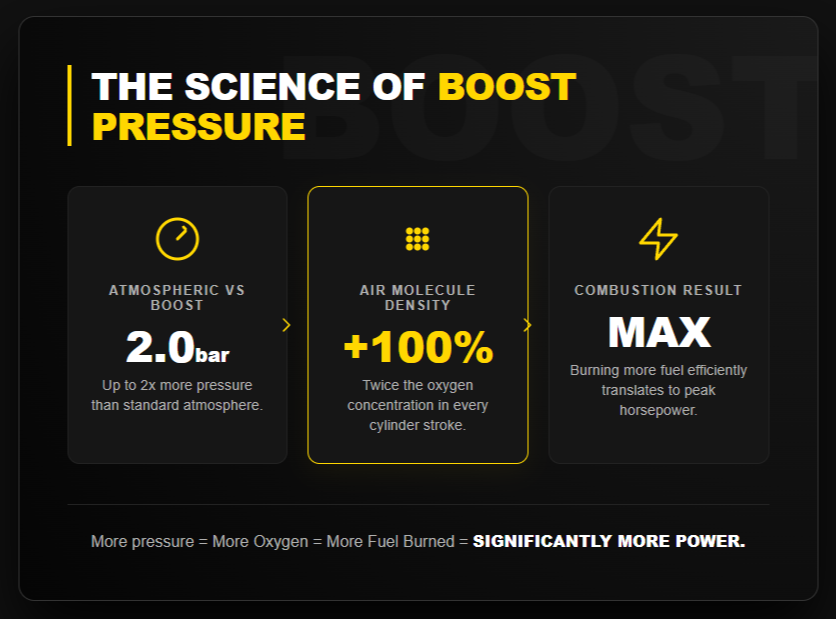
Result: your engine gets maybe 1.5-2.0 bar of air pressure instead of 1.0 bar atmospheric. That’s 50-100% more air molecules in each cylinder, which allows burning 50-100% more fuel, which produces significantly more power.
The problem is heat. Compressing air generates heat (basic thermodynamics), and hot air is less dense than cool air. That’s why most turbocharged engines include an intercooler – a radiator that cools the compressed air before it enters the engine. Cooler, denser air = more oxygen molecules = better combustion.
Why Diesel Engines Are Perfect for Turbocharging
Diesel engines work fundamentally differently than gasoline engines, and these differences make them ideal for both turbocharging and chip tuning.
Diesel advantages for tuning:
Compression ignition means no spark plugs. Diesels ignite fuel purely through compression heat (around 550°C). This means you can run much higher boost pressures without worrying about detonation (knock) that limits gasoline engines.
Lean fuel mixture. Diesels always run with excess air – unlike gasoline engines that need precise air-fuel ratios. You can add more fuel without running rich, as long as you’re adding proportional boost pressure.
Massive low-end torque. Diesel combustion produces peak torque at much lower RPMs than gasoline. Turbocharged diesels often hit maximum torque by 1,500-2,000 RPM. This makes them incredibly responsive to tuning.
Built stronger from the factory. Diesel engines have higher compression ratios (typically 16:1 to 22:1 versus 9:1 to 11:1 for gasoline), so they’re built with stronger internals – forged crankshafts, reinforced pistons, heavier connecting rods. This means they can handle more power without mechanical failure.
| Engine Type | Typical Power Gain | Typical Torque Gain | Why |
| Turbo-diesel | Up to +30% | Up to +35% | High boost headroom, strong internals |
| Turbo gasoline | Up to +30% | Up to +30% | Boost limited by knock, requires timing retard |
| Naturally aspirated | Up to +12% | Up to +15% | No boost to increase, limited by displacemen |
These numbers come from GAN’s testing on over 30,000 vehicles since 2015 across 8 countries.
How GAN GT Works on Turbo-Diesel Engines
GAN GT targets the fuel rail pressure sensor in diesel engines. This sensor tells the ECU how much pressure exists in the fuel system (typically 1,600-2,000 bar in modern common-rail diesels).
The process:
The sensor reads actual fuel rail pressure at, say, 1,800 bar. GAN GT intercepts this signal and modifies it downward to 1,500 bar before sending it to the ECU. The ECU thinks pressure is low, so it commands the high-pressure fuel pump to increase pressure. Actual pressure climbs to 2,000 bar.
Higher fuel pressure means finer fuel atomization and the ability to inject more fuel per stroke. Combined with the turbocharger already providing excess air, this creates more power.
Critical safety point: Factory protection systems stay active. If exhaust gas temperature climbs too high, the factory ECU still limits fuel. If turbo boost exceeds safe levels, the factory wastegate still opens to bleed off pressure. GAN modules work within these safety parameters – they request more performance, but the factory ECU has veto power if conditions become unsafe.
Engineers with over 20 years of calibration experience designed the GAN GT specifically for turbo-diesel engines. The module knows the safe operating limits for fuel pressure, boost pressure, and exhaust gas temperature, and stays within them.
Real-World Performance Gains on Turbo-Diesels
The gains from chip tuning turbo-diesels are substantial and immediately noticeable.
Typical results from GAN GT on common turbo-diesel engines:
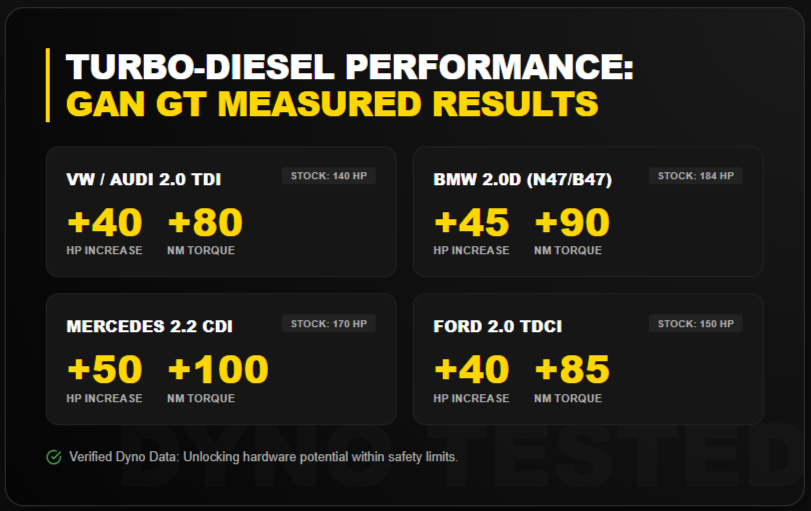
- VW/Audi 2.0 TDI (140 HP stock): +40 HP, +80 Nm torque
- BMW 2.0d (184 HP stock): +45 HP, +90 Nm torque
- Mercedes 2.2 CDI (170 HP stock): +50 HP, +100 Nm torque
- Ford 2.0 TDCi (150 HP stock): +40 HP, +85 Nm torque
These aren’t theoretical numbers – they’re measured on dynamometers with real vehicles.
The torque increase is particularly noticeable in daily driving. Before tuning, you might need to downshift from sixth to fourth gear to pass someone on the highway. After tuning, you can pull away in sixth gear from 1,800 RPM. The extra torque just pulls you forward without dropping gears.
- Question: Why do turbo-diesels gain more than turbocharged gasoline engines?
- Answer: Diesel engines can safely run higher boost pressures without knock (detonation), and they always operate with excess air, so adding fuel doesn’t create a dangerously rich mixture. Gasoline engines are limited by knock – add too much boost and the engine starts destroying itself. Diesels don’t have this limitation because they use compression ignition, not spark ignition.
- Question: Will increased fuel pressure damage my diesel engine’s fuel system?
- Answer: GAN GT stays within the mechanical limits of factory fuel system components. Modern common-rail diesel systems are rated for pressures exceeding 2,200 bar, but manufacturers limit them to 1,600-1,800 bar for longevity. GAN typically increases to 1,900-2,000 bar – well within component specifications. That’s why they can offer a €5,000 engine guarantee for 2 years.
Fuel Economy Benefits Specific to Turbo-Diesels
Turbo-diesels see fuel economy improvements more consistently than gasoline engines when chip tuned, for a specific reason: torque curve optimization.
Stock turbo-diesels often have a narrow torque peak – maximum torque available in a small RPM range, say 1,800-2,500 RPM. Outside this range, torque drops off. This means you’re constantly shifting to keep the engine in its power band.
After tuning, the torque curve flattens and widens. You might have near-maximum torque from 1,500 RPM all the way to 3,500 RPM. This means fewer gear changes, more time at optimal engine speeds, and better overall efficiency.
Real fuel economy data from GAN testing:
Highway driving (constant speed): 10-15% improvement
Mixed city/highway: 8-12% improvement
City driving (conservative): 5-8% improvement
Aggressive driving: 0-5% improvement
The improvement comes from staying in higher gears at lower RPMs while still having adequate power for acceleration. Less time at high RPM = less fuel consumption.
Commercial diesel operators (vans, trucks) running highway routes see the biggest benefits. Fleet testing shows some vehicles saving 10+ liters per 100 km over thousands of kilometers, which adds up significantly.
Installation and Reversibility
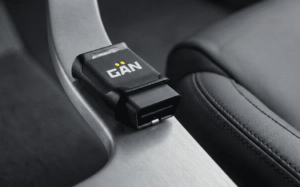
GAN GT connects either via the OBD-II port or directly to the fuel pressure sensor, depending on your specific vehicle. Installation takes 10-15 minutes with basic tools.
The module is completely reversible. Unplug it and the factory ECU returns to stock behavior immediately. No software changes, no permanent modifications, zero trace in ECU memory.
This reversibility is crucial for diesel owners who use their vehicles commercially or under warranty. Remove the module before service appointments, reinstall after. The dealer cannot detect anything in the ECU’s diagnostic logs.
Compare this to ECU remapping, which permanently modifies the factory software and leaves traces that dealers can easily identify during diagnostics.
Why Manufacturers Limit Turbo-Diesel Performance
If turbo-diesels can safely handle 30% more power, why don’t manufacturers tune them that way from the factory?
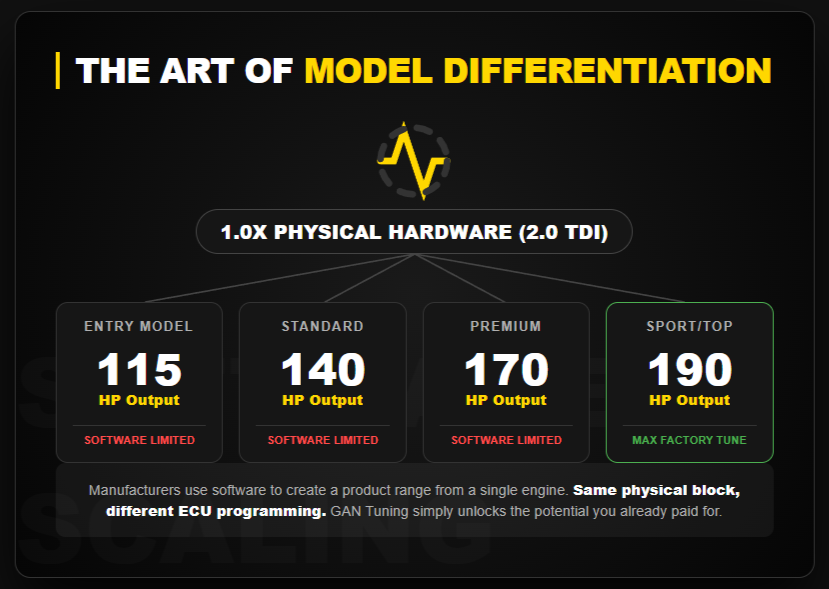
Model differentiation. The same 2.0 TDI engine appears in VW, Audi, Skoda, and SEAT models with power outputs ranging from 115 HP to 190 HP. It’s the exact same physical engine – just different ECU programming. Manufacturers use software to create entire model lineups.
Global market requirements. One engine has to work in countries with terrible diesel quality and also in markets with ultra-low sulfur diesel. Conservative tuning ensures reliability everywhere.
Emissions regulations. Higher power often means slightly higher NOx emissions. Manufacturers tune conservatively to meet emissions standards with margin for variability.
Warranty costs. Program the engine to maximum power and you’ll see more warranty claims from drivers who abuse it. Conservative tuning reduces warranty expenses.
All these factors mean manufacturers typically use 70-75% of the hardware’s capability. The remaining 25-30% is performance headroom that chip tuning unlocks.
The Bottom Line on Turbo-Diesel Chip Tuning
Turbo-diesel engines are the best candidates for chip tuning because:
- They have the most performance headroom built into the hardware
- Compression ignition allows higher boost without knock concerns
- Strong factory internals handle increased power safely
- Fuel economy typically improves rather than worsens
- Torque gains make daily driving noticeably better
GAN GT tested on 30,000+ vehicles shows consistent, reliable performance gains without compromising engine longevity. The €5,000 engine guarantee backs this up – they wouldn’t offer it if turbo-diesels couldn’t safely handle the power increase.
If you’re driving a turbo-diesel and want more performance, chip tuning delivers better results than any other modification you could make.
Articoli utili sul chip tuning:

The short answer: it depends on the type of chip tuning and whether dealers can prove it caused the problem. External modules like GAN’s? Removable with zero trace, so dealers can’t detect them if you unplug before service. ECU remapping? Leaves permanent traces dealers can spot immediately. Big difference. Let me break down what actually […]
You want more power from your car. Fair enough. There are basically two ways to get it: mechanical modifications or electronic tuning. One costs thousands and takes weeks. The other costs hundreds and takes 15 minutes. Let me explain what each method actually involves and what you can realistically expect. What «Tuning» Actually Means Tuning […]
Naturally aspirated engines gain less from chip tuning than turbocharged engines. That’s just physics. You’ll see around 10-12% power increase, maybe 15% torque increase at best. But that 10-12% is still worth having. Let me explain what’s actually possible with naturally aspirated engines and why the gains are limited compared to turbocharged motors. What Makes […]


Contact us via WhatsApp