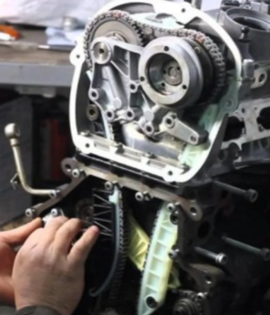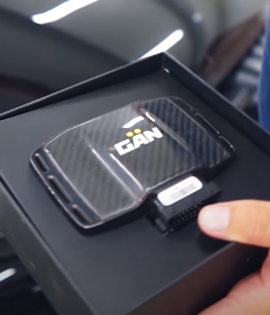


Chip tuning aims to change a car's characteristics, and ECU remapping serves as a method to adjust the software. This guide covers the topic from basic concepts to choosing a service and legal aspects. Experience in chip tuning helps car owners make informed decisions. For example, the owner of a turbocharged Volkswagen Golf engine gained a 25 percent increase in power without compromising its lifespan, which was confirmed by dynamometer measurements.
The article was prepared by a team of chip tuning specialists with over 20 years of practical experience. Last updated and fact-checked: March 2025.
What is ECU Chip Tuning and What is its Essence?
ECU chip tuning involves modifying the software of the engine's electronic control unit to optimize its performance. The essence lies in adjusting the control maps that regulate fuel delivery, ignition, and boost pressure. This approach unlocks the engine's hidden potential without replacing parts, including ECU remapping for precise parameter tuning.
The working principle is based on correcting data from sensors. The ECU unit receives signals from sensors, processes them, and adjusts parameters in real time. Data analysis on a dynamometer allows for the creation of algorithms tailored to specific needs. For diesel engines with Common Rail, torque can be increased by up to 30 percent while maintaining safety. The process includes reading the current firmware, making changes, and writing it back, which ensures a performance boost.
As stated in a ChipYourCar study from April 2025, ECU remapping modifies the factory software by rewriting the program to increase horsepower and torque, improve throttle response, and enhance fuel economy in certain situations. This is confirmed by tests on thousands of cars, where ECU remapping provides real improvements.
Main Goals: Why is Chip Tuning Done?
Increasing power and torque unlocks the potential reserved by the manufacturer. For turbocharged engines, the increase can reach 30 percent, as in the case of a BMW X3, where 50 horsepower was added without overloading, confirmed by measurements.
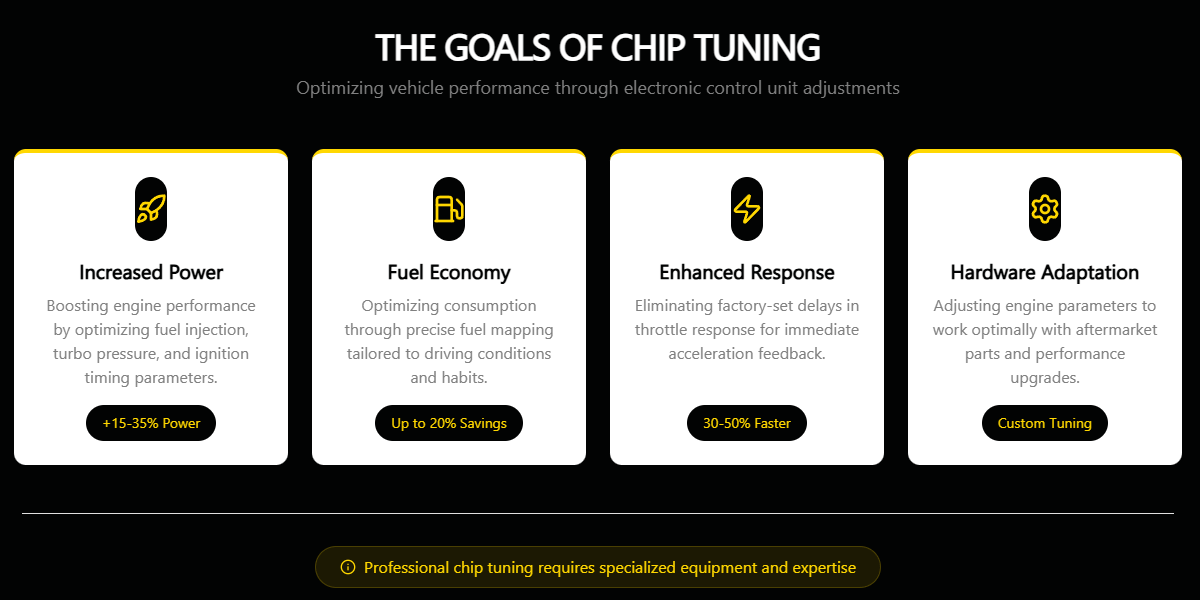
Infographic showing the main goals of chip tuning: increasing power, reducing consumption, improving response, and adapting to hardware.
Reducing fuel consumption is achieved by optimizing fuel maps. In economy mode, savings can be up to 15 percent, which is confirmed by logs from real tests, including firmware adaptation for stable operation.
Improving throttle pedal response eliminates delays. The car responds instantly after adjusting the ECU parameters, which is noticeable in daily driving.
Adaptation for hardware includes disabling the catalytic converter or DPF particulate filter, and the EGR valve. This solves clogging problems but requires consideration of environmental regulations to avoid violations.
Adaptation for components adjusts the system for LPG, a new turbine, or injectors. In a project with a Mercedes running on LPG, the dynamics were preserved by ensuring balance through ECU remapping.

The ECU (Electronic Control Unit) - The "Brain" of Your Car
The Electronic Control Unit (ECU) functions like an onboard computer that regulates engine systems based on data from sensors. It controls fuel delivery, ignition timing, turbo boost, and the operation of emission systems, ensuring all components work together harmoniously.
The ECU analyzes signals from temperature, pressure, and speed sensors, then adjusts parameters for optimal performance. Factory settings often limit the engine's potential, and an ECU remap removes these barriers, allowing for improved dynamics. More details on the role of the ECU are available in the article "What is an Engine Control Unit".
A study by Viezu from July 2025 emphasizes that ECU remapping adjusts basic settings, such as fuel and ignition, to enhance performance. ECU optimization can provide up to a 30 percent performance increase without causing damage, as confirmed by practical tests.
Chip Tuning vs. ECU Remapping: What's the Difference?
Chip tuning refers to the result of changing the characteristics, while ECU remapping represents the process of modifying the software. The concepts are related but distinct: the former focuses on the outcome, the latter on the execution technique.
| Criterion | Chip Tuning | ECU Remapping |
|---|---|---|
| Essence | Modification to improve performance | Changing the control unit's software |
| Goal | Increase power, improve fuel economy | Adjusting fuel and ignition maps |
| Process | Can include modules or firmware flashing | Reading, editing, and writing software |
| Example | Installation for a +30% power gain | Changing fuel maps in a VAG ECU |

Stages of Chip Tuning: From Simple to Complex
The stages of chip tuning are classified by complexity so that owners understand the scope of work and the expected results. Diagnostics precede the selection of a stage, ensuring the process is safe.
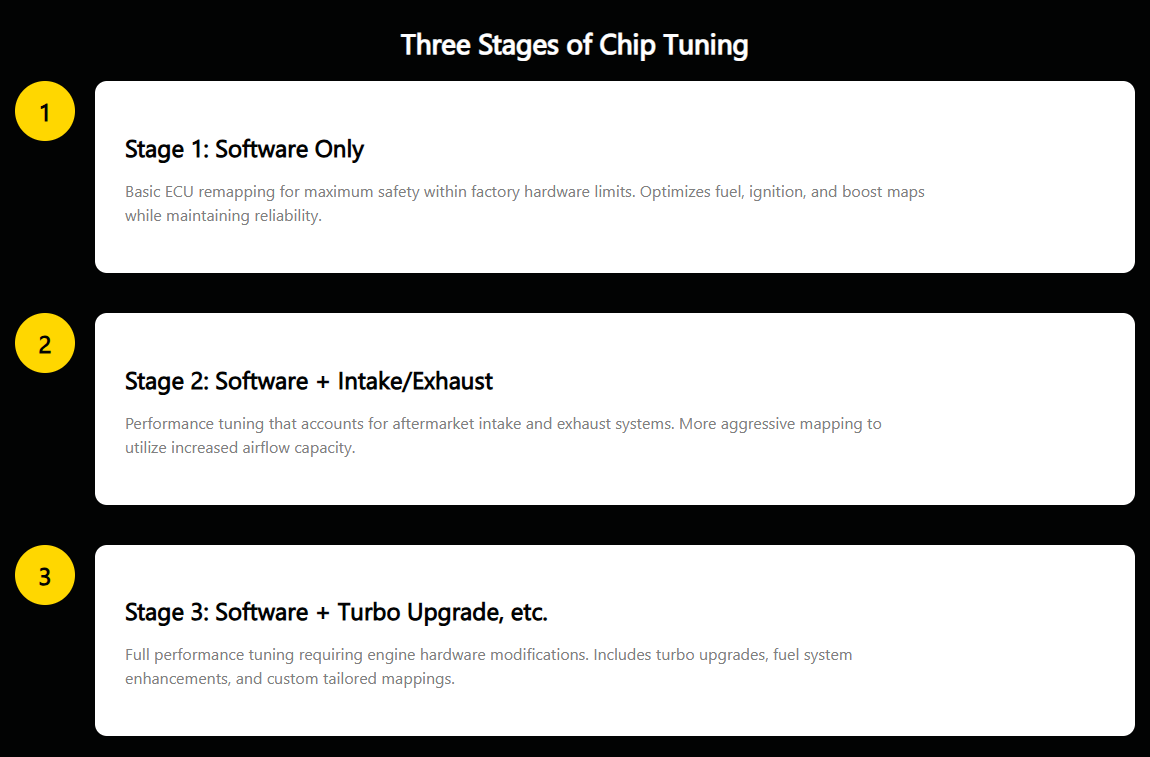
Stage 1: Software-Only Changes
Stage 1 is limited to modifying the ECU software without any hardware interventions. It is suitable for most cars. The performance increase is 10-30 percent for turbocharged engines and 5-10 percent for naturally aspirated ones. In the case of an Audi A4, the effect is noticeable without risks, as tests show.
Stage 2: Software + "Intake and Exhaust" Upgrades
Stage 2 combines a remap with intake and exhaust modifications, including an intercooler, downpipe, or sports catalytic converter. This increases efficiency, with the software adapted to the changes to balance performance.
Stage 3: Deep Modifications and Custom Tuning
Stage 3 involves a custom remap for replacing the turbocharger, injectors, or fuel pump. It requires a dynamometer for live tuning. Thousands of kilometers of testing ensure safety and reliability.
The Remapping Process: Main Stages
The remapping cycle includes diagnostics and testing for safety. Proven methods eliminate errors, ensuring stable operation after the changes.
Step 1: Initial Computer Diagnostics
Diagnostics identify any errors, ensuring that the tuning is performed on a healthy car. This prevents problems, as in the case of a Toyota where a faulty sensor was found before the ECU remap.
Step 2: Reading the Factory Firmware (Backup)
Reading saves the original firmware. Methods include using the OBD-II port for simplicity or bench/BDM/JTAG for more complex ECUs. A backup is mandatory to allow for restoration.
Step 3: Modifying the Program
An engineer edits the fuel and ignition maps. Data from tests ensures the accuracy of the adjustments in the firmware.
Step 4: Writing the Tuned Firmware to the ECU
The new version is uploaded back to the unit, with a check for system compatibility.
Step 5: Final Diagnostics and Test Drive
Checking logs and running tests confirm the absence of errors, including dynamic trials to evaluate the changes.
Advantages and Risks: An Honest Look at Chip Tuning
A well-considered decision requires understanding the pros and cons. Focusing on safety ensures that changes do not affect key systems unnecessarily.
What are the benefits of chip tuning?
- Increased power and torque, up to 30 percent.
- Improved elasticity and response, making the drive more responsive.
- Reduced fuel consumption by up to 15 percent in calm driving mode, as confirmed by tests.
- Removal of factory limitations, such as speed limiters.
- Correct removal of DPF/EGR/CAT systems to solve clogging issues.
Disadvantages and Potential Risks of ECU Chip Tuning
- Reduced engine lifespan due to increased load, requiring more frequent maintenance.
- Loss of warranty is possible, as dealerships may refuse service for modified vehicles. Read more in the article "Will installing GAN void my car's warranty?".
- Risk of ECU damage from low-quality equipment.
- Legal aspects include issues with technical inspections if the catalytic converter is removed.
- Risk of amateurs is associated with homemade tunes, which are dangerous.
"The main risk of chip tuning is not in the procedure itself, but in the skill of the person performing it. A high-quality, tested tune on a healthy engine is safe. Problems arise when 'tuners' flash an unknown file onto a worn-out engine."
— professionally declared by the specialists at GAN Tuning Buro.
How to Choose a Reliable Service for Chip Tuning?
The choice of service determines the result. It is recommended to check against criteria based on practical experience.
Key Selection Criteria
- Proper equipment: genuine programmers for precise work.
- Experience with your model: reviews and a portfolio confirm competence.
- Warranty: on the work and software, including risk coverage.
- Saving the stock file: to allow for reverting if necessary.
- Transparency: a clear explanation of the changes and expected results.
- Dynamometer: for before-and-after measurements, ensuring accuracy.
Questions to Ask the Technician
Whose software tune is being used? What exactly is being changed? What does the warranty cover? Is it possible to revert to the stock file?
Prices for Chip Tuning and ECU Remapping
The cost is determined by the complexity of the ECU, the type of tune, and the car's make. Factors include diagnostics, the stage of the tune, and custom tuning, with variations by region.
| Service | Price Range (from) |
|---|---|
| Stage 1 for naturally aspirated engines (passenger cars) | 150 EUR |
| Stage 1 for turbocharged engines (VAG, BMW) | 200 EUR |
| Stage 2 + disabling emission systems | 400 EUR |
| Custom Stage 3 tuning | 800 EUR |
Frequently Asked Questions (FAQ) about Chip Tuning and Remapping
Are chip tuning and remapping the same thing?
No. Chip tuning defines the goal of changing the characteristics. Remapping is the method used to achieve it.
How much will my car's power increase?
It depends on the engine: turbocharged engines see a 15-30 percent gain, while naturally aspirated ones get 5-10 percent. Diagnostics will provide more precise figures.
Will chip tuning affect the engine's lifespan?
Yes, increasing performance raises the load. A quality tune and regular maintenance minimize the impact, preserving longevity.
Can the factory firmware be restored?
Yes, a professional service saves the original file to allow for reverting at any time.
What is a chip tuning box (tuning box) and why is it worse?
A tuning box deceives the ECU with false signals. Learn more in the article "Are Power Increase Modules for Cars Just a Hoax?".
Does a remap affect passing a technical inspection?
A Stage 1 tune usually does not. However, removing the catalytic converter will be detected during an emissions test, which can cause problems.
Conclusion: Key Takeaways
- Chip tuning effectively unlocks a car's potential.
- Success depends on the skill of the technician and the quality of the program.
- Weigh the pros and cons for your specific vehicle.
- Always start with diagnostics.