Chip Tuning and ECU Remapping: A Complete Guide to Engine Tuning
Chip tuning aims to change a car’s characteristics, and ECU remapping serves as a method to adjust the software. This guide covers the topic from basic concepts to choosing a service and legal aspects. Experience in chip tuning helps car owners make informed decisions. For example, the owner of a turbocharged Volkswagen Golf engine gained a 25 percent increase in power without compromising its lifespan, which was confirmed by dynamometer measurements.
Written by the GAN Tuning Buro team — engineers with a combined 20+ years of hands-on ECU tuning experience, and the people behind the GAN GT and GAN GA+ modules. We build what we’d want installed in our own cars.
What is ECU Chip Tuning and What is its Essence?
ECU chip tuning involves modifying the software of the engine’s electronic control unit to optimize its performance. The essence lies in adjusting the control maps that regulate fuel delivery, ignition, and boost pressure. This approach unlocks the engine’s hidden potential without replacing parts, including ECU remapping for precise parameter tuning.
The working principle is based on correcting data from sensors. The ECU unit receives signals from sensors, processes them, and adjusts parameters in real time. Data analysis on a dynamometer allows for the creation of algorithms tailored to specific needs. For diesel engines with Common Rail, torque can be increased by up to 30 percent while maintaining safety. The process includes reading the current firmware, making changes, and writing it back, which ensures a performance boost.
As stated in a ChipYourCar study from April 2025, ECU remapping modifies the factory software by rewriting the program to increase horsepower and torque, improve throttle response, and enhance fuel economy in certain situations. This is confirmed by tests on thousands of cars, where ECU remapping provides real improvements.
Infographic showing the main goals of chip tuning: increasing power, reducing consumption, improving response, and adapting to hardware.
Main Goals: Why is Chip Tuning Done?
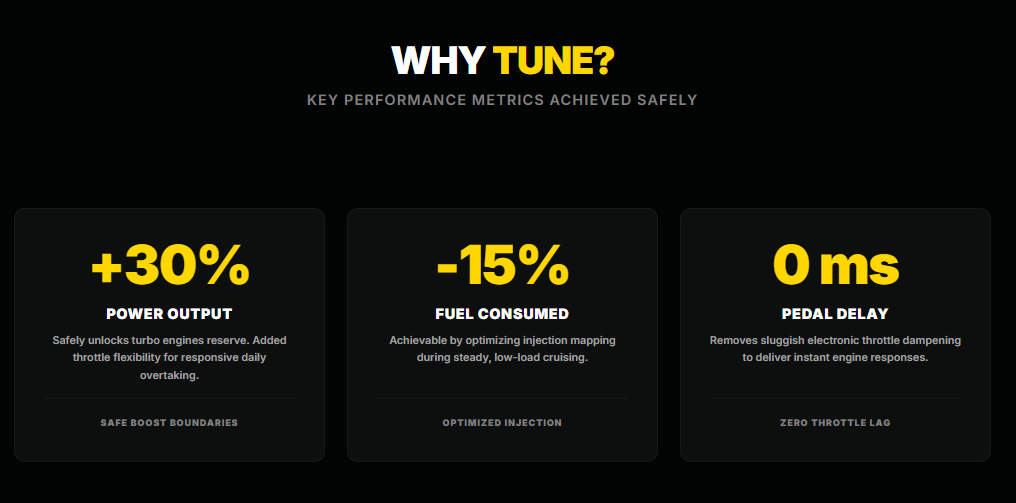
Increasing power and torque unlocks the potential reserved by the manufacturer. For turbocharged engines, the increase can reach 30 percent, as in the case of a BMW X3, where 50 horsepower was added without overloading, confirmed by measurements.
Reducing fuel consumption is achieved by optimizing fuel maps. In economy mode, savings can be up to 15 percent, which is confirmed by logs from real tests, including firmware adaptation for stable operation.
Improving throttle pedal response eliminates delays. The car responds instantly after adjusting the ECU parameters, which is noticeable in daily driving.
Adaptation for hardware includes disabling the catalytic converter or DPF particulate filter, and the EGR valve. This solves clogging problems but requires consideration of environmental regulations to avoid violations.
Adaptation for components adjusts the system for LPG, a new turbine, or injectors. In a project with a Mercedes running on LPG, the dynamics were preserved by ensuring balance through ECU remapping.
The ECU (Electronic Control Unit) – The “Brain” of Your Car
The Electronic Control Unit (ECU) functions like an onboard computer that regulates engine systems based on data from sensors. It controls fuel delivery, ignition timing, turbo boost, and the operation of emission systems, ensuring all components work together harmoniously.
The ECU analyzes signals from temperature, pressure, and speed sensors, then adjusts parameters for optimal performance. Factory settings often limit the engine’s potential, and an ECU remap removes these barriers, allowing for improved dynamics.
A study by Viezu from July 2025 emphasizes that ECU remapping adjusts basic settings, such as fuel and ignition, to enhance performance. ECU optimization can provide up to a 30 percent performance increase without causing damage, as confirmed by practical tests.
Chip Tuning vs. ECU Remapping: What’s the Difference?
Chip tuning refers to the result of changing the characteristics, while ECU remapping represents the process of modifying the software. The concepts are related but distinct: the former focuses on the outcome, the latter on the execution technique.
Criterion
Chip Tuning
ECU Remapping
Essence
Modification to improve performance
Changing the control unit’s software
Goal
Increase power, improve fuel economy
Adjusting fuel and ignition maps
Process
Can include modules or firmware flashing
Reading, editing, and writing software
Example
Installation for a +30% power gain
Changing fuel maps in a VAG ECU
Stages of Chip Tuning: From Simple to Complex
The stages of chip tuning are classified by complexity so that owners understand the scope of work and the expected results. Diagnostics precede the selection of a stage, ensuring the process is safe.
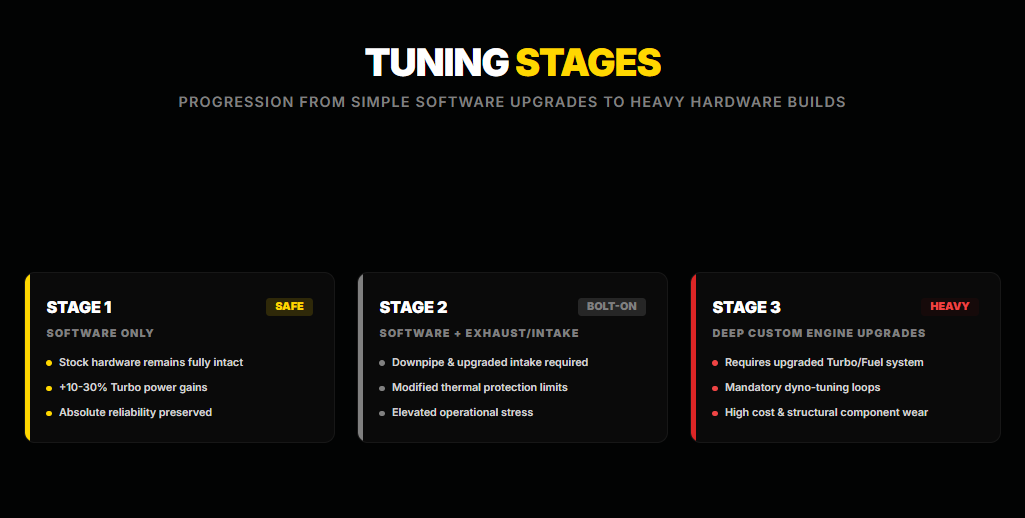
Infographic showing the three stages of chip tuning, from software-only changes to deep engine modifications.
Stage 1: Software-Only Changes
Stage 1 is limited to modifying the ECU software without any hardware interventions. It is suitable for most cars. The performance increase is 10-30 percent for turbocharged engines and 5-10 percent for naturally aspirated ones. In the case of an Audi A4, the effect is noticeable without risks, as tests show.
Stage 2: Software + “Intake and Exhaust” Upgrades
Stage 2 combines a remap with intake and exhaust modifications, including an intercooler, downpipe, or sports catalytic converter. This increases efficiency, with the software adapted to the changes to balance performance.
Stage 3: Deep Modifications and Custom Tuning
Stage 3 involves a custom remap for replacing the turbocharger, injectors, or fuel pump. It requires a dynamometer for live tuning. Thousands of kilometers of testing ensure safety and reliability.
The Remapping Process: Main Stages
The remapping cycle includes diagnostics and testing for safety. Proven methods eliminate errors, ensuring stable operation after the changes.
Step 1: Initial Computer Diagnostics
Diagnostics identify any errors, ensuring that the tuning is performed on a healthy car. This prevents problems, as in the case of a Toyota where a faulty sensor was found before the ECU remap.
Step 2: Reading the Factory Firmware (Backup)
Reading saves the original firmware. Methods include using the OBD-II port for simplicity or bench/BDM/JTAG for more complex ECUs. A backup is mandatory to allow for restoration.
Step 3: Modifying the Program
An engineer edits the fuel and ignition maps. Data from tests ensures the accuracy of the adjustments in the firmware.
Step 4: Writing the Tuned Firmware to the ECU
The new version is uploaded back to the unit, with a check for system compatibility.
Step 5: Final Diagnostics and Test Drive
Checking logs and running tests confirm the absence of errors, including dynamic trials to evaluate the changes.
Advantages and Risks: An Honest Look at Chip Tuning
A well-considered decision requires understanding the pros and cons. Focusing on safety ensures that changes do not affect key systems unnecessarily.
What are the benefits of chip tuning?
Increased power and torque, up to 30 percent.
Improved elasticity and response, making the drive more responsive.
Reduced fuel consumption by up to 15 percent in calm driving mode, as confirmed by tests.
Removal of factory limitations, such as speed limiters.
Correct removal of DPF/EGR/CAT systems to solve clogging issues.
Disadvantages and Potential Risks of ECU Chip Tuning
Reduced engine lifespan due to increased load, requiring more frequent maintenance.
Loss of warranty is possible, as dealerships may refuse service for modified vehicles. Read more in the article “Will installing GAN void my car’s warranty?”.
Risk of ECU damage from low-quality equipment.
Legal aspects include issues with technical inspections if the catalytic converter is removed.
Risk of amateurs is associated with homemade tunes, which are dangerous.
“The main risk of chip tuning is not in the procedure itself, but in the skill of the person performing it. A high-quality, tested tune on a healthy engine is safe. Problems arise when ‘tuners’ flash an unknown file onto a worn-out engine.”— professionally declared by the specialists at GAN Tuning Buro.
How to Choose a Reliable Service for Chip Tuning?
The choice of service determines the result. It is recommended to check against criteria based on practical experience.
Key Selection Criteria
Proper equipment: genuine programmers for precise work.
Experience with your model: reviews and a portfolio confirm competence.
Warranty: on the work and software, including risk coverage.
Saving the stock file: to allow for reverting if necessary.
Transparency: a clear explanation of the changes and expected results.
Dynamometer: for before-and-after measurements, ensuring accuracy.
Questions to Ask the Technician
Whose software tune is being used? What exactly is being changed? What does the warranty cover? Is it possible to revert to the stock file?
Prices for Chip Tuning and ECU Remapping
The cost is determined by the complexity of the ECU, the type of tune, and the car’s make. Factors include diagnostics, the stage of the tune, and custom tuning, with variations by region.
Service
Price Range (from)
Stage 1 for naturally aspirated engines (passenger cars)
150 EUR
Stage 1 for turbocharged engines (VAG, BMW)
200 EUR
Stage 2 + disabling emission systems
400 EUR
Custom Stage 3 tuning
800 EUR
Frequently Asked Questions (FAQ) about Chip Tuning and Remapping
Are chip tuning and remapping the same thing?
No. Chip tuning defines the goal of changing the characteristics. Remapping is the method used to achieve it.
How much will my car’s power increase?
It depends on the engine: turbocharged engines see a 15-30 percent gain, while naturally aspirated ones get 5-10 percent. Diagnostics will provide more precise figures.
Will chip tuning affect the engine’s lifespan?
Yes, increasing performance raises the load. A quality tune and regular maintenance minimize the impact, preserving longevity.
Can the factory firmware be restored?
Yes, a professional service saves the original file to allow for reverting at any time.
What is a chip tuning box (tuning box) and why is it worse?
A tuning box deceives the ECU with false signals.
Does a remap affect passing a technical inspection?
A Stage 1 tune usually does not. However, removing the catalytic converter will be detected during an emissions test, which can cause problems.
Conclusion: Key Takeaways
Chip tuning effectively unlocks a car’s potential.
Success depends on the skill of the technician and the quality of the program.
Weigh the pros and cons for your specific vehicle.
Always start with diagnostics.
The Biggest Misconceptions About Chip Tuning: The Whole Truth from the Experts
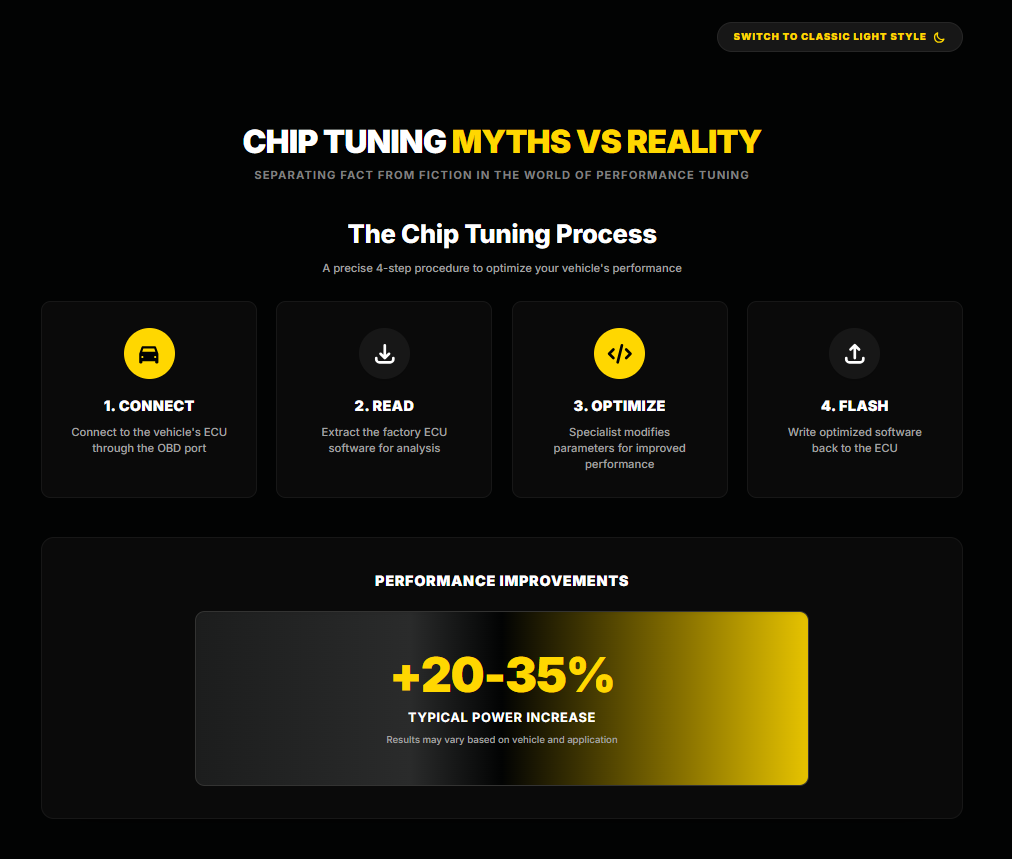
Chip tuning remains one of the most popular upgrades for car owners looking to increase power and performance. By 2025, the market has expanded, but the topic has accumulated myths due to low-quality services and inflated expectations. Based on dyno data, real-world tests, and extensive experience, we break down the common misconceptions about chip tuning. This article will separate fact from fiction, revealing the pros and cons, benefits and risks, all based on calibration and diagnostic analysis.
Chip Tuning: Harmful or Beneficial? A Detailed Analysis of Consequences, Pros, and Cons
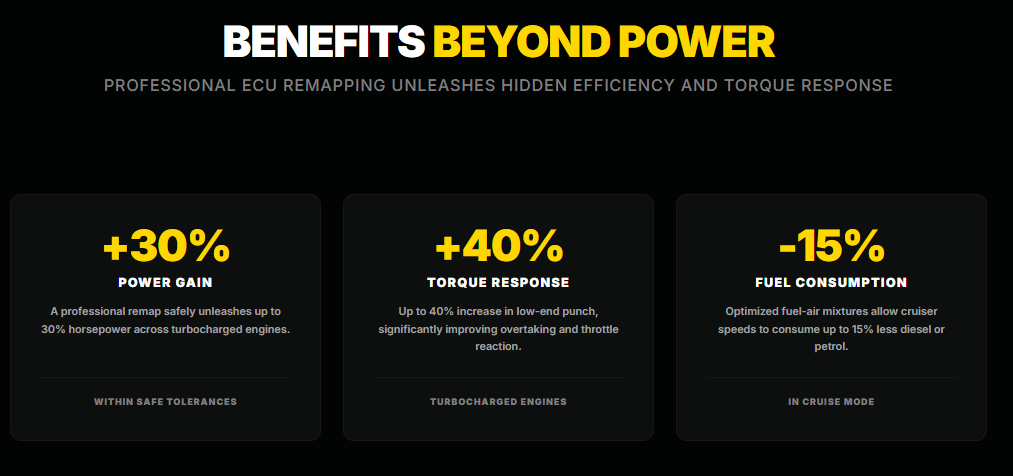
Chip tuning involves adjusting the parameters of the engine’s electronic control unit, or ECU, to optimize power, torque, and fuel consumption. The outcome is determined by the specialist’s skill: a professional calibration is beneficial, while a clumsy remap can cause harm. A professional approach can deliver a power increase of up to 30% without compromising the engine’s lifespan, as recorded in dynamometer tests. Turbocharged engines see a 25-40% increase in torque, which improves overtaking and can reduce fuel consumption by up to 15% during cruising.
In a case study involving a turbodiesel, a 30% power increase was recorded with no rise in fuel consumption, but only after a thorough dyno analysis. In unprofessional cases, detonation was observed due to calibration errors. Such outcomes highlight the importance of preliminary diagnostics and choosing a specialist with positive reviews.
Detailed Comparison: The Pros vs. Cons of Car Chip Tuning
✅ Pros of Professional Chip Tuning
❌ Cons and Risks of Unprofessional Chip Tuning
Increases power by up to 30% and torque without harming the engine’s lifespan
Reduces engine lifespan due to exceeding boost limits
Reduces fuel consumption by up to 15% in calm driving mode
Increases fuel consumption and causes detonation from an incorrect air-fuel mixture
Preserves the factory warranty with no changes to the ECU
Loses warranty if software modifications are detected
Improves engine flexibility for confident overtaking
Causes wear on the automatic transmission and turbine due to incorrect settings
Adapts to driving style through custom calibration
Leads to ECU failure from unverified software
Potential Harm and Negative Consequences of Chip Tuning for the Engine
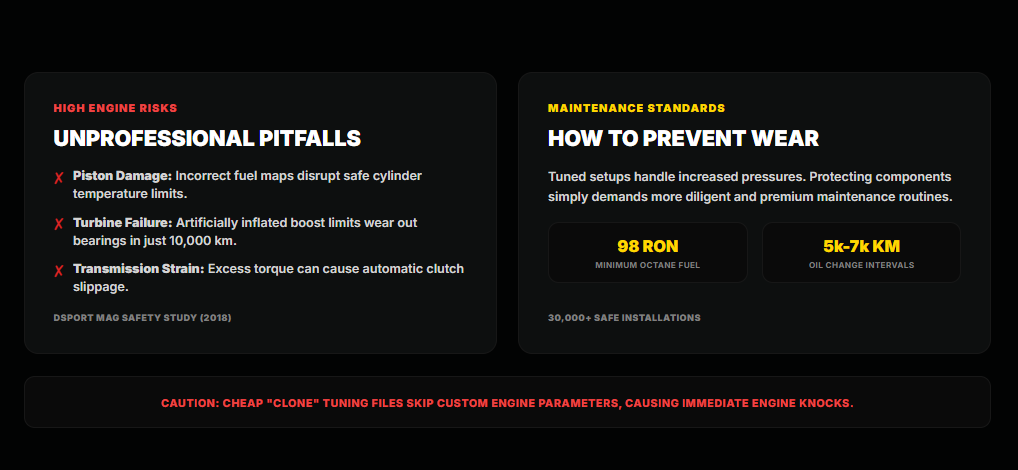
A clumsy ECU remap can cause detonation, overheating, and wear on the piston group if the calibration disrupts temperature management. There are recorded cases where incorrect boost limits caused a turbine to fail after just 10,000 kilometers. The risks also include automatic transmission failure from increased torque and higher fuel consumption due to an overly rich mixture. A 2018 study by Dsport Mag notes that low-quality tunes can accelerate wear by 20-30%. “Many tuners lack deep understanding, resulting in overly rich or conservative tunes that reduce benefits or safety.” — Dsport Mag, 2018.
Such problems arise from the calibrator’s errors, not the technology itself. In our experience with over 30,000 vehicles, harm only occurred when diagnostics were ignored. It is crucial to consider the engine’s limits and perform dynamometer tests for safety.
“The main danger lies not in increasing power, but in disrupting the stoichiometric mixture and temperature parameters. A proper tune never exceeds the safety margins engineered by the manufacturer.”— The GAN Tuning Buro development team, leading engineers.
What Are the Benefits of Chip Tuning: More Power and Beyond
In a case study with a gasoline turbo engine, strong low-end torque was noted, which reduced acceleration times by 1-2 seconds. Such improvements enhance reliability when calibrated correctly.
Debunking Myths and Misconceptions About Chip Tuning: Fact and Fiction
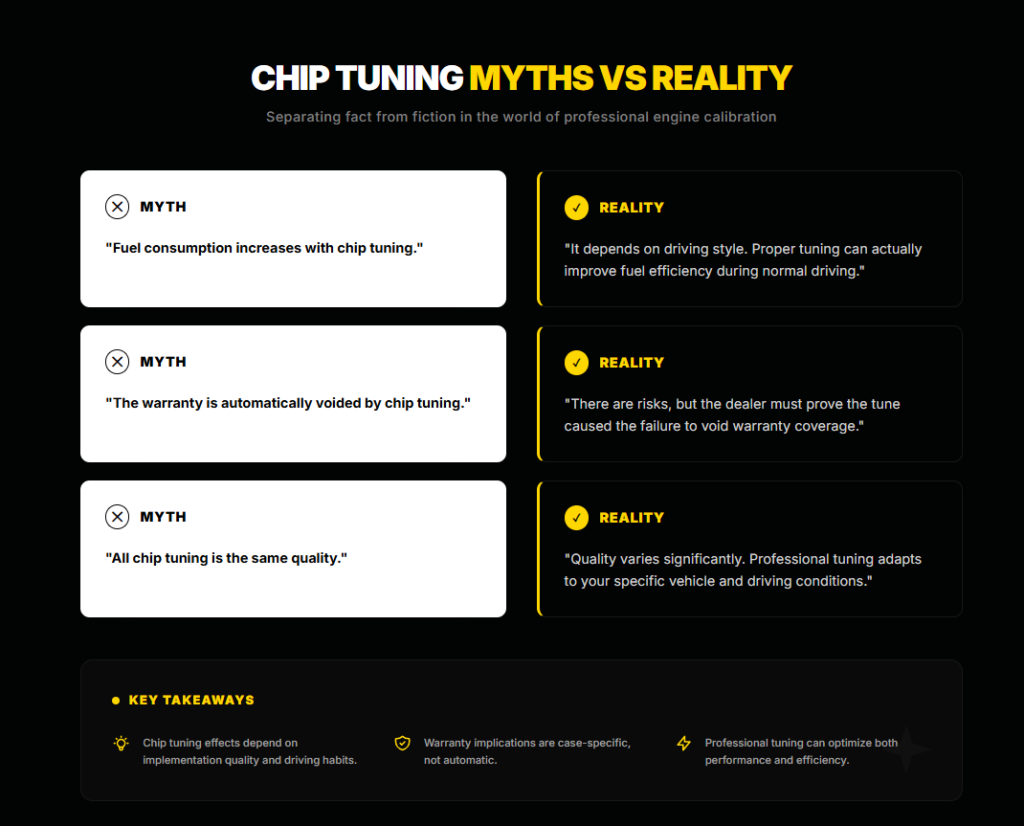
Misconceptions about chip tuning stem from marketing hype and bad experiences. It’s often believed that it is always harmful or provides a +50% power boost, but the facts show that gains depend on the engine type, and harm depends on the quality of the ECU remap. Let’s break down the common myths about chip tuning, based on tests and research. In dyno measurements, fuel consumption decreased by 0.5-1 liter per 100 kilometers during steady driving. A 2025 analysis by AlianAuto shows that these myths often mask a lack of expertise. “Manufacturers often restrict engine parameters for global compatibility and emissions compliance, leaving a reserve that skilled remappers can unlock safely.” — AlianAuto, 2025.
Myth 1: Chip tuning drastically reduces the lifespan of the engine and automatic transmission
The engine’s lifespan is only reduced with aggressive Stage 1 or higher calibrations, or with a low-quality ECU remap. A proper tune operates within the safety margins set by the manufacturer. In tests on 30,000 vehicles, lifespan was reduced by no more than 2-3 percent with regular maintenance. A 2025 study, “Tuning Myths EXPOSED,” confirms that a professional approach preserves reliability. “Professional tuning operates within safe limits to avoid reducing engine life, although poorly done tunes can cause damage.” — Tuning Myths EXPOSED video, 2025.
Myth 2: After a remap, the car will lose its warranty
This is partially true. A dealer will deny warranty repair for a component if they can prove a link between the failure and the modified ECU software. However, a high-quality calibration is often undetectable by many dealers. It’s also possible to revert to the factory settings before a service visit. The 2025 ReynLab study points to legal protections.
During aggressive driving, fuel consumption does increase. But with a calm driving style, it remains the same or even decreases by 0.5-1 liter per 100 kilometers, thanks to increased torque at low RPMs. Dynamometer measurements show a consumption drop of up to 1.5 liters for turbo engines. The 2023 RocketChip USA study debunks this myth: consumption depends on driving habits. Learn more about fuel consumption after tuning in the article Does Chip Tuning Increase or Decrease Fuel Consumption? Real Data from 30,000+ Cars.
Myth 4: Power will increase by 30-50% on any engine
No. Turbocharged engines show a gain of 20-35 percent. Naturally aspirated engines gain 5-10 percent, but throttle response and flexibility are improved. The 2025 AlianAuto study clarifies: gains vary by engine type. Find out more in Chip Tuning Naturally Aspirated Engines. Realistic Expectations for 2026.
Myth 5: Any “backyard” mechanic can perform a quality chip tune
No. A quality ECU remap requires licensed equipment, databases of verified calibrations, and expert knowledge. Without a dynamometer, the risk of breakdowns increases. Dsport Mag (2018) warns: amateurs cause damage.
Myth 6: Factory settings are always optimal and cannot be improved
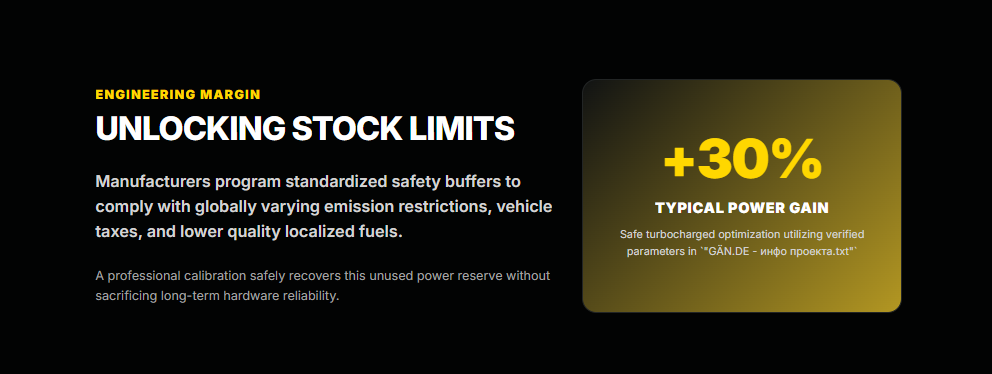
Factory ECU maps balance power with Euro 5/6 emissions standards, taxes, and fuel quality. Optimization unlocks the engine’s full potential. The 2025 AlianAuto study explains this reserve margin.
Myth 7: You can just download a remap from the internet and install it yourself
This often leads to expensive repairs. Unverified software contains errors that can damage the ECU. Each calibration must be matched to the car’s specific software ID. ReynLab (2025) highlights these risks.
Want to get the most out of your car safely?
Calculate the power gains for your model online
Learn about chip tuning for diesel engines
What is software deletion of the EGR and particulate filter?
See our work with customer reviews
What is Chip Tuning in Simple Terms?
Chip tuning is the reprogramming of the engine’s electronic control unit, or ECU, without installing a physical chip. The ECU regulates fuel injection, ignition, and boost. These parameters are adjusted for optimization. The process involves reading the software, modifying it, and writing it back. The 2025 AlianAuto study describes this as unlocking the engine’s potential.
How to Choose a Professional Service and Avoid Amateurs
Checklist for Choosing the Right Tuning Shop
Dynamometer Availability: This is the only way to objectively confirm power gains.
Licensed Equipment: Ask what equipment they use (e.g., Alientech, Magicmotorsport, Autotuner).
Work Guarantee: The service should provide a guarantee that the software will not harm the ECU or the engine.
Reviews and Case Studies: Look for real reviews and a portfolio of work with “before” and “after” dyno graphs.
Reversal Option: Clarify if they save your factory software and if you can revert to it.
Willingness to Answer Questions: A professional will always answer all your technical questions in detail and with patience.
Frequently Asked Questions (FAQ)
Can I revert to the factory software?
Yes, a professional service saves your factory ECU software. The rollback procedure is usually free or inexpensive.
What are Stage 1, Stage 2, and Stage 3?
Stage 1: A software calibration with no hardware changes, providing a safe increase within factory limits. Stage 2: A remap plus intake and exhaust upgrades, such as a downpipe. Stage 3: A remap with a replacement turbocharger, injectors, and fuel pump.
Do I need to change the oil more often after chip tuning?
For Stage 1, it’s not mandatory, but reducing the replacement interval by 20-30 percent—from 10,000 kilometers to 7,000—is recommended as a safety measure for aggressive driving.
Author: the engineering team at GAN Tuning Büro — specialists in engine mapping with 20+ years of experience across turbocharged and naturally aspirated engines. Since 2018, the brand has upgraded more than 30,000 vehicles, with a consistent focus on engine longevity and warranty preservation.
Chip Tuning for Beginners: A Complete A-to-Z Guide
What Is Chip Tuning in Simple Terms? A Beginner’s Guide
Chip tuning involves software optimization of the engine control unit (ECU) to improve engine performance. Essentially, the process is similar to updating the software on a smartphone to make it faster and more efficient. For beginners, it’s important to understand that this procedure doesn’t require replacing any physical components. Instead, it unlocks the engine’s potential that manufacturers often limit for reasons such as emissions regulations, reliability, or marketing strategy. For example, dynamometer tests show power gains of up to 30% on turbocharged engines without reducing engine lifespan. This is the basic explanation of chip tuning for those just starting to explore the topic.
What Chip Tuning Delivers: Key Benefits and Real-World Results
Chip tuning improves vehicle dynamics, increases power output, and optimizes fuel consumption. The driver gets a more responsive engine, quicker acceleration, and the potential to save fuel during relaxed driving. Dyno tests show performance gains on turbocharged engines with fuel savings of up to 15%.
Parameter
Factory Settings (Stock)
After Chip Tuning (Stage 1)
Power (hp)
150
180–195
Torque (Nm)
250
300–320
0–100 km/h Acceleration (s)
9.2
7.8–8.2
Fuel Consumption (highway, L/100 km)
6.5
5.8–6.2 (with moderate driving)
Throttle Response
Standard
Improved, no delay
Disabling “Eco” Functions and Errors: EGR, DPF, AdBlue
Chip tuning can be used to disable systems such as EGR (exhaust gas recirculation), DPF (diesel particulate filter), and AdBlue (NOx reduction). This can solve mechanical issues but also increases emissions and violates environmental regulations. Disabling EGR on diesel engines can boost power by up to 20%, but compliance checks are required, as stated in the Alientech Official Guide, 2025.
Hidden Pitfalls and Risks: What Tuners Don’t Tell You
Chip tuning carries certain risks, including increased engine wear, potential loss of warranty, and higher fuel consumption during aggressive driving. Incorrect tuning increases stress on the engine and shortens its lifespan. Research shows that tuning errors lead to damage in 20% of cases, according to TuningBot, “Beginner’s Guide to Chiptuning: How to Start Tuning Safely and Professionally”, 2025.
Loss of Dealer Warranty: Myth or Reality?
Modifications to the ECU give dealers a reason to void the engine and transmission warranty. Some external modules do not modify the factory software and can be removed without a trace before a service visit.
Impact on Engine and Transmission Lifespan
Increased power means increased load and reduced mechanical safety margins. Stage 1 typically stays within factory tolerances, but aggressive driving accelerates wear. Real-world data from thousands of tuned cars shows stock-level longevity with responsible use.
“Smart tuning is not about pushing the engine to its limits — it’s about optimization. We always keep a 15–20% safety margin to protect engine life during normal use.”— GAN Tuning Buro Engineering Team
Higher Fuel Quality and Maintenance Requirements
After tuning, high-octane fuel is required — for example, 98 RON instead of 95 — along with more frequent oil changes every 5–7,000 km. This helps prevent detonation and premature wear.
Types and Methods of Chip Tuning: How It’s Done
Chip tuning involves either modifying the ECU software directly or installing external tuning modules. These approaches provide flexibility and safety for different types of engines.
Stage 1, 2, 3: What Do These “Stages” Mean?
Stage 1 focuses on software only and is ideal for beginners. Stage 2 adds supporting hardware upgrades, while Stage 3 involves more significant component replacements for performance builds.
Stage Level
What’s Modified?
Hardware Requirements
Best For
Stage 1
Software adjustments only
None
Beginners, daily driving
Stage 2
Software + downpipe, intercooler
Light modifications
Enthusiasts
Stage 3
Software + upgraded turbo, injectors
Major modifications
Motorsport
ECU Remapping (Flash Tuning) vs. Tuning Box (Power Box)
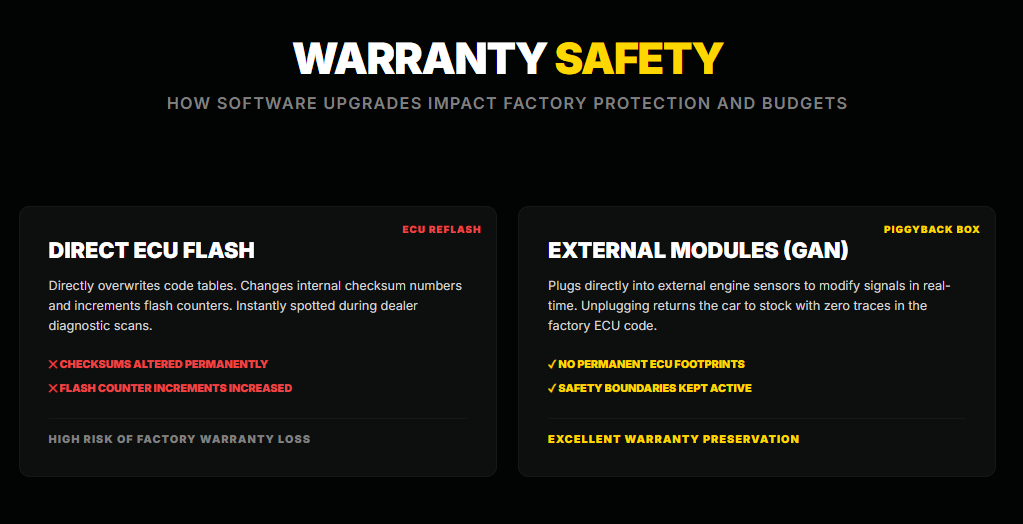
Remapping modifies the ECU software comprehensively, while a tuning box intercepts and alters sensor signals. Tuning boxes are often considered safer since they don’t modify the ECU directly and can be removed easily. This is supported by research from ChipYourCar in “Tuning for Beginners: How to Enhance Your Car’s Performance”, 2024.
Chip Tuning for Diesel vs. Gasoline Engines
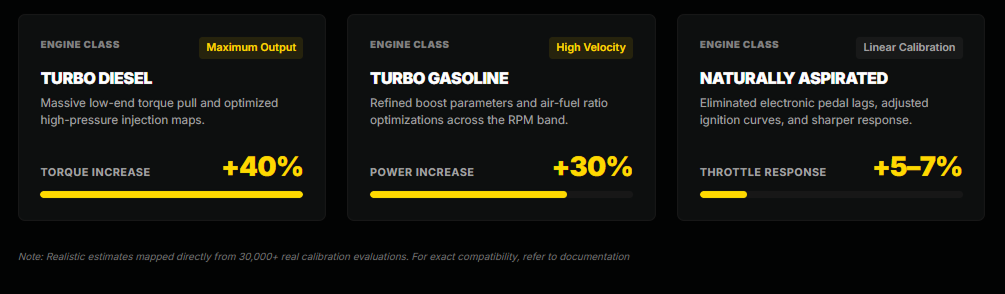
Turbo diesel engines can gain up to 40% more torque and improved fuel economy. Naturally aspirated gasoline engines typically gain 5–7%, while turbocharged gasoline engines can see up to 30% more power. Learn more in the article Chip Tuning Naturally Aspirated Engines. Realistic Expectations for 2026.
How to Choose the Right Tune and Specialist for Chip Tuning
The choice depends on reviews, warranty options, and proper diagnostics. A test drive helps evaluate the real effect.
✅ Mandatory pre-check diagnostics: A professional inspects the vehicle before tuning.
✅ Own professional equipment: Does not work with cheap clone tools.
✅ Reputation and reviews: Real feedback from forums and Drive2.
✅ Transparent process: Explains what will be changed and how.
✅ Stock backup: Makes a full backup of the original factory file.
✅ Warranty and support: Provides a guarantee and fine-tunes the software if needed.
DIY Chip Tuning: Why It’s Not for Beginners
Doing chip tuning on your own can easily damage the ECU due to mistakes. Beginners often end up with serious engine issues, which is why professional tuning is strongly recommended. For newcomers, this is especially risky because it requires in-depth knowledge of automotive electronics.
Frequently Asked Questions (FAQ)
Can everything be reverted to stock?
Yes, a professional tuner saves the original factory file so the ECU can be restored at any time. External modules can be removed without leaving traces.
How long does chip tuning take?
From 1 to 4 hours, depending on the car. Module installation takes about 15 minutes.
Will my car tax increase after tuning?
No, vehicle tax remains unchanged since the official power rating in the vehicle registration doesn’t change. Documentation stays the same, as noted by Integrated Engineering, “ECU Tuning: A Beginner’s Guide”, 2024.
Chip Tuning Myths vs. Facts
Myth: The engine will wear out quickly. Fact: A properly done Stage 1 only minimally affects engine longevity.
Myth: Fuel consumption always goes down. Fact: It decreases with calm driving but increases under aggressive acceleration.
Conclusion: Is Chip Tuning Worth It?
Chip tuning can safely improve vehicle performance when done by a trusted specialist. It’s an affordable way to unlock your car’s true potential.
Ask a Chip Tuning Expert!
Still have doubts? Get a free consultation for your vehicle. We’ll assess its potential and explain the possible risks.
This article was prepared by the GAN Tuning Buro team, whose engineers bring a combined 20+ years of experience working with modern ECUs and drivetrains. Our goal is to give you practical, honest guidance — whether or not it involves our products.
Chip Tuning: A Complete Breakdown — Pros, Cons, and All the Risks for Your Car
Author:The GAN Tuning Buro engineering team, whose combined 20+ years in ECU calibration inform every risk assessment in this guide. We’ve built our tuning modules specifically to avoid the pitfalls described below. Learn more on our company profile gantuning.com.
What is chip tuning in simple terms?
Chip tuning is the modification of the engine control unit (ECU) software to optimize its performance. Manufacturers set restrictions in the stock firmware to comply with environmental standards, reduce taxes, or extend engine life.
Tuning removes these barriers by adjusting parameters such as fuel injection, ignition timing, and boost pressure. As a result, the engine delivers more power and torque without replacing hardware components. This is especially relevant for turbocharged engines, where gains can reach up to 30 percent, as proven by dynamometer tests.
The results confirm that proper tuning improves efficiency without harming key components.
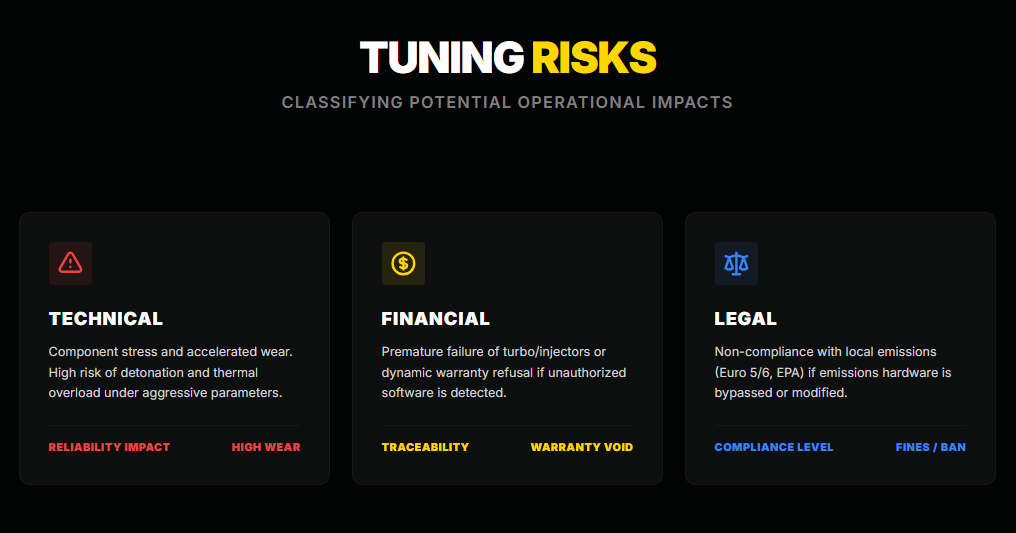
Chip Tuning Risks: A Complete Guide
Chip tuning can pose potential problems if the procedure is approached without proper preparation. Negative consequences usually arise from incorrect calibration or poor-quality software, which may create risks for the engine and other systems.
Breaking down the risks into technical, financial, and legal aspects helps to understand how to avoid common mistakes. Based on GAN’s installation base of 30,000+ vehicles, the share of reported issues drops significantly when the process is approached correctly.
The main risks in chip tuning are linked to increased loads, and minimizing them requires thorough diagnostics before installation.
Risk Classification: Technical, Financial, and Legal
Technical Risks: How Chip Tuning Can Harm Your Car
Engine Risks from Chip Tuning
Chip tuning increases the load on the engine, which accelerates wear if the software is not properly adapted. Engine wear grows due to higher pressure and temperatures, potentially leading to piston deformation.
Engine lifespan is reduced when tuning ignores factory safety limits, shortening mileage by an estimated 10–20 percent based on industry observations. Overheating can occur under aggressive settings, especially in hot climates, without upgraded cooling systems.
Detonation appears as uncontrolled combustion in the cylinders, damaging valves and pistons. Proper parameter balancing helps prevent such issues, with dynamometer tests confirming safety when tuning is done correctly.
According to Autowerkes, performance chip tuning can potentially raise horsepower and torque by up to 30 percent and improve throttle response, though it may void the vehicle’s warranty and affect emissions compliance depending on the region and chip quality.
Impact of Chip Tuning on Transmissions: Potential Risks (Manual, Automatic, DSG, CVT)
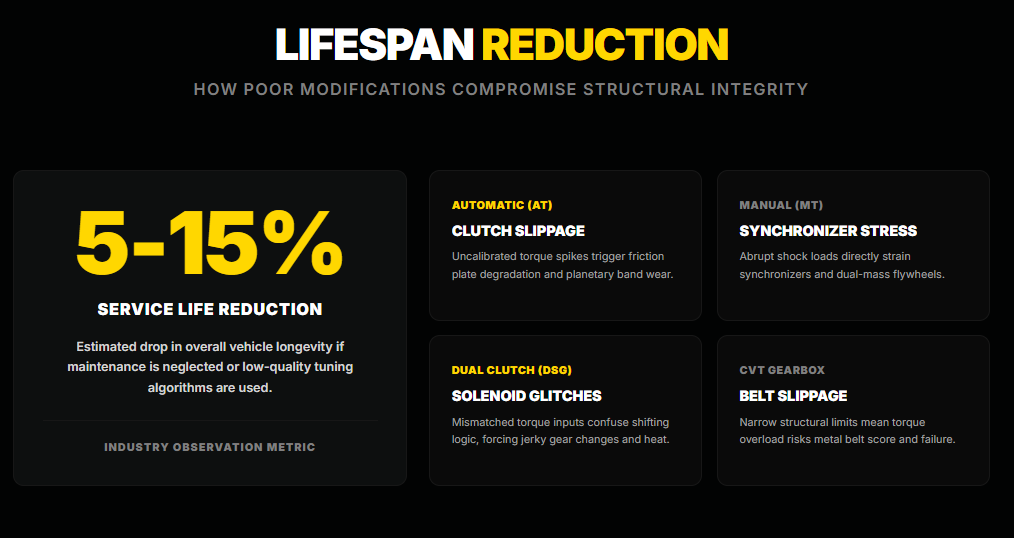
Chip tuning transfers increased torque to the transmission, accelerating wear. Gearboxes face overloads that can lead to failures. Automatic transmissions (AT) risk clutch slippage due to power mismatch. Manual transmissions (MT) suffer from synchronizer wear under sudden loads. DSG and CVT units are prone to jerks and premature clutch failures, as seen in cases of poor-quality remaps. Compatibility checks help prevent repairs that cost several times more than tuning. The downsides are evident if risks are ignored, but the advantages appear when adaptive tuning is applied.
How Does Chip Tuning Affect the Overall Lifespan of a Car?
Chip tuning reduces a vehicle’s service life by accelerating component wear. Based on industry observations, lifespan can shrink by an estimated 5–15 percent if the car’s condition is not monitored. Increased wear impacts not only the engine but also suspension and brakes. In projects where adaptive algorithms are applied, lifespan is preserved through precise optimization — a pattern consistent with GAN’s installation base of 30,000+ vehicles.
According to Pedal Commander’s tuning guide, poorly executed chip tuning can increase engine wear and lead to failures in components not built for higher loads, which is why professional installation matters.
Chip tuning risks are reduced with regular maintenance.
Fuel System Risks in Chip Tuning
The fuel system is stressed by higher fuel pressure and injector loads. The fuel pump wears out faster if fuel quality is poor. Case studies show injectors often clog after tuning, leading to costly repairs. Proper parameter calibration ensures balance, minimizing drawbacks. The benefits in this area largely depend on fuel quality and timely servicing.
Risk of Increased Fuel Consumption After Chip Tuning
Fuel consumption rises with aggressive driving, despite optimization. Higher consumption occurs when drivers actively exploit the power increase, sacrificing efficiency. Tests show that savings of up to 15 percent are only possible with a calm driving style.
According to ChipYourCar, professional ECU remapping adjusts engine control maps — such as the air-fuel ratio and ignition timing — to optimize output, while piggyback boxes offer a less intrusive but less customizable alternative.
Specific Risks for Diesel and Gasoline Engines
For diesels, risks include clogging of the particulate filter, EGR failure, and turbo breakdowns due to higher boost. Gasoline engines are prone to detonation and catalytic converter wear. Adaptation by engine type minimizes these issues, unlocking benefits without excessive drawbacks. More details on turbo-diesel chip tuning can be found in the article “Chip Tuning Turbo-Diesel Engines”.
Risk Aspect
Gasoline Engine (NA/Turbo)
Diesel Engine
Exhaust System
Catalyst wear from high temperatures
Particulate filter and EGR clogging
Fuel Equipment
Increased injector pressure
Risk of CommonRail pump failure
Boost
Turbo overheating (turbocharged versions only); not applicable to naturally aspirated engines
Increased load on turbo and intercooler
Comparison of specific chip tuning risks for diesel vs. gasoline engines
Financial Risks: When Tuning Leads to Major Expenses
Warranty Cancellation: The Main Financial Risk of Chip Tuning
Factory warranty is void if the dealer detects ECU modifications through diagnostics. Official service centers then refuse repairs, causing extra expenses. Plug & Play modules that leave no traces preserve warranty, as confirmed in proven cases. More on warranty preservation with GAN modules in the article.
Legal Aspects and Risks of Chip Tuning: What You Need to Know
The legality of chip tuning is questionable when emission standards are violated, which can lead to fines. In some cases, registering modifications is mandatory, otherwise insurance issues may arise. Compliance with regulations avoids legal risks while keeping the benefits of tuning.
How to Minimize Risks in Chip Tuning: Expert Recommendations
To minimize risks, follow these steps:
Choose a specialist with proven experience and reviews.
Use trusted software.
Perform diagnostics before installation.
Monitor vehicle condition afterward.
Use high-quality components.
This meaningfully reduces the share of reported problems. Chip tuning risks are minimized with an individualized approach, consistent with GAN’s installation base of 30,000+ vehicles.
A staged approach to chip tuning (Stage 1 to Stage 3) progressively increases power demands and often requires mechanical upgrades to the braking and suspension systems.
The Importance of Diagnostics Before Chip Tuning
Diagnostics reveal hidden defects and allow preventive measures.
Engine condition check.
Transmission inspection.
ECU error analysis.
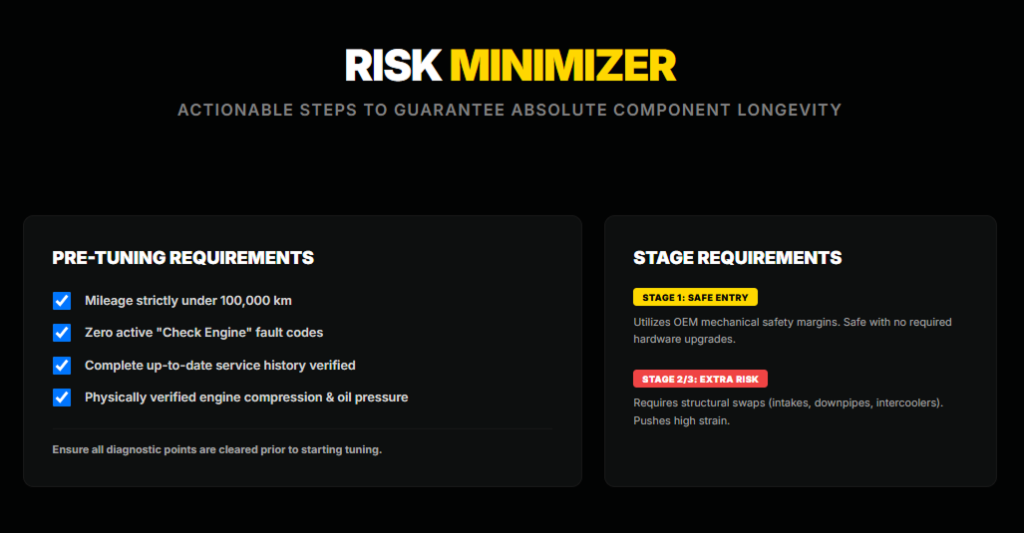
Mileage under 100,000 km
No Check Engine errors
Timely maintenance
Oil pressure verification
Choosing a Professional Workshop and the Right Tune
Look for workshops with dynamometer testing, customer reviews, and warranties. “Off-the-shelf” remaps are universal, but custom dyno tuning is tailored to your car, reducing risks. More details in the article “I Want to Increase My Engine Power. How Can I Do It?”.
Stage 1 vs Stage 2/3: Comparing Risks and Requirements
Stage 1 tuning is safe without hardware changes, with minimal risks. Stage 2/3 require modifications (intake, cooling, etc.), significantly raising both cost and risk. The downsides of higher stages are balanced by greater power gains.
Advantages of Chip Tuning: Why Is It So Popular?
Increased Power and Torque
Up to 30 percent gains confirmed by tests.
Improved Driving Dynamics and Throttle Response
Better pedal response and acceleration dynamics.
Fuel Consumption Optimization (with calm driving)
Up to 15 percent savings in eco-driving mode.
Real Reviews and Stories: Negative Experiences with Chip Tuning
One Skoda Octavia owner reported a loss of low-end torque after a remap, which eventually led to costly repairs. Another diesel VW owner complained about a clogged filter. Such issues are rare but highlight the importance of choosing the right solution. Reviews show real stories of risks associated with chip tuning.
Question — What problems did this Skoda Octavia owner experience after chip tuning?
The owner noted that the car began to jerk at low RPMs (loss of torque at low revs) — in the end, he had to revert to the stock firmware to restore normal performance.
Busting Popular Myths About Chip Tuning
Myth 1: “Chip tuning always harms the engine”
Fact: A high-quality Stage 1 tune on a healthy vehicle, with proper diagnostics and calibration, is generally safe and does not significantly reduce engine life.
Fact: Fuel savings are only possible in limited conditions (eco-driving); under active use of added power, consumption actually increases.
Myth 3: “You can just download a tune from the internet and flash it yourself”
Fact: This is highly risky — you may brick the ECU or cause unstable engine operation. It’s strongly recommended to trust professionals and dyno-tested calibrations.
Alternatives to Chip Tuning
External Tuning Boxes (Power Boxes)
These plug in without ECU reflashing and are often marketed as safer.
Mechanical Tuning (Hardware Upgrades)
Replacing and upgrading components (intake, turbo, exhaust, etc.) reliably increases power but is more expensive. The advantage is durability; the downside is higher costs and complexity of work.
Conclusion: Is Chip Tuning Worth It? Expert Opinion
Chip tuning delivers noticeable performance gains, but the risks depend entirely on the approach: software quality, diagnostics, and the expertise of the tuner. With proper preparation (diagnostics, dyno calibration, monitoring), Stage 1 often brings driving pleasure with minimal risks.
Expert Tip: If you are not ready for potential expenses or unsure about the condition of your vehicle, postpone tuning. When choosing a workshop, prioritize those with a dynamometer and service warranty. For most drivers, Stage 1 offers the best balance of power and safety.
Parking Gear on Automatic Transmission: What P Really Does – and How to Use It Right
What does P mean in automatic – and what actually happens inside the gearbox?
Think of the parking lock as a small bolt sitting deep inside the transmission. That bolt – technically called a parking pawl – drops into a toothed wheel (the parking gear wheel) and locks the output shaft in place by positive engagement. Once it’s engaged, the vehicle cannot be moved by the drivetrain.
In practical terms: an SUV with a kerb weight of 2,100 kg parked on an 8° gradient places around 2,900 Newtons of continuous force on that pawl. A single instance is not a problem. What becomes a problem is when it happens every single day.
Parking position automatic – the difference between P and N
Many drivers confuse what P and N actually do. The difference is fundamental:
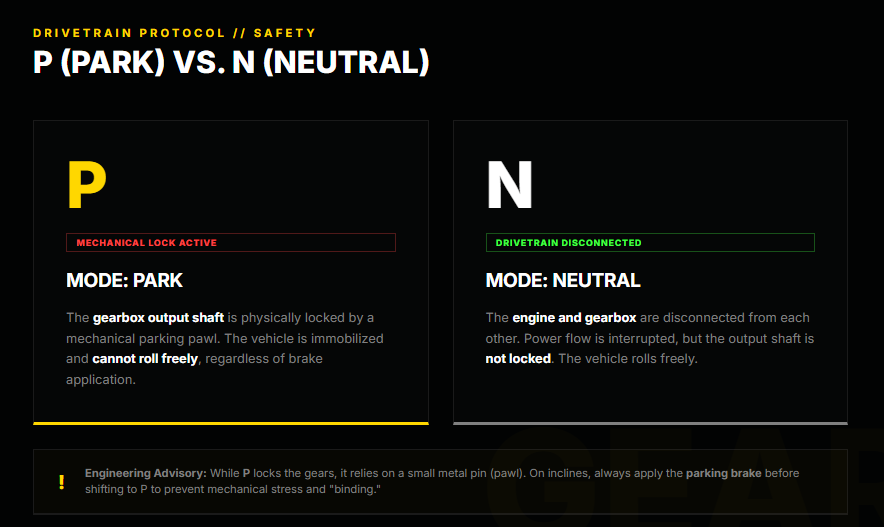
P (Park): the gearbox output shaft is mechanically locked. The vehicle cannot roll freely.
N (Neutral): the engine and gearbox are disconnected – but the output shaft is not locked. The vehicle rolls freely.
N makes sense when being towed (if the manufacturer permits it), going through a car wash, or during brief stops over 30 seconds at a traffic light. The parking position automatic – that is, P – is the right choice when you’re leaving the vehicle for good. But only with the correct sequence of steps.
Why the order you engage park mode on your automatic transmission matters
This is the point where habits diverge – and where you either protect your gearbox or quietly destroy it. The correct sequence when stopping:
Bring the vehicle to a complete stop (keep your foot on the footbrake)
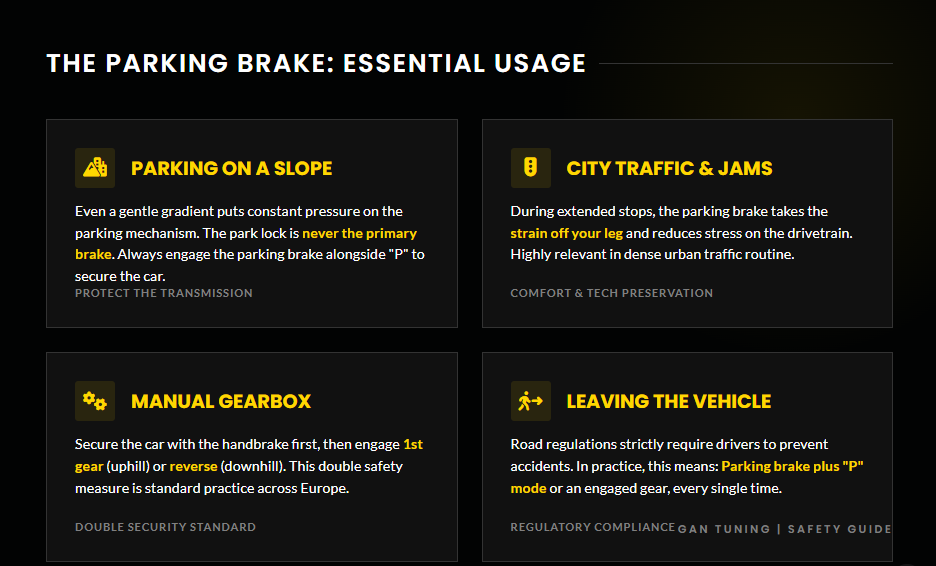
Apply the handbrake – the vehicle is now held by the brake, not the gearbox
Only now move the selector into P
Release the footbrake
Switch off the engine
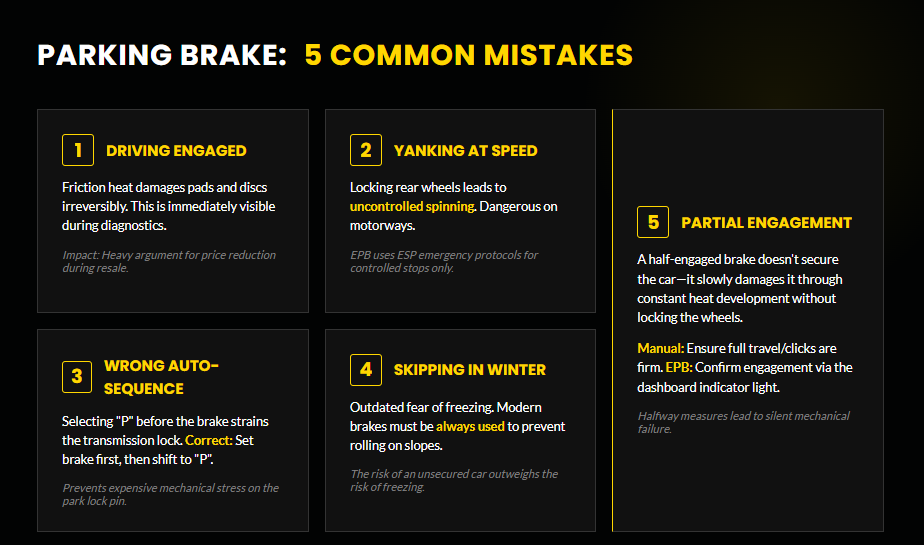
Why this order? If you engage P first and apply the handbrake second, the car rolls slightly downhill after you lift the footbrake – just until the parking pawl catches the ratchet wheel. At that moment, the pawl takes the full load of the vehicle. This creates mechanical tension inside the gearbox.
“Apply the handbrake first – it unloads the parking pawl. You’ll also notice the selector moves out of P far more easily afterwards.”
This is not a driving school myth. It’s physics: when the handbrake engages first, there is zero force on the pawl when you select P. When you set off, release P first, then release the handbrake – and the selector will move noticeably more freely because the gearbox isn’t under tension.
What road traffic regulations say across Europe
Traffic regulations across European countries share one common requirement: drivers must secure the vehicle against rolling before leaving it. In most jurisdictions, this means engaging both the parking brake and the transmission lock. Insurers reinforce this – if a vehicle without an applied handbrake rolls away and causes damage, the policyholder can lose cover entirely.
Using park mode on the automatic transmission alone typically satisfies legal requirements on level ground. On a slope, however, relying solely on P – without the handbrake – can expose you to full liability for any resulting damage or accident.
Automatic transmission park mode: which gearbox types exist, and does it matter?
Not all automatic gearboxes are built the same way. This has a direct effect on how sensitive the parking lock is to misuse.
Torque converter automatic (traditional)
The classic torque converter automatic – fitted to vehicles like Toyota, Lexus, and many older executive saloons – has a robust parking lock that is mechanically linked directly to the selector lever. The pawl is comparatively large. Occasional misuse is less critical here than in more modern designs.
Dual-clutch gearbox (DSG / DCT)
In dual-clutch transmissions (used by Volkswagen, Audi, Skoda, Seat, BMW M models, various Ford performance cars), the packaging is tighter and the parking lock correspondingly more compact. Comparative data shows: the pawl in these gearboxes is more vulnerable to impact loading when P is engaged while the vehicle is still moving.
Volkswagen’s own owner’s manuals for DSG vehicles explicitly recommend securing the vehicle with the handbrake before selecting P.
Continuously variable transmission (CVT)
CVT gearboxes, as used in Toyota (Yaris, Corolla Hybrid), Nissan and Subaru models, have a similar parking lock construction – but react more sensitively to lateral forces when parked at an angle and to residual speed when P is engaged.
Shift-by-Wire (electronic selector)
Modern vehicles with an electronically controlled selector – including BMW models from 2018 onwards, the Mercedes-Benz EQS, and the Jaguar Land Rover Defender – automatically engage the automatic transmission park mode when the engine is switched off. A built-in guard prevents P from engaging above approximately 5 km/h. This eliminates the most common mistake – but it does not mean you can skip the handbrake.
Common mistakes when using the parking gear – and what they cost to fix
Mistake 1: selecting P while the vehicle is still moving
This is the most expensive mistake. The parking pawl drops towards the ratchet wheel while the car is rolling and is mechanically deflected – but above a certain speed, this protection does not work reliably on all vehicles.
On vehicles without an electronic guard – particularly pre-2010 models – engaging P at 3–5 km/h can cause immediate mechanical locking. The force involved is equivalent to a full emergency stop from that speed, concentrated entirely on a pawl just a few centimetres wide.
Typical repair costs for parking lock damage:
Type of damage
Typical cause
Cost (indicative)
Worn parking pawl
Regular hill parking without handbrake
€800 – €1,800
Broken ratchet wheel
P engaged while moving, or foreign object
€2,000 – €4,500
Full gearbox failure
Extreme load, trailer use, steep ramp repeatedly
€4,000 – €12,000
Shift-by-Wire actuator failure
Overload through incorrect use
€600 – €2,200
Mistake 2: relying entirely on P without the handbrake
This matters most for heavier vehicles: SUVs from 1,800 kg upwards, estate cars with loaded roof boxes, vehicles with tow bars. The parking pawl is engineered for everyday use – not as a permanent load-bearing component.
Mistake 3: towing a vehicle with P engaged
The rarest but most consequential mistake: having a vehicle towed with P selected. The locked output shaft transfers all forces directly into the gearbox casing. Damage to the shaft, differential, and gearbox housing follows – repair bills running into five figures are not unusual.
The correct approach: always select N before being towed, and follow the manufacturer’s guidance on maximum towing speed and distance (typically: no more than 50 km/h, no more than 50 km).
Using the parking gear in winter: what many drivers get wrong
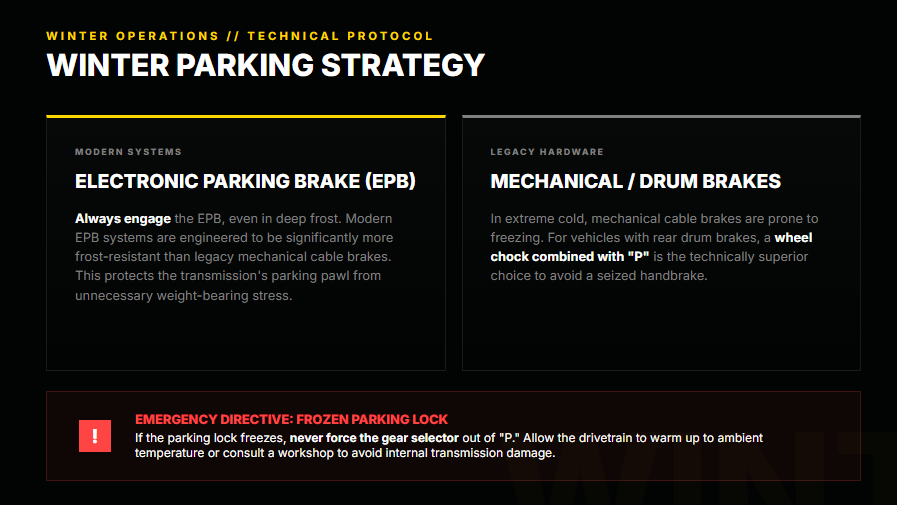
Winter places additional demands on the parking lock. At temperatures below −10 °C, the parking pawl can freeze in position – particularly in older vehicles with less well-protected gearbox housings. When this happens, the transmission simply will not move out of P.
On modern vehicles with EPB (electronic parking brake): always engage, even in frost – EPB systems are more frost-resistant than mechanical cable brakes
On older vehicles with rear drum brakes: in extreme cold, a wheel chock combined with P is preferable to the mechanical handbrake
If the parking lock freezes: never force the vehicle out of P. Allow it to warm up or call a workshop
Park mode automatic transmission and modern electronics: what newer systems do differently
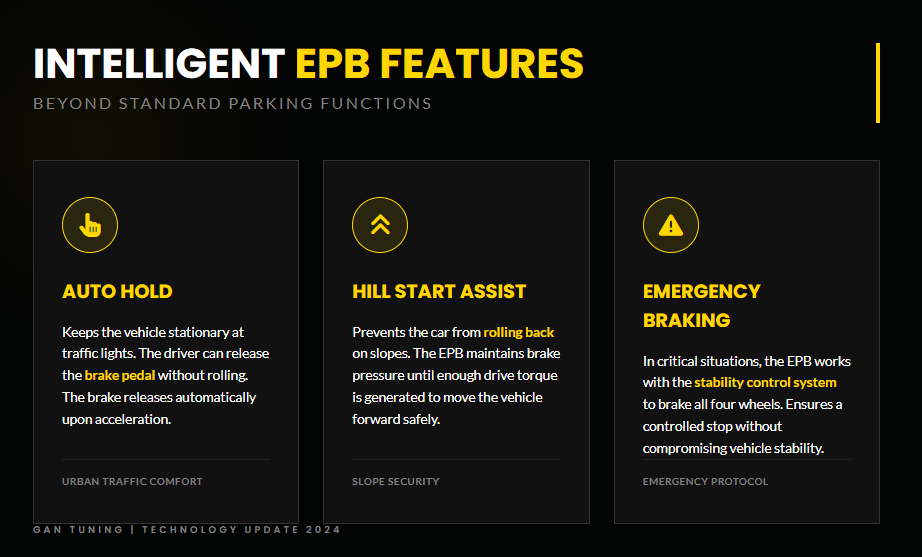
Newer vehicles take more decisions away from the driver. Shift-by-Wire systems in current models from multiple manufacturers engage park mode on the automatic transmission automatically when the engine is switched off. Electronic parking brakes (EPB) can be linked to trigger simultaneously – some models do this as standard.
That sounds convenient – and it is. But automatic P engagement does not mean you should depend on it entirely. Electronic systems fail. A manually applied handbrake works mechanically, independently of battery voltage or control unit status.
Quick FAQ on what P means in automatic and how to use it:
Q: Do I still need to use the handbrake on an automatic car? A: Yes – always. The parking gear is a supplement, not a replacement. The handbrake secures the vehicle directly through the wheels, independently of what the gearbox is doing. If another vehicle strikes your parked car, a failed parking lock significantly increases the damage – the handbrake absorbs those forces far better.
Q: Can I select P while still moving slowly? A: On vehicles with modern Shift-by-Wire electronics, a guard prevents this above approximately 5 km/h. On older vehicles without that protection: no, never. Even 2–3 km/h of residual speed is enough to generate a damaging impact load on the parking pawl.
Q: Why does my selector stick when I try to move it out of P? A: This is a classic sign that the vehicle is sitting in P under tension – the parking pawl is carrying the vehicle weight. The fix: next time, apply the handbrake first, then select P. The stiffness disappears immediately.
Automatic transmission and engine performance: why engine mapping matters too
Using the parking gear correctly protects the gearbox. But what if the engine itself is not running at its optimum?
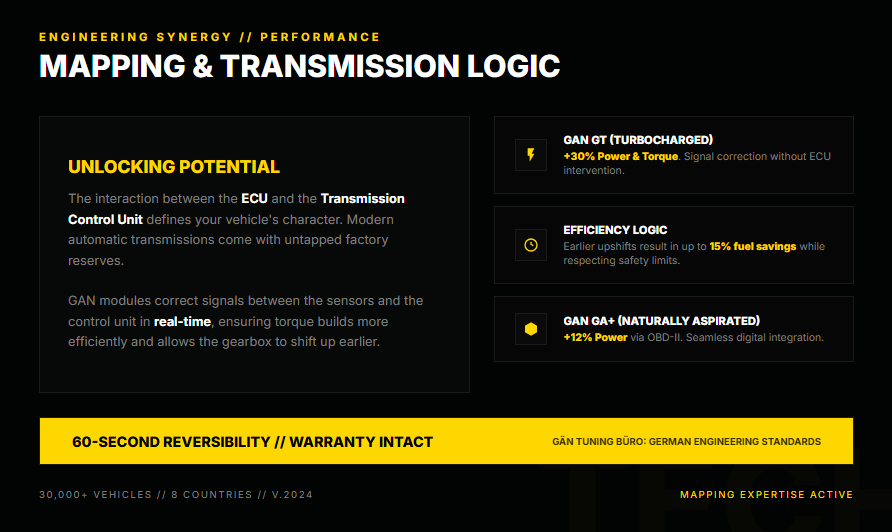
Many vehicles with automatic transmissions – particularly turbocharged ones – come from the factory with performance reserves that manufacturers leave untapped for compatibility reasons. The interaction between the engine control unit (ECU) and the transmission control unit determines how the vehicle responds, when upshifts happen, and how torque builds.
GÄN Tuning Büro – a German engineering company whose team brings over 20 years of engine mapping experience – has optimised more than 30,000 vehicles across 8 countries since 2015. The GAN GT module for turbocharged engines increases power by up to 30% and torque by up to 30%, without touching the ECU directly. It corrects signals between the control unit and sensors (boost pressure, fuel rail pressure) in real time, remains fully reversible, and leaves no trace whatsoever.
For vehicles with automatic transmissions, this is particularly relevant: the transmission control unit reads the higher torque value and shifts up earlier – which, with a measured driving style, can deliver fuel savings of up to 15%. The gearbox is not put under additional strain because GAN GT respects the manufacturer’s built-in safety limits.
The GAN GA+ module for naturally aspirated engines (connected via OBD-II) delivers a power increase of up to 12% – also with no software intervention in the ECU.
Both modules can be removed in 60 seconds without tools before the vehicle goes in for a service – the dealer sees nothing, and the manufacturer warranty remains fully intact.→ GÄN Tuning Büro: check compatibility for your vehicle
Summary: parking gear on automatic – the key rules at a glance
Situation
Recommended approach
Parking on level ground
Hold footbrake → select P → apply handbrake → switch off
Parking on a slope (3° or more)
Hold footbrake → apply handbrake → select P → release footbrake
Parking in hard frost (older vehicles)
P + wheel chock; mechanical handbrake only if disc brakes fitted
Brief stop (traffic light, driveway)
Stay in D or N with foot on brake – never select P
Being towed
Select N, follow manufacturer guidance on max speed and distance
Car wash (drive-through)
Select N – P would lock the wheels and prevent movement
Technical recommendations and real-world gearbox inspection data consistently show that following these rules substantially extends the life of the parking lock – and prevents repairs that can, in the worst case, exceed the market value of the car itself.
The core rule stays simple: handbrake first, parking gear second. Two extra seconds – and your gearbox will reward you with tens of thousands of additional kilometres.
GÄN Tuning Büro – German engineering for real-world performance gains. More than 30,000 vehicles optimised since 2015 · 8 countries · Engine warranty up to €5,000 · 50-day money-back trial.
AC vs open windows: what saves more fuel, what’s safer, and what actually protects your engine
Does AC use more gas — and by how much?
That’s the central question. And it doesn’t have a single answer — it depends entirely on speed.
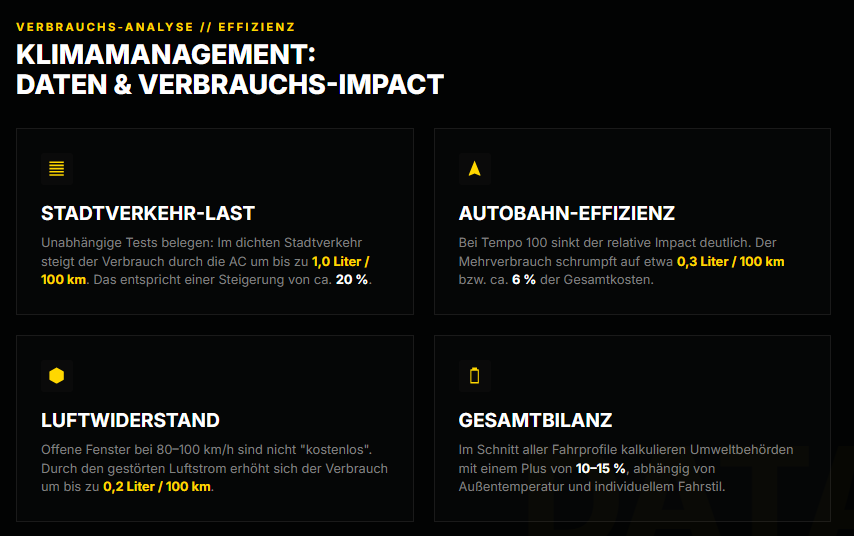
Independent automotive tests show that running the AC in city traffic can add up to 1 litre per 100 km to your fuel consumption — roughly a 20% increase. At motorway speeds around 100 km/h, that figure drops sharply: the penalty shrinks to around 0.3 litres per 100 km, or about 6%.
Environmental agency data consistently puts the average air conditioning fuel consumption increase at 10–15%, varying with outside temperature, vehicle class, and how you’re driving.
What catches most people off guard: open windows at speed aren’t free either. At 80–100 km/h, open side windows generate measurable aerodynamic drag — adding up to 0.2 litres per 100 km to your fuel bill.
The short version: at higher speeds, the gap between AC vs open windows gas mileage is tiny — and frequently reverses in favour of the AC.
Speed
Better choice
Why
Below 50 km/h
Windows down
AC costs noticeably more here
50–80 km/h
Situation-dependent
Consumption difference is negligible
Above 80 km/h
AC on, windows up
Aerodynamics make open windows costlier
Windows down or AC: which is actually safer?
There’s a clear answer here — and it surprises most people.
Research shows that at cabin temperatures above 27 °C, driver concentration measurably deteriorates. That’s not a comfort issue — it’s a safety issue. Particularly on fast-moving roads where reaction time is everything.
Open windows don’t cool the cabin. They just move the air around — and in hot weather, that air is already hot. Add in the significant wind noise above 80 km/h, which builds up into real fatigue on long stretches, and the picture becomes clear. Air conditioning holds the cabin temperature steady, keeps noise down, and maintains alertness. That matters most on long trips with children, or on back-to-back motorway legs without a proper break.
Something many drivers underestimate: a car parked in the sun heats up fast. Interior temperatures of 50–60 °C in direct sunlight are common across Europe in summer. The practical fix — open all windows first, let the hot air out, then switch the AC on. It takes under a minute, reduces strain on the compressor, and cools the cabin faster.
What does AC actually do to your engine — myth vs. reality
The myth: “Air conditioning kills the engine.” It sounds like hard-earned wisdom. It isn’t.
Modern compressors run at variable load. They adjust to demand and are managed by the engine’s own electronics. The load is engineered into the system from the start — no manufacturer builds a climate system that damages its own engine. Current compressor technology uses significantly less energy than older-generation units.
Here’s what experienced mechanics actually say: the real risk runs the other way. Leaving the AC unused for months allows seals to dry out and refrigerant to leak — which leads to expensive repairs down the line. The standing recommendation among automotive professionals is to run the AC regularly, even in winter when temperatures are above +5 °C, to keep seals lubricated and the system functional.
Simple as that: regular use extends the life of the system. Leaving it idle shortens it.
Air conditioning fuel consumption in city driving — where can you actually save?
City driving is where AC hits hardest. Up to 20% extra fuel consumption happens right here — stop-start traffic, frequent acceleration, engine constantly working at partial load. This is also where a bit of awareness makes a real difference.
Comparative tests show: at outside temperatures below 22 °C, skipping the AC and going windows down genuinely saves fuel in city conditions. Once it climbs past 25 °C, the calculation gets more complex — heat impairs driver performance, and that’s a real cost too.
A practical, field-tested approach:
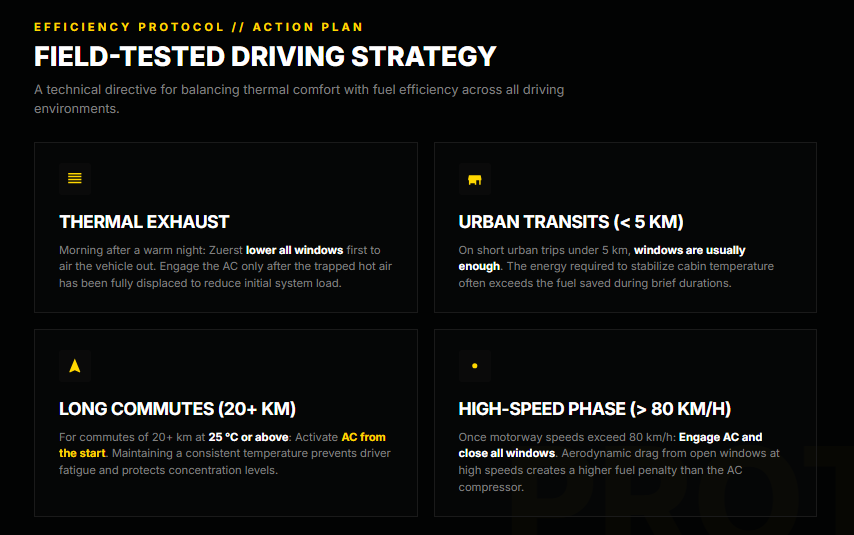
Morning after a warm night → windows down first, air the car out, then AC Short urban trips under 5 km → windows are usually enough Commute of 20+ km at 25 °C or above → AC from the start Motorway driving above 80 km/h → AC on, windows closed
What often gets overlooked: the fuel penalty from running the AC can be partially offset by smarter engine management. Driving with more torque available at lower revs means fewer downshifts, smoother acceleration, and lower consumption overall — regardless of whether the AC is running. Based on data from over 30,000 vehicles, the GAN Tuning module demonstrates exactly this in real-world driving: higher low-end torque means earlier gear changes and measurably less fuel used, with or without the AC. More at gantuning.com/gan-gt
Electric vehicles: AC costs more here, and it shows
EV drivers play by slightly different rules — and with electric cars becoming increasingly common across Europe, this is worth knowing.
Tests show that a typical EV air conditioning system draws around 1.3–1.5 kW continuously. Over eight hours of driving, that translates to roughly 16% of battery capacity. Noticeable — but manageable, as long as it’s factored into route planning.
For EV drivers, the windows vs AC logic applies with a bit more weight on both sides: at lower speeds and moderate temperatures, windows down is the smarter call. In summer heat on the motorway, switch to AC and close the windows — the aerodynamic loss from open windows will exceed the energy cost of the compressor.
How does chiptuning affect AC efficiency?
It’s rarely discussed in technical circles — but for any driver running a tuning module, it’s a genuinely practical question.
The AC puts the heaviest load on the engine precisely when the engine is already running at partial capacity: urban traffic, pulling away from lights, accelerating from a standstill. More torque available at those moments means the AC’s impact on engine behaviour becomes far less noticeable.
The GAN GT module — developed for turbocharged petrol and diesel engines — increases torque by up to 25%. In practice: the engine pulls sooner, gear changes come earlier, and partial-load efficiency improves. That directly offsets part of the extra fuel consumption caused by running the AC.
Technically, GAN GT works like this: it doesn’t touch the ECU software. Instead, it communicates with the boost pressure sensor (on turbo petrol engines) and the rail pressure sensor (on Common Rail diesels). The ECU receives a modified signal and raises output — within the safety parameters set by the manufacturer.
Feature
GAN GT
Standard ECU remap
Power increase
up to 25%
up to 25%
Fuel saving
up to 15%
variable
Manufacturer warranty
preserved
often voided
Removal time
60 seconds
not possible
Engine warranty
2 years, up to €5,000
none
Trial period
50 days, money back
14–30 days
For anyone looking to reduce base fuel consumption — independently of the AC vs windows question — GAN GT offers a technically sound solution that leaves no trace when removed. Find your vehicle at gantuning.com
AC and manufacturer warranty: what holds, what doesn’t
A question that comes up regularly in workshop conversations: can modifications to a vehicle void the manufacturer’s warranty?
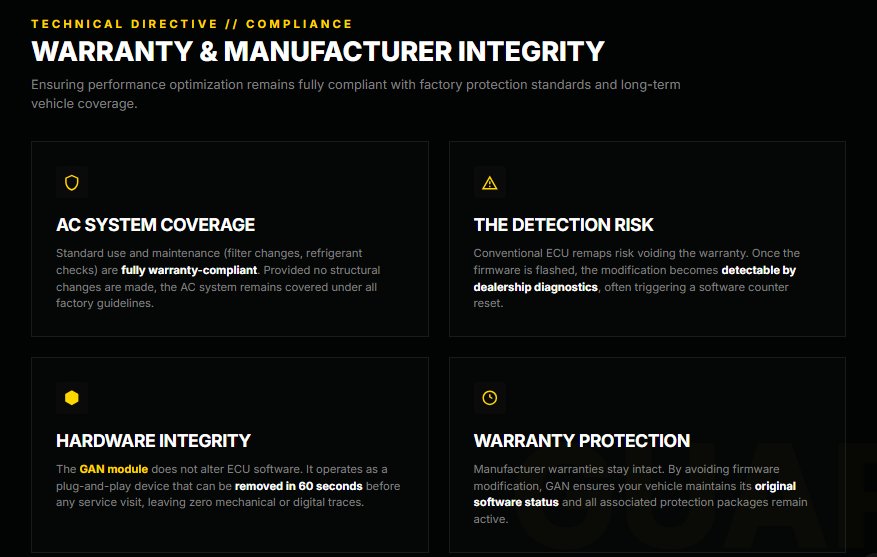
For the AC system itself — no, provided no structural changes are made. Regular use and maintenance (filter changes, refrigerant checks) are fully warranty-compliant and, in fact, recommended.
With chiptuning, it’s more nuanced. A conventional ECU remap can put the warranty at risk if the modification is detectable. The GAN module doesn’t alter the ECU software — it can be removed in 60 seconds before any dealership visit. No mechanical traces, no firmware counter reset. The manufacturer’s warranty stays intact.
On top of that, GAN provides its own two-year engine warranty with financial coverage up to €5,000 — the only company in the segment offering this level of concrete protection. That’s not a marketing line; it’s a contractual commitment. Warranty details at gantuning.com/gan-gt
Common questions about AC and fuel consumption
Q: Is it worth switching the AC off in a traffic jam? A: In a jam, the engine is already at idle or near-idle load. The AC draws relatively little here because the engine itself is barely consuming fuel. What does make sense is switching it off a few minutes before a full stop — the residual cool air holds for a while. In dense stop-start traffic, the saving from switching off is usually minimal.
Q: At what outside temperature does running the AC make sense? A: From a purely practical standpoint, around 18–20 °C — when driving comfort and concentration start to suffer. For the engine, it’s entirely unproblematic. From a safety perspective, the meaningful threshold starts at around 27 °C cabin temperature, where driver alertness measurably declines.
Q: Does switching the AC on immediately at engine start damage anything? A: No. Modern vehicles are designed for exactly that. That said, if the car has been sitting in the sun, the smarter move is to open the windows first and let the hot air escape — it reduces the load on the compressor and gets the cabin to temperature faster.
What engine tuning has to do with AC efficiency — an underrated connection
Looks like two different topics at first. It isn’t.
Data across more than 30,000 vehicles reveals a consistent pattern: engines with an optimised low-rev torque curve handle the additional AC load without the same abrupt load spikes. Smoother engine operation, more stable fuel flow, less strain overall.
That’s exactly what the GAN GT module targets. Five driving modes — Dynamic, Eco, Sport, Stock, and Custom — allow precise adaptation to different driving situations. In Eco mode, fuel consumption drops by up to 15%. That includes journeys with the AC running.
For drivers covering long daily distances with the climate control on, that adds up to a measurable annual saving. https://www.gantuning.com/
The verdict: AC vs open windows comes down to speed
The decision is simpler than most people think — once you understand the physics.
Below 50 km/h: windows down. The AC uses meaningfully more fuel than the aerodynamic cost of open windows at low speed.
Above 80 km/h: AC on, windows up. Aerodynamics flip the equation.
For driving safety: almost always AC — especially at temperatures above 25 °C.
For the engine: regular use is better than months of sitting idle.
For drivers who also want to reduce their vehicle’s base fuel consumption, the GAN GT module offers a field-tested solution: up to 25% more power, up to 15% less fuel, a 50-day no-risk return window, and a two-year engine warranty with up to €5,000 in coverage.
Sources: ADAC automotive testing (adac.de), European environmental agency data, GAN Tuning technical documentation (gantuning.de)
Water from exhaust in summer: condensation or serious problem?
Water from exhaust in summer is, in most cases, completely harmless condensation — nothing to worry about as long as the vapour disappears after warm-up, coolant levels stay stable and there’s no sweet smell coming from the pipe. But if white smoke from exhaust persists on a fully warmed engine, or coolant keeps dropping without any visible leak, you could be looking at a blown head gasket — and a repair bill running anywhere from a few hundred to several thousand euros.
What actually causes water from exhaust — and why does it happen in July?
Most drivers associate this with winter: a small white puff at start-up, a few drops at the tailpipe. In December, nobody blinks. In the middle of summer it looks odd. The physics behind it, though, are exactly the same — season makes no difference.
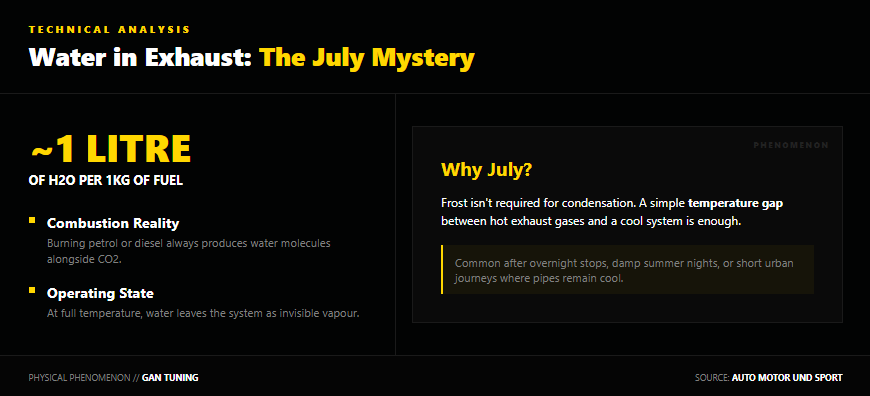
Burning petrol or diesel always produces water molecules alongside carbon dioxide. To put it simply: roughly one litre of water is generated for every kilogram of fuel burned. When the exhaust system is at operating temperature, that water leaves as invisible vapour. The issue arises when the pipework is still cold — after an overnight stop, a run of short urban journeys, or a prolonged period of the car sitting unused.
In those conditions, hot vapour condenses on the cold metal walls, collects in the rear silencer, and eventually starts dripping out. The point is: frost isn’t required for condensation in exhaust to form. A temperature gap between hot exhaust gases and a cool system is enough — and that can happen just as easily in August after a damp night.
According toauto motor und sport, a small white cloud at a cold start is not automatically a fault signal — it’s a physical phenomenon that relates directly to how the vehicle is being used.
When is water dripping from exhaust pipe completely normal?
There are clear signs that point to harmless condensation:
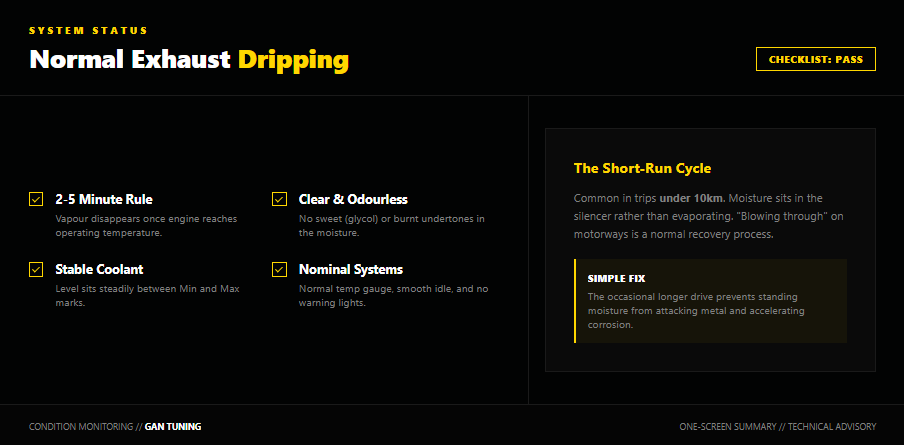
The white vapour or drops disappear within two to five minutes once the engine reaches operating temperature
The water is clear and odourless — no sweet or burnt undertone
Coolant level in the expansion tank sits steadily between the Min and Max marks
The engine temperature gauge behaves normally
No warning lights, no rough idle, no difficulty starting
This is especially common in drivers who mostly do short runs — under ten kilometres — where neither the engine nor the exhaust system ever fully reaches operating temperature. The moisture sits in the silencer rather than evaporating off. If that same driver then takes a longer motorway trip, they’ll often notice the system “blowing through” — and very little dripping afterwards.
That’s not a fault. It is, however, a signal that the driving pattern is gradually doing damage: standing moisture attacks metal from the inside and accelerates corrosion. The simplest fix is the occasional longer drive.
When does water from exhaust become a warning sign?
This is where many drivers misjudge things — in both directions. Some ignore genuinely serious smoke because they put it down to the weather. Others panic over condensation that’s entirely normal.
The key principle: it’s not the weather that matters, it’s the behaviour of the smoke.
Warning signs that need immediate attention:
Symptom
Likely cause
Urgency
White smoke on a warm engine
Coolant in the combustion chamber
High — go to garage immediately
Sweet smell from the exhaust
Burning coolant (glycol)
High
Coolant level dropping with no visible leak
Head gasket failure
High
Creamy, brownish residue under the oil filler cap
Oil-coolant emulsion
Very high
Rising engine temperature
Risk of overheating
Stop immediately
Bubbling in the coolant expansion tank
Combustion pressure entering cooling system
High
Water dripping from exhaust pipe on a warm engine
Coolant breakthrough
High
The head gasket separates the combustion chamber, oil circuit and cooling system. When it fails, coolant enters the combustion process — it vaporises there and exits as dense, persistent white smoke from exhaust. A typical giveaway is a sweet smell caused by burning glycol compounds from the coolant. The fluid disappears without trace, leaks in the engine bay are often invisible — the loss only becomes apparent when topping up repeatedly.
According toherzfeld-akademie.de, a foamy, whitish-brown emulsion under the oil filler cap — often described as a “chocolate milkshake” effect — is a reliable indicator that coolant has entered the oil circuit. This condition requires immediate diagnosis and repair.
How to tell the difference between condensation and a real fault
This can be figured out on the spot with a simple step-by-step check — no tools needed, just observation.
Step 1 — Cold start observation Start the car from cold and watch. Is the smoke light and thin, disappearing within two to three minutes? If yes, that points to harmless condensation in exhaust.
Step 2 — Wait for warm-up Let the engine run for at least ten minutes, or take a short drive. Is white smoke from exhaust still visible after warm-up? That’s a clear warning sign.
Step 3 — Check coolant level Switch off the engine, wait at least five minutes. Open the expansion tank and check the level. Is it sitting between Min and Max? Or has it been dropping week by week without any visible puddles underneath? The latter strongly suggests a leaking head gasket.
Step 4 — Smell test Smoke from a faulty engine usually smells sweet — the result of burning glycol compounds from the coolant. Normal condensation from exhaust smells of nothing, or faintly of metal.
Step 5 — Check the oil filler cap Unscrew the cap. A creamy, brownish deposit underneath means oil and coolant have mixed — a definitive sign of a failed head gasket.
In practice: anyone who works through these five steps can usually judge for themselves whether a garage visit is needed. The combination of persistent smoke + coolant loss + sweet smell leaves very little room for doubt.
How much does a head gasket repair cost — and why acting quickly pays off?
This is the question that makes most drivers wince. The answer depends heavily on the vehicle type and how long the problem has been left unaddressed.
Based on current market data, repair costs typically range from a few hundred to several thousand euros — a significant spread, driven primarily by the degree of secondary damage. Caught early, it often means replacing the gasket and skimming the cylinder head. Continue driving with an overheating engine, though, and you risk a warped cylinder head or — worst case — cracks in the engine block. At that point the bill escalates sharply, or the vehicle becomes uneconomical to fix.
The most important cost argument is straightforward: don’t keep driving if the engine is overheating. On motorways or under sustained load, temperature and pressure in the cooling system rise quickly, turning a small fault into a major one. In such cases, the only right move is to stop immediately and let the engine cool down.
One more consideration: when buying a used car, persistent white smoke from exhaust combined with a falling coolant level is either a solid negotiating point or a clear reason to walk away entirely.
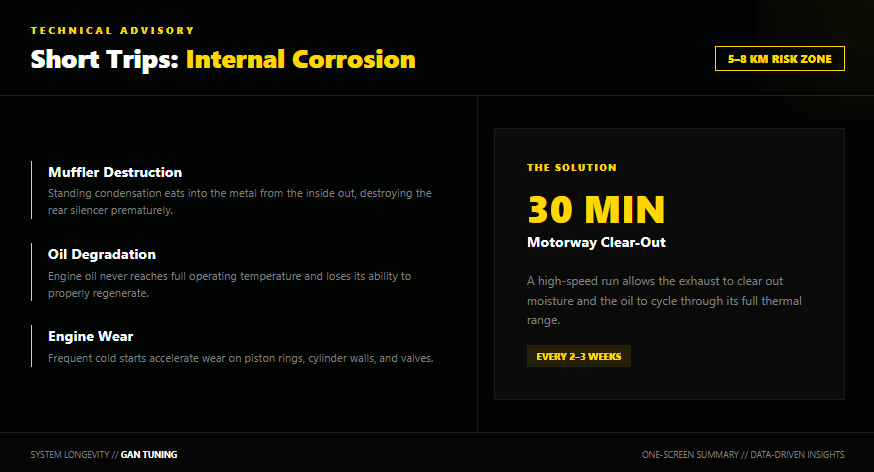
Short-trip drivers: this damages your exhaust more than rain does
It’s an aspect that rarely gets attention. Anyone driving five to eight kilometres a day — commuting in town, supermarket runs — never gives the exhaust system a chance to fully heat up. Condensation builds, sits there, and eats into the metal from the inside out.
That sounds manageable. Over time, it isn’t:
Standing condensation in exhaust triggers internal corrosion and destroys the rear silencer prematurely
Short trips also stress the engine oil, which never reaches full operating temperature and can’t properly regenerate
Frequent cold starts increase wear on piston rings, cylinder walls and valves
The simplest solution: plan a drive of at least thirty minutes on an open road or motorway every two to three weeks. The exhaust system gets a proper clear-out, the oil cycles through its thermal range — and the lifespan of the entire system improves noticeably.
What does chip tuning have to do with a healthy exhaust?
At first glance, an unexpected connection. But the logic is direct: an engine running optimally — with properly calibrated combustion parameters, correct injection pressure and efficient mixture formation — produces fewer residues that contribute to condensation in the exhaust tract. Tuning a turbocharged engine with an external module improves not just performance, but the quality of combustion itself.
That’s exactly where theGAN GT module from gantuning.com comes in. It works as an external unit connected to the air pressure and fuel rail pressure sensors, optimises signals for each operating condition, and delivers power gains of up to 25% on turbocharged petrol and diesel engines — with no intervention in the ECU software. At the same time, GAN offers fuel savings of up to 15%, which matters most for drivers doing regular short urban runs.
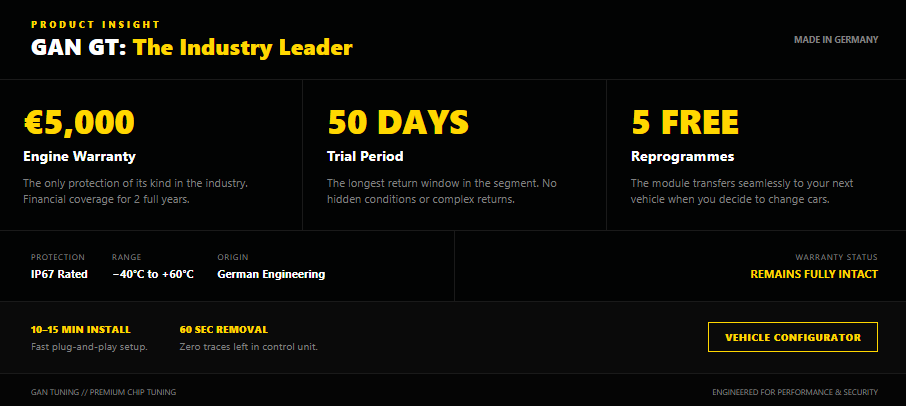
The GAN GT module installs in 10–15 minutes and can be removed without a trace in 60 seconds — no mechanical or electronic marks left in the control unit. That means: unplug before a service visit and the manufacturer’s warranty remains fully intact. Developed and manufactured in Germany, IP67-rated (waterproof to 30 minutes submersion), operating range from −40°C to +60°C.
Three things that separate GAN from the rest:
Engine warranty with financial coverage: 2 years, up to €5,000 — the only protection of this kind in the industry
50-day return period — the longest trial window in the segment, no hidden conditions
5 free reprogrammes — the module transfers seamlessly to a new vehicle when you change cars
Q: Is water dripping from the exhaust pipe in summer normal? A: Yes — in most cases it’s condensation that forms during a cold start. The key question is whether the vapour disappears after warm-up and whether coolant levels remain stable. If both are true, no garage visit is needed.
Q: When should white smoke from exhaust send me straight to a mechanic? A: As soon as white smoke persists on a warm engine, a sweet smell is noticeable, or coolant is dropping without any visible leak — get the car checked promptly. Ignoring a failing head gasket leads to secondary damage that costs considerably more than the original repair.
Q: How much does a head gasket replacement typically cost? A: Depending on vehicle type and extent of damage, anywhere from a few hundred to several thousand euros. Caught early with no overheating damage, the cost usually sits in the lower range. Driving on with an overheating engine risks a write-off.
Q: What does more damage — short city trips or long motorway drives? A: For the exhaust system, frequent short trips are more damaging. The system never fully heats up, and standing condensation triggers corrosion. Regular longer drives noticeably extend its lifespan.
The bottom line: watch the clock, not the calendar
Whether water from exhaust is a problem has nothing to do with the month. The same rule applies in summer and winter: vapour disappears after warm-up, coolant is stable, no sweet smell — everything is fine. White smoke from exhaust lingers on a warm engine, coolant drops, or there’s a glycol smell — act quickly.
Anyone looking to protect their engine further and sharpen combustion quality will find that a tuning module like the GAN GT delivers not just performance gains and fuel savings, but also a two-year engine warranty up to €5,000 — a level of cover no other supplier in the segment provides. Full installation details and answers to common questions at the GAN FAQ.
Steering wheel on full lock: what happens to your steering system and how to avoid damage
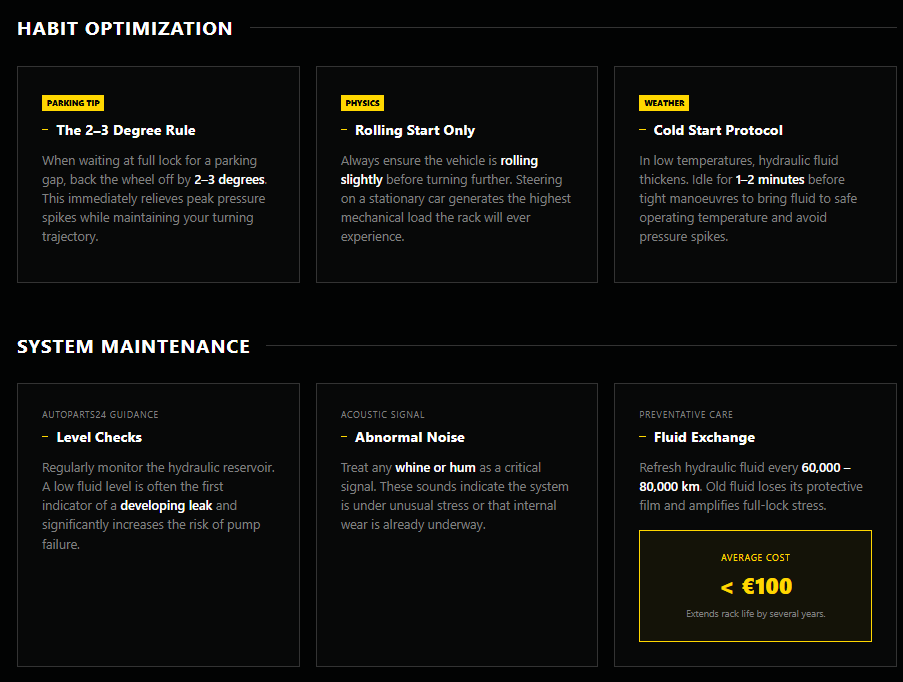
Turning your steering wheel to full lock is perfectly legal and mechanically possible — but holding it there for more than a few seconds causes measurable wear to your power steering system. In hydraulic setups, oil pressure spikes to its maximum, the pump runs at full load, and seals along with the steering rack degrade significantly faster than under normal operating conditions.
Why does pressure spike so sharply at full lock?
Anyone who has held the wheel at full lock while waiting to squeeze into a parking space has probably heard a faint whine or hum coming from under the bonnet. That sound is not random. The hydraulic pump reaches its highest pressure precisely when the steering is turned all the way to one side — at that point, the entire flow of fluid is directed into the working chamber with nowhere to go back directly.
The result: the power steering pump has to sustain maximum output without any movement to relieve the load. Fluid circulates under peak pressure through valves, hoses and seals that were never designed to operate continuously in that state.
In practice this means: a brief flick to full lock while manoeuvring is not a problem. Holding the wheel at full lock for five, ten or more seconds, however, puts real strain on the system.
There is also a thermal factor that tends to be overlooked. Hydraulic fluid heats up rapidly under sustained load — and without the car moving, that heat has nowhere to dissipate. Within just a few minutes, fluid temperature rises noticeably, viscosity drops and its lubricating properties deteriorate. Experienced mechanics consistently point to this effect as one of the most common yet least recognised causes of premature steering wear.
What actually happens to the steering rack and power steering system at full lock?
The mechanical consequences are well documented.According to Auto Bild, steering on a stationary vehicle places the greatest single load on the steering rack — second only to the so-called kerb-push test, and made worse by high-grip road surfaces.
Here is what happens when you hold full lock steering on a stationary or very slowly moving car:
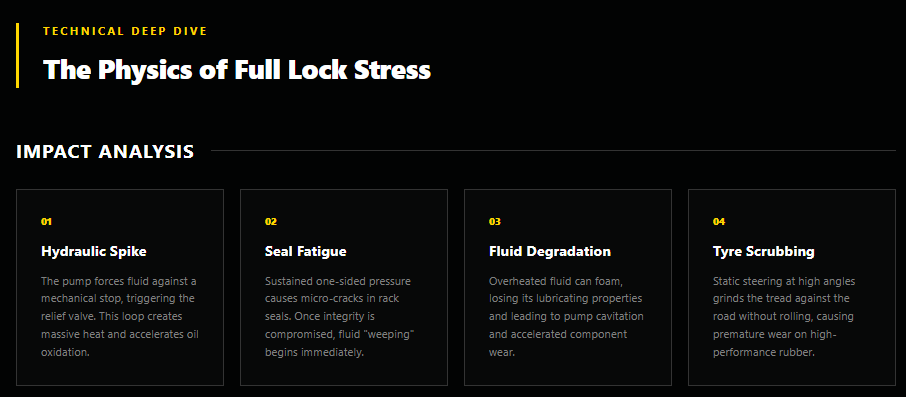
1. Pressure spike in the hydraulic circuit The pump keeps pushing fluid even though the rack has nowhere left to travel. Oil is diverted back through the pressure relief valve — an energetically wasteful loop that generates heat and accelerates fluid ageing.
2. Wear on seals and rack gaiters Holding the wheel all the way to the stop for an extended period puts sustained one-sided pressure on the rack seals. These are the first components to suffer, and once they start to weep, fluid loss follows quickly.
3. No direct return path for the fluid The pump’s full output is forced into the working chamber. The fluid overheats, can foam under extreme conditions, and loses its lubricating properties. Over time, micro-cracks develop in seals — cracks that will eventually become leaks.
4. Tyre wear A less obvious side effect: when you steer on the spot, the tyres scrub against the road surface without rolling. This accelerates tread wear noticeably — particularly on high-grip summer tyres.
Hydraulic, electrohydraulic or electric: does the type of system make a difference?
Short answer: yes — but not as much as most people assume.
System type
Risk at full lock
Recommendation
Hydraulic (conventional)
High — pump under continuous load
Hold for 1–2 sec. max
Electrohydraulic
High — same underlying principles
Hold for 1–2 sec. max
Electric (EPS)
Lower — no hydraulic pressure
Still: keep it brief
With electric and electromechanical power steering, the consequences are less severe because there is no hydraulic pump involved. That said, the electric motor still operates under increased load when the wheels are hard against the mechanical stop and the driver continues to apply steering force.
The core issue remains the same regardless of system type: applying force against a mechanical stop is not an operating condition that steering systems are designed to sustain continuously.
Keeping your car in good mechanical shape goes beyond the steering. Drawing on experience tuning over 30,000 vehicles since 2015, GAN explains how an external tuning module works — and why it leaves your manufacturer warranty completely intact. →Learn more about GAN Tuning
What long-term damage can occur — and what does it cost to fix?
Experienced mechanics see the consequences regularly: weeping rack gaiters, worn-out steering racks, failed power steering pumps. What stands out in practice is that a disproportionate share of these faults occur on cars used predominantly in urban environments — where parking, tight turning circles and steering wheel full lock manoeuvres are simply part of daily life.
The most common failure patterns:
Leaking rack gaiter — fluid escapes and leaves puddles or stains under the car. Repair costs: from around €200, rising sharply if a full rack replacement is needed.
Failed power steering pump — a high-pitched whine when turning, heavy steering feel. According to Autozeitung, parts and labour combined can run to several hundred euros (as of November 2025).
Worn steering rack — play in the wheel, clunking over uneven roads. Replacement often falls between €700 and €1,500 depending on the vehicle.
MOT or roadworthiness failures — excessive steering play and fluid leaks are flagged as defects during periodic vehicle inspections across Europe.
To put it plainly: a few seconds of carelessness at full lock, repeated year after year, can produce a four-figure repair bill.
What makes it particularly insidious is that the damage accumulates invisibly. A car with 80,000 km on the clock may show no symptoms at all, even though the seals are already beginning to break down. Fluid loss typically surfaces somewhere between 110,000 and 130,000 km — and often from several points at once. The link to driving habits is rarely made in hindsight, because years can pass between cause and visible fault.
Anyone buying a used car should make a point of checking three things: are there any traces of fluid around the steering rack? How does the wheel feel during slow parking manoeuvres? Is there any whine or squeal at full lock? Those three questions alone can protect against an expensive mistake.
Myth: “Full lock steering isn’t an issue on modern cars”
This misconception persists — especially among drivers of newer vehicles fitted with electric power steering. The reality is more nuanced.
What is true: Modern EPS systems include protective mechanisms. The control unit detects when the rack has reached its stop and automatically reduces assistance. This does make the situation less damaging than in a purely hydraulic system — but it does not make it harmless.
What is not true: The assumption that you can hold the steering wheel all the way to the lock indefinitely. The electric motor still heats up, the steering rack mechanics remain under load, and vehicles with electrohydraulic setups — where an electric motor drives a hydraulic pump — share the same fundamental problem as conventional hydraulic systems.
The guidance from most vehicle manufacturers is consistent: brief full lock is acceptable; holding it there is not.
Want to keep your car in top condition and get more from the engine at the same time? The GAN GT module for turbocharged engines raises power and torque by up to 25% — with no modification to the ECU software. Your manufacturer warranty stays fully intact, and the module can be removed without trace in 60 seconds. →GAN GT vs GA+: see the comparison
What should you do differently when parking and manoeuvring?
One small habit change that takes significant strain off your steering system:
While waiting for a parking gap: If you are sitting with the wheel at full lock waiting for a space to clear, turn the wheel back 2–3 degrees away from the stop. That is enough to drop the peak pressure without affecting your ability to complete the manoeuvre.
When reversing or manoeuvring: Always let the car roll slightly before turning further. Steering on a stationary car is the combination that loads the rack most heavily — not the angle of lock itself.
On cars with hydraulic power steering:According to Autoparts24, fluid level in the reservoir should be checked regularly — a low level may indicate a developing leak and meaningfully increases wear risk.
Take noises seriously: A whine or hum when turning the wheel is not normal operating noise — it is a signal that the system is under unusual stress or that wear is already underway.
Change the power steering fluid regularly: On hydraulic systems, most manufacturers recommend a fluid change every 60,000–80,000 km. Old, dark fluid provides less protection, amplifies the stress caused by power steering full lock manoeuvres, and accelerates wear on both the pump and seals. A fluid change typically costs under €100 — and can push a rack replacement several years further into the future.
Be especially careful in cold weather: In low temperatures, hydraulic fluid is thicker, and the pressure spike at full lock is even higher than in summer. Turning the wheel all the way to the stop in the first few minutes after a cold start loads the system twice over — once from the cold start itself, once from the pressure spike. Letting the engine idle for one to two minutes is enough to bring the fluid up to operating temperature before attempting tight manoeuvres.
Frequently asked questions about full lock steering (FAQ)
Question: Is it safe to turn the steering wheel to full lock when parking? Answer: Yes — briefly, it is technically fine. The damage occurs when you hold the wheel at the stop for several seconds while continuing to apply steering force. The rule of thumb: do not hold full lock for more than one to two seconds at a time.
Question: Does this apply to cars with electric power steering? Answer: Partly. Electric systems (EPS) are more resilient because there is no hydraulic pressure involved. However, the electric motor still operates under increased load at full lock. On electrohydraulic systems — still fitted to many cars built before 2015–2018 — the same restrictions apply as on conventional hydraulic setups. When in doubt: hold briefly, then ease back.
Question: How do I know if my steering rack is already damaged? Answer: Common signs are play in the steering wheel, knocking or clunking over rough surfaces, a whine when turning, and fluid stains under the car. Any of these symptoms warrants an immediate inspection — a worn steering rack affects both handling precision and roadworthiness.
Question: Is steering on a stationary car worse than full lock alone? Answer: Yes, noticeably so. The combination of a stationary vehicle and full lock is the single most demanding operating condition for a steering rack. The rack has to develop maximum force with no rolling movement to distribute the load. Simply letting the car roll slightly first reduces the stress considerably — even at the same steering angle.
Bottom line: Turning your steering wheel all the way to full lock is fine. Holding it there is what costs your steering rack years of service life. Understanding the mechanics behind it takes about two minutes — and can save you a repair bill that would ruin anyone’s week. That simple.
Not sure whether a tuning module is right for your specific car? The GAN module comes with a 50-day risk-free trial period — the longest money-back window in the segment. On top of that, a 2-year engine warranty covering up to €5,000 provides the kind of financial protection you will not find from any other tuning product on the market. →Start your 50-day risk-free trial
How to use the parking brake correctly: when, why, and what most drivers get wrong
The parking brake keeps your car stationary when parked, holds it on slopes, and protects the gearbox from premature wear. On automatic transmission vehicles, it takes the load off the parking pawl — a mechanism that simply isn’t designed to hold the full weight of the car indefinitely on its own. Used consistently and correctly, the handbrake can save you a significant amount in repair costs over the years.
What is the parking brake — and why do you need it when there’s already a “P” mode?
Many drivers with automatic gearboxes assume: select “P” and the car is safely parked. Technically, that’s only partly true. In “P” mode, a locking pin engages with the toothed wheel on the driveshaft and blocks the wheels from rotating. But only up to a certain load.
Under heavy stress — on a steep incline, or from an impact in a car park — that pin can be overwhelmed. The mechanism simply isn’t built to bear the car’s full weight continuously and alone.
That’s exactly where the handbrake comes in: it acts directly on the brake pads. If a parked car sitting in “P” mode without the parking brake engaged gets struck by another vehicle, there’s a real chance the automatic transmission takes damage alongside the bodywork. A repair bill that one simple action could have prevented entirely.
The bottom line: “P” and the parking brake complement each other — neither replaces the other.
Want to get more out of your engine without touching the electronics? It’s worth looking into the GAN Tuning approach. Drawing on experience from tuning over 30,000 vehicles since 2015, GAN explains how an external tuning module works — and why it doesn’t affect your manufacturer’s warranty. →Learn more about GAN Tuning
When to use the parking brake — and when it’s not optional
There are situations where applying the parking brake isn’t a recommendation — it’s a necessity.
When parking on a slope. The obvious one. Even a gentle gradient puts constant pressure on the parking mechanism. Manufacturers are explicit about this: the park lock should never be used as the primary means of holding the vehicle — the parking brake must always be engaged alongside “P” to properly secure the car.
During extended stops in city traffic. Sitting in a traffic jam or at a red light with the engine running is exactly when the parking brake takes strain off your leg and reduces stress on the drivetrain. Particularly relevant in dense urban traffic, which is routine in most major European cities.
With a manual gearbox. Before switching off the engine, secure the car with the handbrake and engage first gear (pointing uphill) or reverse (pointing downhill). This double safety measure is considered standard practice by most driving instructors across Europe.
Every time you leave the vehicle. Road traffic regulations across Europe consistently require drivers to take all necessary steps to prevent accidents or traffic disruption when leaving a vehicle unattended. In practice: parking brake plus “P” mode, or an engaged gear.
How to use the parking brake correctly: the right sequence for each gearbox type
The order of operations matters more than most drivers realise. A very common mistake is selecting “P” first, then applying the handbrake. For the transmission, that’s the wrong way round.
Manual gearbox
Bring the vehicle to a complete stop, keeping the brake pedal depressed.
Engage first gear (uphill) or reverse (downhill).
Pull the handbrake lever to a firm hold — typically 3–5 clicks.
Only then release the brake pedal.
Automatic gearbox
The correct sequence is different here — and it matters for preserving the parking pawl, the locking mechanism inside the transmission.
Come to a stop with your foot on the brake → shift the selector to neutral “N” → apply the parking brake → only then shift to “P” and release the pedal. This way, the parking brake bears the vehicle’s weight rather than the transmission mechanism. When setting off: press the brake, release the parking brake, then shift into “D” or “R”.
Electronic parking brake (EPB)
In modern cars, a button or small toggle switch increasingly replaces the classic handbrake lever. On many models, the electronic parking brake engages automatically — when the engine is switched off or when the driver’s door is opened.
The Auto Hold function goes a step further: it stores the last braking pressure applied and keeps the car stationary while the driver moves their foot from brake to accelerator. Especially useful in stop-and-go traffic, at traffic lights, or at level crossings. The system releases the brake automatically when you pull away.
How to use the parking brake: 5 common mistakes and how to avoid them
Knowing when to apply the handbrake is half the battle. Equally important is understanding what you should never do.
Mistake 1: Driving away with the parking brake still on. The most common — and costly — mistake. The friction heat drives brake pads and discs to critical temperatures. Overheating damage is immediately visible during a vehicle inspection or pre-sale diagnostic, and becomes a concrete argument against you when negotiating the price of a used car.
Mistake 2: Yanking the handbrake sharply at speed. On a motorway, this is particularly dangerous. Locking the rear wheels causes the car to spin. Manufacturers warn against this explicitly in their owner’s manuals. The electronic parking brake in emergency mode operates differently — it’s governed by the stability control system and therefore controlled — but that’s an exceptional scenario, not everyday use.
Mistake 3: Wrong sequence with an automatic gearbox. Select “P” first, then apply the handbrake — and the full weight of the car is already resting on the transmission mechanism. The correct order is the opposite: engage the parking brake first, then shift into “P”.
Mistake 4: Skipping the handbrake in winter out of fear it will freeze. This was a genuine problem in older cars with drum brakes. Today it’s technically outdated: on modern vehicles, the parking brake can and should be used even in winter. The risk of an unsecured car rolling on an icy slope is far more serious than any risk of the brake sticking.
Mistake 5: Only half-applying the handbrake. A parking brake that’s only halfway engaged doesn’t hold the car — it slowly damages it. The brake pads heat up without fully locking the wheels. If you hear clicks when engaging, make sure the lever has reached its full travel, or that the EPB button has been pressed until the indicator light confirms engagement.
Electronic parking brake: the technology changing driver habits
Over the past two decades, the electronic parking brake (EPB) has progressively replaced the classic handbrake lever. Instead of a mechanical cable, an electric motor operates the brakes on the rear axle — either via a central actuator or through motors integrated directly into the brake callipers, pressing the pads against the disc.
The key difference from the mechanical version: the EPB delivers consistent, repeatable braking force regardless of how hard the driver pulls. This improves reliability and reduces the scope for human error.
Additional functions of the EPB in modern vehicles:
Auto Hold — keeps the car stationary at traffic lights without the driver having to hold the brake pedal.
Hill start assist — prevents the car from rolling back on a slope until enough drive torque is available to move forward.
Emergency braking while moving — in a critical situation, the EPB works in conjunction with the stability control system to brake all four wheels in a controlled manner, without compromising vehicle stability.
One practical note on maintenance: diagnosing an EPB requires specialist workshop equipment. If a warning light appears on the dashboard, don’t delay — visit a garage promptly.
If you’re driving your car hard — motorways, all weather conditions — it’s worth thinking beyond the paintwork and considering what your engine could do with the right support. GAN GT increases the power output of turbocharged engines by up to 25%, torque by up to 25%, and reduces fuel consumption by up to 15%. IP67 protection rating, 5 operating modes, smartphone control. Removed in 60 seconds — manufacturer’s warranty stays intact. Engine warranty up to €5,000 for 2 years. →Find out more about GAN GT
Parking brake and total cost of ownership: why it matters more than you think
How you use the parking brake has a direct effect on your total cost of ownership — the full running cost of a vehicle over time. European buyers are increasingly aware of this figure when choosing and maintaining a car.
Replacing worn brake pads and discs caused by routinely driving away with the handbrake on can run into several hundred euros. Repairing a damaged parking pawl in an automatic gearbox: several thousand. Loss of resale value due to visible overheating damage spotted during a vehicle inspection: real money, again.
In that sense, using the parking brake correctly isn’t pedantry — it’s rational behaviour. Particularly given how thoroughly used cars are inspected across European markets before sale.
For owners of modern turbocharged engines: protecting your engine and transmission through good parking habits is just as valuable a contribution to vehicle longevity as a smooth driving style on the road. This is exactly what comes up when discussing the preservation of the manufacturer’s warranty and the condition of critical drivetrain components.
Frequently asked questions about the parking brake
Q: Is it enough to just select “P” on an automatic?
The “P” position technically prevents the car from rolling away, but it continuously loads the transmission’s parking mechanism — particularly on slopes. Experts and manufacturers consistently recommend combining the parking brake with “P”. The sequence matters: apply the parking brake first, then shift into “P”.
Q: Should I use the handbrake in winter?
Yes. The old advice to skip the handbrake in freezing temperatures applied to older vehicles with drum brakes. On modern disc brake systems, the brake doesn’t freeze under normal conditions. The risk of an unsecured car on a slope in sub-zero temperatures is incomparably greater.
Q: What’s the difference between the electronic parking brake and Auto Hold?
The electronic parking brake (EPB) is the equivalent of the classic handbrake — activated by a button instead of a lever. Auto Hold is an extension of it: the system automatically keeps the car stationary at a standstill — at traffic lights or in a queue — without the driver having to keep their foot on the brake. After a few minutes at a standstill, the EPB takes over automatically.
Final thoughts
The parking brake is not an outdated control you can quietly ignore. It’s an active line of defence — for your transmission, your braking system, and your car as a whole. Drivers who follow the correct sequence when parking, especially with automatic gearboxes, protect critical components and meaningfully extend their service life.
This holds true across any market: the condition of a vehicle’s parking brake tells a story at every inspection, and evidence of misuse is a hard argument to counter when selling a used car.
Getting the fundamentals right is a good start — but it doesn’t have to stop there. The GAN GT module increases the power of turbocharged engines by up to 25%, can be removed without a trace in 60 seconds, and leaves the manufacturer’s warranty untouched. 50-day return window, engine warranty up to €5,000 for 2 years — developed and manufactured in Germany. →Try GAN GT risk-free
Car Detailing Guide 2026: Paint Protection Film, Ceramic Coating and Polishing — What’s the Difference?
What does car detailing actually involve — and why does it matter?
Car detailing is not a glorified car wash. It is a systematic approach to vehicle care that encompasses cleaning, paint correction, and the application of a protective layer. Professional car detailing has established itself as a distinct specialism across Europe — particularly among owners of premium and performance vehicles.
There is one fundamental distinction worth understanding from the outset:
Polishing works on the existing paint. It removes scratches, swirl marks, and dullness. This is restoration, not protection. Polished too frequently, the clearcoat thins faster than most owners realise.
Ceramic coating is a protective layer applied over the paint. It doesn’t fix existing damage — it prevents new damage from chemicals, UV radiation, and everyday grime. It requires a polish beforehand to seal the paint in its best possible condition.
Paint protection film (PPF) is a physical film laid over the paint. It protects against stone chips, scratches, and minor impacts. It is the only method that genuinely absorbs mechanical force.
Confusing these three approaches either costs you money on something unnecessary — or leaves you without protection where you actually need it.
Polishing: what it does and when it’s worth doing
Polishing is the foundation of any serious car detailing process, and understanding it correctly matters. An abrasive compound removes an extremely thin layer of clearcoat, levelling the surface. The visible result: swirl marks, light scratches, dullness, and haziness disappear.
The catch: the clearcoat on most modern vehicles is only 30–50 µm thick. Every polish removes a few microns. That means polishing is not a routine annual ritual — it is a targeted correction carried out before applying a protective product, or when there is a genuine need.
When polishing makes sense:
Before applying ceramic coating or paint protection film — to seal the paint in a clean, corrected state
When swirl marks and dullness are visible after improper washing
When preparing a vehicle for sale
When polishing is not necessary:
As a standard annual treatment — that is marketing logic, not technical logic
On paint that already has a ceramic coating applied — the coating absorbs the damage, not the clearcoat
After polishing without any follow-up protection, the paint is left open and vulnerable. This is precisely why professional car detailing treats polishing and ceramic coating as a single, inseparable step.
Ceramic coating: what it is and what it genuinely delivers
Ceramic coating is a liquid polymer based on silicon dioxide (SiO₂) that bonds chemically with the vehicle’s clearcoat. Once cured, it forms a hard, hydrophobic layer. This is not a wax that washes off after a few weeks — it is a fully bonded car paint protection layer that lasts for years.
What ceramic coating actually does:
— Hydrophobicity. Water and dirt bead off the surface. Washing takes roughly half the time, and everyday grime does not bond to the paint.
— Chemical resistance. Bird droppings, acid rain, dried insects — all of these aggressively attack clearcoat. Ceramic coating creates a chemical barrier. One important nuance: the longer an aggressive substance sits on the surface, the greater the risk of damage. The coating does not make paint invulnerable — but it meaningfully extends the safe window before damage occurs.
— UV protection. Slows down paint fade caused by ultraviolet light — particularly relevant for dark and saturated colours.
— Surface hardness. Quality products increase hardness by several steps on the pencil hardness scale, with some reaching 9H. This does not make the paint scratch-proof, but it does reduce microabrasions from everyday contact.
What ceramic coating does not do:
This is the critical point in any PPF vs ceramic coating comparison. Ceramic coating is a layer of 1–6 µm. It protects against what lands on the paint — PPF protects against what hits the paint. Stone chips, physical scratches, dents — ceramic coating provides no meaningful defence against these. That is the job of paint protection film.
Longevity: Professionally applied coatings last 3–9 years. The typical result without proper surface preparation: 1–2 years.
Cost: Professional ceramic coating application costs roughly €400–€1,200 depending on vehicle size and product quality. Adding a ceramic coating over PPF can extend the film’s service life from 5–7 years to 7–10 years.
A well-protected exterior is part of the logic of a properly maintained car. If you’re considering a broader performance upgrade — GÄN Tuning Büro has been delivering engine tuning since 2015, with over 30,000 vehicles tuned across 8 countries. Curious what’s possible for your car’s performance? →Find the right GÄN tuning module for your vehicle
Paint protection film (PPF): physical defence against mechanical damage
Paint protection film is a transparent thermoplastic polyurethane film approximately 150–200 µm thick, applied directly over the paint. Its working principle is fundamentally different from ceramic coating: the film does not create a chemical barrier — it absorbs impact energy. A stone from the road hits the PPF, not the paint beneath it.
What paint protection film delivers:
— Stone chip protection. The only method that genuinely stops road debris from damaging the paint. Particularly critical for the front end: bonnet, front bumper, wings, and mirrors.
— Self-healing. Modern premium films — XPEL, SunTek, STEK — feature a self-healing topcoat. Light scratches disappear under heat (sunlight or warm water). This is not marketing language — it is a real and measurable property, though it has limits: deep damage will not self-repair.
— Protection from insects and bird droppings. Aggressive contaminants attack the film, not the paint underneath. When a damaged section of film is replaced, the original paint remains untouched.
— Resale value. A paint inspection at point of sale will reveal every concealed defect. Paint protected by PPF looks as it did on the day it left the factory.
PPF application options:
Full vehicle wrap provides maximum protection at maximum cost. A front package — front bumper, bonnet, wings, mirrors — delivers the most practical balance of protection and cost for the majority of vehicles.
Typical costs: A front package starts from approximately €1,800; partial front coverage including A-pillars from around €2,100; full vehicle wraps from €5,500 or more depending on vehicle size and complexity. Premium brands such as XPEL back their film with a 10-year manufacturer’s warranty.
What paint protection film does not do:
Without a ceramic coating applied on top, the film gradually loses its gloss and becomes harder to maintain — dirt adheres more readily to the surface. The professional standard for serious car paint protection is the combination: PPF first, ceramic coating over the top.
PPF vs ceramic coating: comparison table
Parameter
Paint Protection Film (PPF)
Ceramic Coating
Thickness
~150–200 µm
1–6 µm
Stone chip protection
✅ Yes — primary function
❌ No
Scratch protection
✅ Yes (self-healing)
⚠️ Partial (micro-abrasions only)
Chemical / bird dropping protection
✅ Yes
✅ Yes — primary function
UV protection
✅ Yes
✅ Yes
Hydrophobicity
⚠️ Lower without additional coating
✅ High
Paint depth / gloss
Neutral
✅ Enhances paint depth
Longevity
5–10 years
3–9 years
Cost (partial)
from ~€1,800
from ~€400
Cost (full vehicle)
from ~€5,500
~€400–€1,200
Removable without damage
✅ Yes, residue-free
❌ No (requires abrasive polishing)
Best suited for
Motorway driving, new cars, performance models
Any vehicle as a baseline car paint protection
The right combination: PPF and ceramic coating together
Combining both methods is not excessive — it is logical. The optimal approach: PPF on high-risk zones first (the front end), then ceramic coating over the entire vehicle, including the film itself. The result is a two-layer system: the film absorbs mechanical impacts, the coating provides chemical protection and ease of maintenance.
One critical point: ceramic coating goes over the paint protection film, never underneath. If you apply the coating first and then attempt to apply the film, adhesion will be poor and edges will lift. The correct sequence is always: PPF → ceramic coating.
The practical outcome of the combination: the film’s service life extends from 5–7 to 7–10 years, and routine maintenance becomes noticeably easier — dirt does not work its way into the film’s surface.
If the car is going to be driven hard after detailing — motorway miles, all weather — it’s worth thinking about the engine as well as the paint. GÄN GT increases turbocharged engine power by up to 25%, torque by up to 25%, and reduces fuel consumption by up to 15%. IP67-rated housing, 5 operating modes, smartphone control. Removes in 60 seconds — manufacturer warranty remains fully intact. Engine warranty up to €5,000 for 2 years. →Learn more about GÄN GT
Common myths about car paint protection that cost you money
Myth: “Ceramic coating protects against stone chips”
The reality: a layer 1–6 µm thick does not absorb the impact of road debris. It is marginally harder than the clearcoat — and that is the extent of it. The only effective car paint protection against stone chips is paint protection film. Anyone promising stone chip resistance from a ceramic coating is being misleading.
Myth: “PPF is completely invisible”
The reality: with professional installation, the film is barely perceptible on gloss surfaces. However, at transition zones — for example, between a wrapped front bumper and an unwrapped wing — the boundary is visible. Full vehicle coverage eliminates this issue; partial coverage does not.
Myth: “After ceramic coating, the car doesn’t need washing”
The reality: the coating makes washing easier, it does not make washing unnecessary. Hydrophobicity means dirt bonds less readily and rinses off more easily — not that dirt doesn’t attach at all. Incorrect washing with abrasive products or stiff brushes damages a ceramic coating just as it damages unprotected paint.
Myth: “Cheap PPF is the same as premium PPF”
The reality: unbranded budget films yellow within 2–3 years, lose clarity, and begin to lift at the edges. Investing in a premium brand with a manufacturer’s warranty represents a genuine difference in both longevity and appearance. Professional films like XPEL Ultimate Plus maintain their clarity and resist yellowing from environmental exposure, bird droppings, and UV — backed by a 10-year manufacturer’s warranty.
Frequently asked questions
Question: Is polishing required before applying ceramic coating?
Answer: Yes, without exception. Ceramic coating seals the surface in exactly the state it finds it. If swirl marks, scratches, or staining are present beneath the coating, they remain visible — simply preserved rather than corrected. At a minimum, a single-stage polish is required; for new vehicles with visible defects, a two- or three-stage paint correction is appropriate.
Question: Can paint protection film be removed later if needed?
Answer: Yes. This is one of the key practical advantages of PPF — it can be removed cleanly without damaging the original paint. This is particularly relevant for leased vehicles: the film is removed before return, and the paint underneath looks exactly as delivered. Ceramic coating, by contrast, cannot be removed without polishing.
Question: What is the right choice for different vehicles?
Answer: For a new or high-value vehicle with a long ownership plan — PPF on the front end from day one, then ceramic coating over the full car. For an everyday mid-range vehicle — ceramic coating after polishing is the sensible baseline. For a leased vehicle or one planned for sale in 2–3 years — PPF on vulnerable zones protects the paint’s resale value directly.
Summary: how to choose car paint protection in 2026
Four questions determine the right answer:
New car or premium model? — PPF on the front end from the first day. Ceramic coating on top immediately after.
Regular motorway driving? — PPF is essential. Road debris at speed is unavoidable.
Limited budget? — Ceramic coating over the full car after polishing. The rational minimum.
Leased vehicle or planning to sell in 2–3 years? — PPF pays for itself through retained paint condition at resale or return.
The correct sequence for maximum car paint protection: polishing → PPF on risk zones → ceramic coating over the entire vehicle.
A well-maintained exterior and a properly tuned engine are two independent but logically connected steps. GÄN Tuning Büro offers a 50-day test period for its tuning module with a full money-back guarantee — the longest return window in the segment. Engine warranty up to €5,000 for 2 years. Developed and manufactured in Germany since 2015. →Try GÄN risk-free for 50 days