SUMMER SALE! Secure €370 discount on GAN until 24.08.26!
05065058
The short answer: it depends on the type of chip tuning and whether dealers can prove it caused the problem.
External modules like GAN’s? Removable with zero trace, so dealers can’t detect them if you unplug before service. ECU remapping? Leaves permanent traces dealers can spot immediately. Big difference.
Let me break down what actually happens with warranties when you modify your car.
Your car comes with two separate warranty protections, and they work differently.
This is legally required consumer protection. Manufacturers must fix defects that aren’t caused by owner abuse or modifications. The keyword is «caused by.» If you install a tuning module and your transmission fails, the dealer has to prove the module caused the transmission failure. If they can’t prove causation, they legally must honor the warranty.
This is extra coverage the dealership offers, usually detailed in your purchase contract. Dealerships can refuse this warranty if they prove a modification caused the problem. But again – they need actual proof, not just «we found a modification.»
Think of it like phone warranties. Drop your phone and crack the screen? Not covered – physical damage from user error. Battery dies after six months of normal use? Covered – that’s a defect unrelated to anything you did.
Here’s what most people don’t realize: dealers can’t just void your warranty because they found a modification. They have to prove that modification caused the specific problem you’re claiming.
Your stereo stops working and they find a tuning module? They can’t refuse warranty coverage unless they can explain how the tuning module damaged the stereo. It doesn’t matter if the module exists – what matters is whether it caused that specific failure.
Your turbocharger fails after 50,000 km and you’ve been running a boost increase module? Now they’ve got a case for causation. Turbo works harder → more stress → premature failure. That’s a direct link.
Real-world scenario from GAN’s 30,000+ tested vehicles:
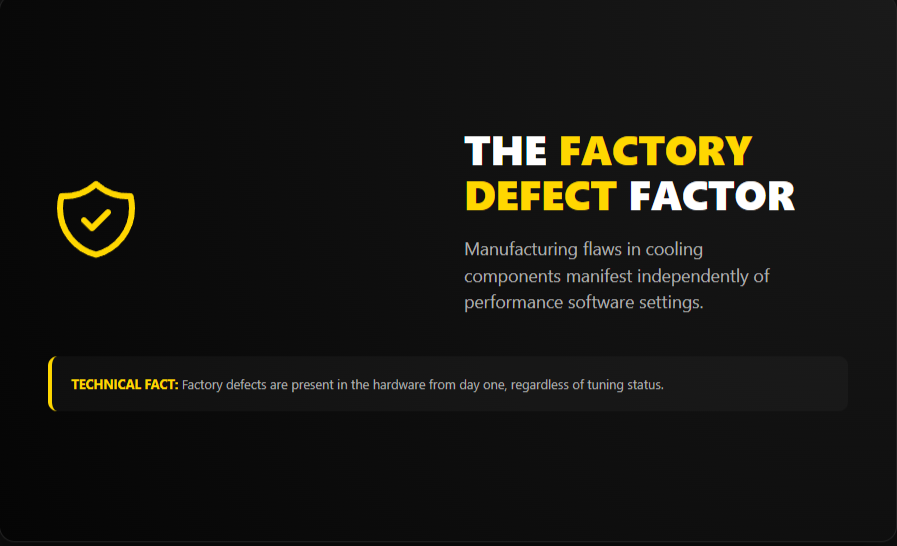
Engine develops a coolant leak at 30,000 km. Owner has GAN module installed. Dealer inspects, finds the leak is from a failed water pump bearing – a known defect for that model. No connection between tuning module (which affects fuel and boost) and water pump bearing failure. Warranty claim approved.
Same car, engine destroys a piston at 40,000 km. Investigation shows the piston failed from excessive cylinder pressure caused by running too much boost. Owner was running sport mode constantly with cheap fuel. Direct causation proven. Warranty claim denied.
The difference? Provable cause and effect.
Some dealers will try to deny warranty claims the moment they see any modification, hoping you won’t fight it. Don’t accept this immediately.
Most markets have consumer protection agencies (Rospotrebnadzor in Russia, similar agencies in EU countries, consumer affairs departments in the US). File a complaint. These agencies investigate whether the dealer’s refusal is legitimate.
The dealer has to provide technical evidence showing how your modification caused the failure. «Customer installed aftermarket part» isn’t sufficient. They need engineering analysis proving causation.
From GAN’s experience across 8 countries since 2018: most warranty disputes over external modules get resolved in the owner’s favor because dealers can’t prove causation for unrelated failures.
| Failure Type | Likely Warranty Outcome with External Module |
| Electrical issues (stereo, windows, sensors) | Covered – no proven connection to tuning |
| Transmission problems | Covered – tuning doesn’t modify transmission |
| Suspension/brake failures | Covered – completely unrelated to engine tuning |
| Engine failure with evidence of over-boost | Denied – direct causation provable |
| Turbocharger failure (heavy use, sport mode) | Possibly denied – causation arguable |
| Engine failure from manufacturing defect | Covered – defect existed independent of tuning |
ECU remapping leaves permanent digital fingerprints. When dealers plug in their diagnostic equipment, they can see:
There’s no hiding it. Once you’ve remapped the ECU, dealers know. Even if you reflash back to stock, often the history is visible in ECU logs.
External modules like GAN’s work completely differently. They sit between sensors and the ECU, modifying signals in real-time. When you unplug the module:
From the ECU’s perspective, nothing ever happened. Dealers literally cannot tell you had a module installed unless they physically see it connected during inspection.
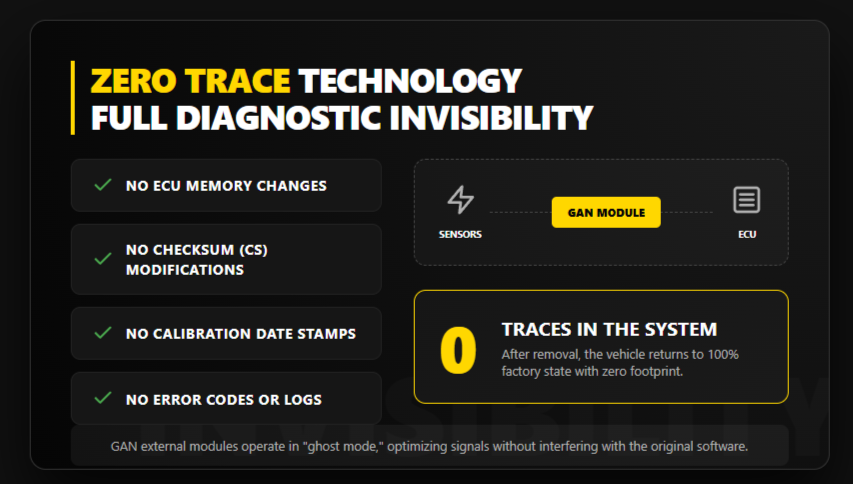
Understanding what the module does helps understand why it’s warranty-safer than ECU remapping.
Optimizes throttle response and fuel delivery by accessing the ECU’s existing high-performance maps. These maps already exist in your factory ECU – manufacturers program them in but restrict access. The module just tells the ECU to use them. No safety systems disabled, no protection limits removed.
Modifies boost pressure sensor signals so the ECU allows more boost. Your turbocharger can handle 2.0 bar but factory limits it to 1.4 bar. The module tells the ECU it’s seeing 1.2 bar when actual boost is 1.7 bar. The ECU compensates by requesting more boost, unlocking performance the hardware already supported.
Critical point: factory safety systems stay active. If knock sensors detect detonation, the factory ECU still pulls timing. If oil pressure drops, the factory ECU still limits power. All manufacturer protection algorithms keep running.
Engineers with over 20 years of calibration experience designed these modules to work within factory safety parameters. That’s why GAN offers a €5,000 engine guarantee for 2 years – they’re confident the modules won’t cause failures.
Installing a GAN module takes 10-15 minutes. Removing it takes 2 minutes. This reversibility is the key to warranty preservation.
Before any dealer service appointment: unplug the module, store it somewhere safe. After service: plug it back in. The factory ECU has no memory of the module ever being connected.
Compare this to ECU remapping, where reversing the flash means paying for another reflash (often €300-500), risking ECU corruption during the process, and still leaving traces in the ECU’s memory that dealers can detect.
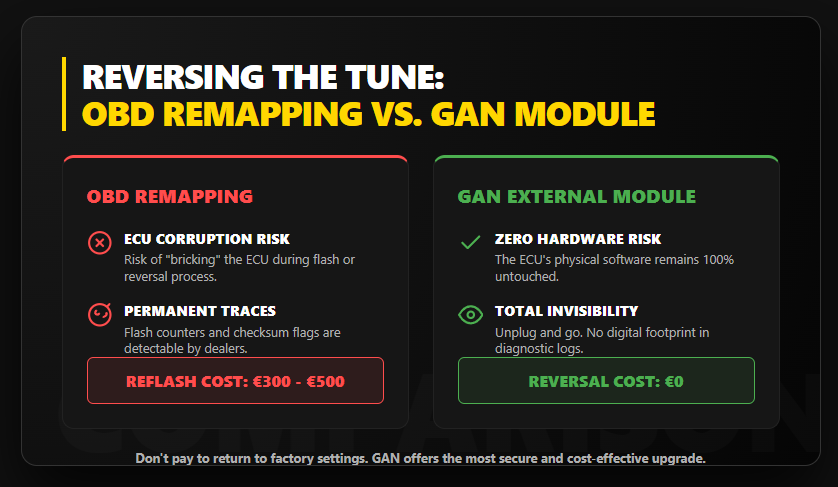
External tuning modules like GAN’s preserve warranties better than any other performance modification because:
They’re completely removable with zero digital trace
Factory safety systems remain fully active
Dealers must prove causation to deny claims, which is difficult for unrelated failures
Mandatory warranty protection stays in effect unless direct causation is proven
ECU remapping voids warranties immediately because dealers can detect it, and you’ve permanently modified factory programming.
If you want more power but need to keep warranty protection, external modules are the only realistic option. Just remember to remove them before service appointments.
The legal reality: dealers need proof of causation, not just proof of modification. Most failures (electrical, transmission, suspension) have no provable connection to engine tuning. But be realistic – if you blow up your engine running maximum boost on cheap fuel, don’t expect warranty coverage.
Your car’s ECU is basically a small computer that runs your engine. That’s it. Everything else – all the power increases, fuel mapping, sensor reading – flows from that one fact.
Understanding what an ECU actually does makes it way easier to understand how chip tuning works and why it’s even possible. So let’s break down what’s happening under your hood.
ECU stands for Electronic Control Unit. Some people call it ECM (Electronic Control Module) or CCM (Central Control Module). Same thing – a microprocessor-based computer that manages engine operation.
The first ECU showed up in 1939 when BMW engineers installed a basic electronic control system. Modern ECUs are obviously way more sophisticated, but the core concept hasn’t changed: read sensor data, make calculations, control engine components.
What your ECU does every second:
All of this happens thousands of times per second while you’re driving. Your throttle input is just one variable the ECU considers when deciding how much fuel to inject and when to fire the spark plugs.
Think of the ECU as constantly answering one question: given current conditions, what should the engine do right now?
Current conditions include: throttle position, engine speed (RPM), intake air temperature, coolant temperature, boost pressure (turbocharged cars), oxygen sensor readings, knock sensor readings, vehicle speed, gear position, and about 30 other variables depending on your car.
The ECU takes all those inputs, looks them up in its fuel maps – which are basically massive tables saying «at X RPM and Y throttle position with Z air temperature, inject this much fuel» – and outputs commands to make it happen.
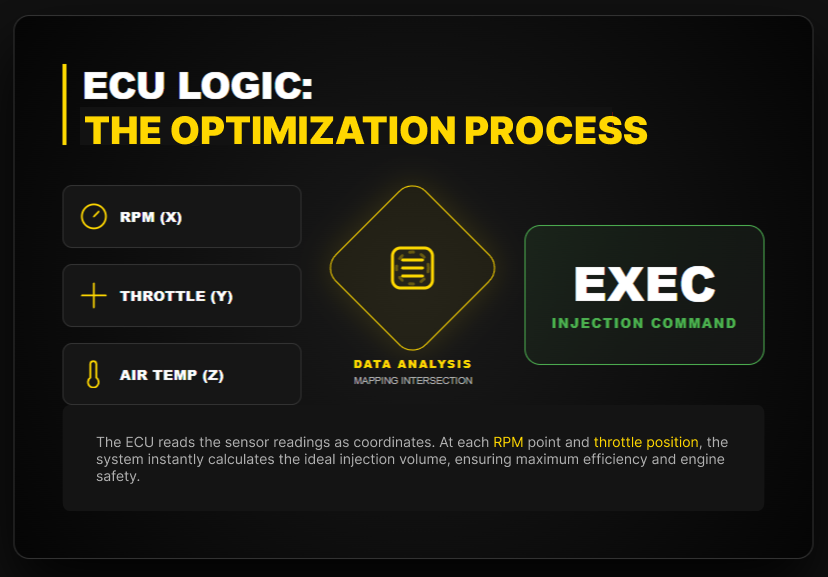
You’re cruising at 2000 RPM, coolant at 90°C, and you push the throttle 30% open. The ECU reads: throttle position sensor (30%), MAF sensor (15 g/s of air flowing), coolant temp (90°C), RPM (2000). It looks up the fuel map for those conditions and calculates: inject 8.5 milliseconds of fuel per cylinder, fire spark plugs 12 degrees before top dead center. Engine produces smooth acceleration.
Now you floor it. Throttle sensor jumps to 100%, air flow spikes to 60 g/s, turbo boost climbs to 1.5 bar. ECU recalculates: inject 22 milliseconds of fuel, advance timing to 8 degrees, maximum power output.
This happens continuously as conditions change. The ECU is basically running a real-time simulation of optimal combustion thousands of times per second.
Fuel maps are where manufacturers build in all their safety margins and restrictions. These tables define how aggressive or conservative your engine runs.
A fuel map might say: «At 3000 RPM and full throttle, inject enough fuel for 1.2 bar boost pressure.» But your turbocharger could safely handle 1.6 bar. Manufacturers program conservative limits to protect against bad fuel, extreme temperatures, and drivers who never do maintenance.
That’s the gap chip tuning exploits. The hardware can handle more than the software allows.
| ECU Parameter | Factory Setting | Hardware Capability | Tuning Unlocks |
| Max boost pressure | 1.4 bar | 2.0 bar | 1.7-1.8 bar |
| Fuel injection duration | 18 ms | 25 ms | 22-23 ms |
| Ignition timing advance | 10° BTDC | 15° BTDC | 12-13° BTDC |
| Torque limiter | 350 Nm | 480 Nm | 450 Nm |
These numbers come from GAN’s testing on 30,000+ vehicles. The pattern holds across manufacturers – conservative factory programming leaves significant performance headroom.
There are two approaches to making the ECU run your engine differently: modify the ECU itself, or modify the signals going into the ECU.
Option 1: ECU remapping (OBD tuning)
Connect to the ECU via the diagnostic port, pull the factory software, modify the fuel maps and parameters, write the new software back. Now the ECU is running different programming.
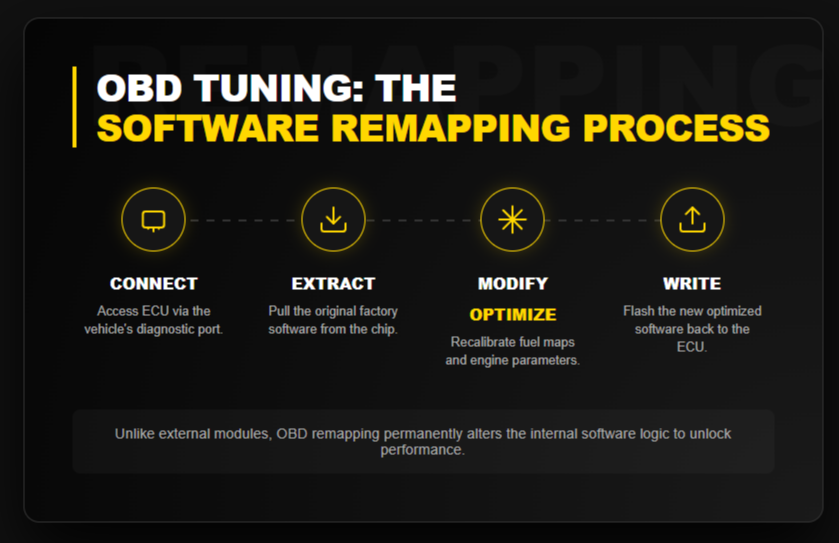
This works, but it’s permanent (until you reflash again), voids warranties because dealers can detect the changes, and often disables safety systems because tuners remove the limits manufacturers programmed in.
Option 2: External control module (chip tuning)
Install a separate device between your sensors and ECU. This module reads sensor signals, modifies them, sends altered data to the ECU. The ECU thinks it’s seeing different conditions and adjusts accordingly.
Your factory ECU and its safety systems stay completely intact. The module is fully removable with zero trace.
When you reprogram the ECU, you’re typically disabling or modifying the safety limits manufacturers spent millions developing. Common changes in ECU remapping: disable torque limiters, remove boost pressure safeties, increase maximum injection duration beyond safe levels, advance ignition timing into knock territory.
These changes extract maximum power but remove the safety net. If something goes wrong – bad fuel, carbon buildup, failing sensor – the ECU won’t protect the engine because you disabled the protection systems.
External modules like GAN’s work differently. They request more power by modifying sensor signals, but the factory ECU’s safety systems stay active. If knock sensors detect detonation, the factory ECU still pulls timing. If oil pressure drops, the factory ECU still limits power. All the manufacturer’s protection algorithms keep running.
Engineers with over 20 years of calibration experience designed GAN modules specifically to work within factory safety limits while unlocking the performance headroom in the hardware. That’s why they can offer a €5,000 engine guarantee for 2 years – the modules don’t ask for anything the engine can’t safely deliver.
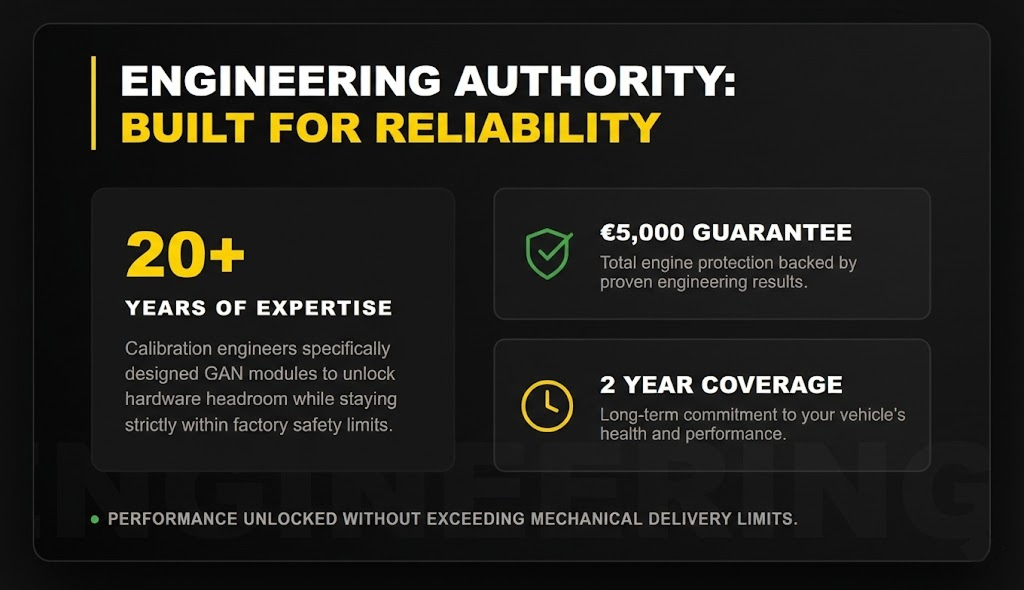
The module connects via your OBD-II port or directly to specific sensors depending on your engine type. Installation takes 10-15 minutes.
Your factory ECU keeps managing everything – coolant temperature, oil pressure, knock detection, emissions controls. Nothing gets disabled. You just get access to performance the manufacturer deliberately restricted.
The module is completely reversible. Unplug it before a dealer visit, plug it back in after. Zero trace in ECU memory. Your warranty stays intact because the factory ECU and its programming never changed.
Your ECU is programmed conservatively to protect against worst-case scenarios most drivers never encounter. The hardware – turbocharger, fuel injectors, engine internals – can handle significantly more than the software allows.
Chip tuning works because it unlocks that headroom without removing the safety systems. External modules are safer than ECU remapping because they keep all factory protections active while requesting more performance.
Understanding what the ECU does makes it obvious why chip tuning is possible and why external modules make more sense than reprogramming for most people.
Everyone asks this question before installing a tuning module: will my fuel consumption go up or down? The honest answer is – it depends entirely on how you drive.
Install a chip and keep driving like you did before? You’ll probably use 10-15% less fuel. Install the same chip and start using all that extra power? Yeah, you’ll burn more. Let me explain what’s actually happening with your engine.
Fuel consumption isn’t just about the hardware in your engine. It’s about what you do with the throttle pedal.
Light-footed drivers who accelerate gently and maintain steady speeds typically see fuel savings after installing a tuning module. Why? Because the extra torque means the engine doesn’t work as hard to maintain speed or accelerate moderately. Less engine load = less fuel.
Aggressive drivers who use the newfound power constantly – hard acceleration, high speeds, frequent overtaking – will burn more fuel. That’s just physics. More power output requires more fuel input.
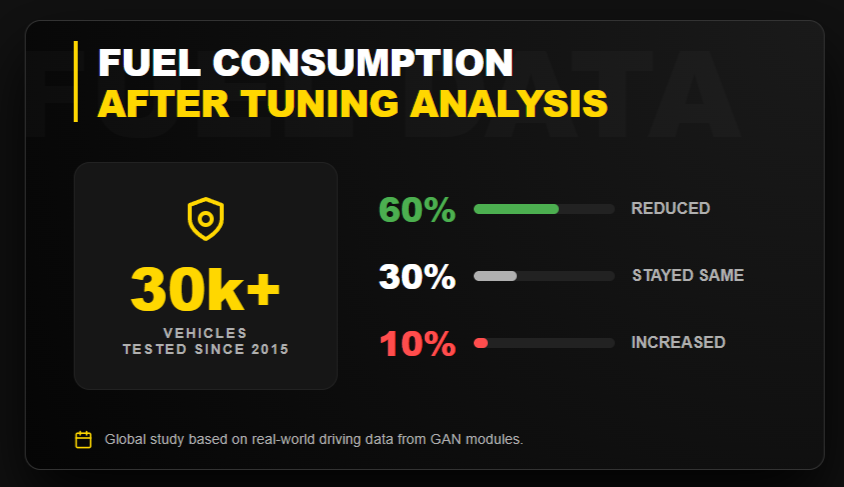
GAN’s data from testing over 30,000 vehicles since 2015 shows the split pretty clearly: about 60% of drivers see reduced fuel consumption, 30% see roughly the same consumption, and 10% see increased consumption. The difference? Driving behavior.
Naturally aspirated engines (no turbo, no supercharger) get the GAN GA+ module. This module convinces your ECU to use more aggressive fuel maps – the kind manufacturers program for high-performance driving but limit access to.
What changes: The air-fuel mixture gets optimized, ignition timing advances, and throttle response sharpens. You get up to 12% more power without any mechanical modifications.
But here’s the interesting part: GA+ includes an eco-mode that leans out the fuel mixture slightly while increasing air intake. This mode prioritizes fuel economy over performance. Drivers using eco-mode see fuel savings up to 15%, which is substantial for commercial vehicles or anyone doing a lot of highway driving.
The catch? GAN’s main focus is increasing power. Fuel efficiency is a side benefit, not the primary goal. If you want maximum fuel savings, stick to eco-mode and drive conservatively.
Turbocharged engines use the GAN GT module, which works differently. Instead of modifying fuel mixture directly, it intercepts boost pressure sensors (gasoline engines) or fuel rail pressure sensors (diesel engines).
The process: GT reads the sensor showing, say, 1.5 bar of boost pressure. It modifies that signal downward to 1.3 bar before sending it to the ECU. The ECU thinks boost is low, so it requests more. Actual boost climbs to 1.8 bar. More air + more fuel = up to 30% more power.
GAN keeps these modifications within safe mechanical limits. Your turbocharger can handle the pressure increase – manufacturers just chose not to use it. If something goes wrong and limits get exceeded, your check engine light will warn you. The factory ECU’s protection systems stay active.
Highway driving at steady speeds: 10-15% reduction possible
Mixed city/highway driving: 5-10% reduction typical
Aggressive driving using full power: 5-15% increase likely
Turbo-diesel drivers see the best results because diesels already run lean fuel mixtures, and the extra torque at low RPMs makes highway cruising much more efficient.
| Driving Scenario | Naturally Aspirated + GA+ | Turbocharged + GT |
| Conservative highway | -10% to -15% | -10% to -15% |
| Mixed driving (eco-mode) | -5% to -10% | -8% to -12% |
| Mixed driving (sport mode) | 0% to -5% | -3% to -7% |
| Aggressive driving | +5% to +10% | +5% to +15% |
These numbers come from GAN’s testing across 8 countries with different fuel qualities, climates, and driving conditions.
Trying to measure fuel economy accurately in urban driving is basically impossible. Too many variables mess with the numbers.
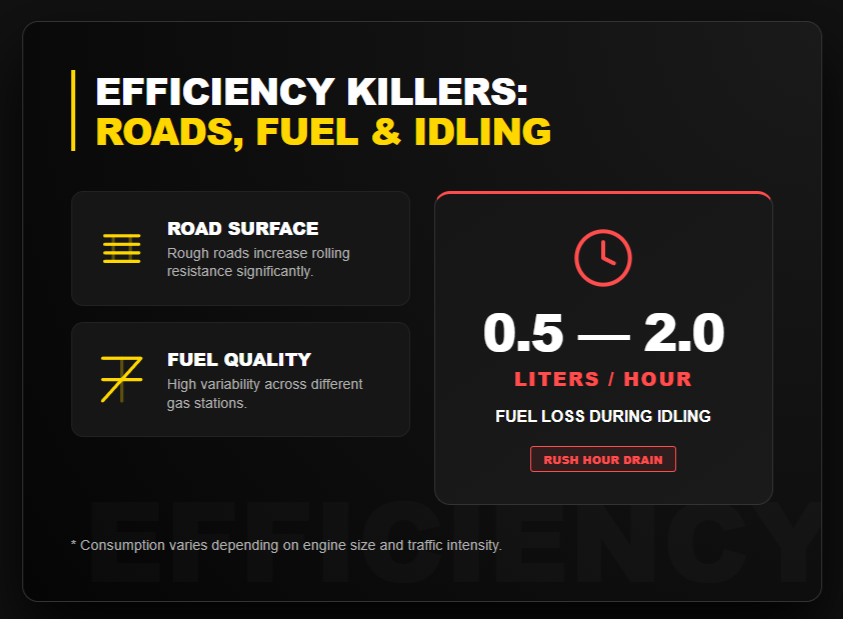
Stop-and-go traffic means constant acceleration and braking – the most fuel-intensive type of driving. Quality of road surface matters (rough roads = more rolling resistance). Fuel quality varies wildly between gas stations. And idling in traffic burns 0.5 to 2 liters per hour depending on engine size, which adds up fast during rush hour.
A tuning module helps somewhat by giving you better throttle response and more low-end torque, so you’re not revving high just to merge into traffic. But city driving will always be fuel-hungry regardless of tuning.
Winter is brutal on fuel economy, tuning module or not. Your car burns extra fuel for several reasons that have nothing to do with chip tuning.
Cold starts require rich fuel mixtures to get the engine running. Warming up the engine before it reaches operating temperature means the combustion isn’t efficient yet. Running the heater, defroster, heated seats, and headlights constantly drains power that the alternator has to replace (which loads the engine).
Winter tires have higher rolling resistance than summer tires. Cold, dense air creates more aerodynamic drag. Snow and ice on roads increase resistance. Everything works against you.
GAN modules help a bit by optimizing combustion and torque delivery, potentially saving about 1-1.5 liters per tank in winter conditions. But winter will always be worse than summer for fuel economy.
This seems counterintuitive, but it’s actually true. Acceleration is when engines consume the most fuel. The longer you spend accelerating, the more fuel you burn.
With a tuning module, you’ve got 20-30% more torque throughout the power band. That means you reach highway speed faster and spend less total time in the high-fuel-consumption acceleration phase. You might burn slightly more fuel per second during that acceleration, but the shorter duration means less overall fuel consumed.
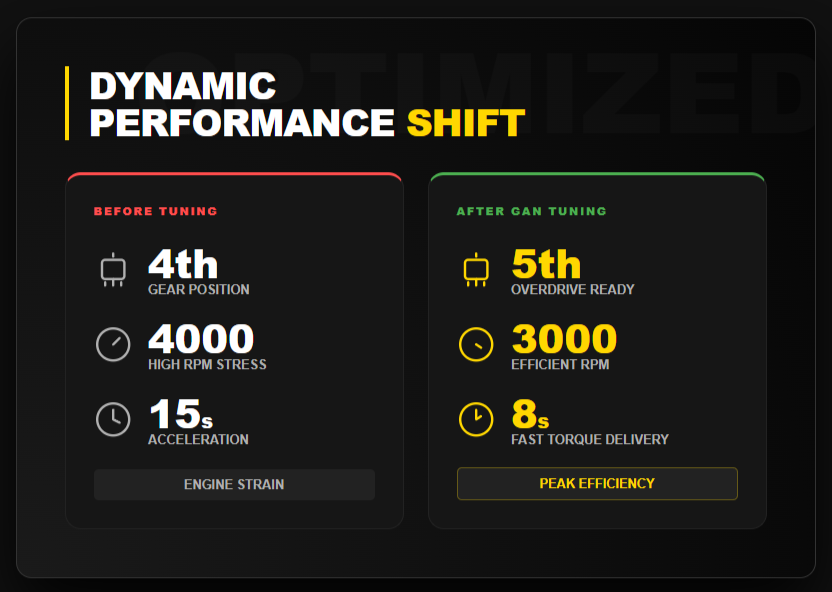
This is especially noticeable on highways with frequent on-ramps or hilly terrain. Before tuning: you downshift to fourth gear, rev to 4000 RPM, take 15 seconds to reach speed. After tuning: you stay in fifth gear, hit 3000 RPM, reach speed in 8 seconds. The second scenario uses less fuel total.
Turbo-diesel drivers see this benefit most clearly. The extra torque at low RPMs means they rarely need to downshift, which keeps the engine in its most efficient operating range.
Based on real-world data from 30,000+ vehicles tested since 2015, here’s what typically happens:
You’ll feel an immediate power increase – 20-30% on turbocharged engines, 10-12% on naturally aspirated. Throttle response sharpens noticeably. The engine pulls harder from lower RPMs.
Fuel consumption in the first few weeks usually goes up slightly because you’re testing the new power. That’s normal. After the novelty wears off and you return to normal driving, fuel consumption typically drops below your pre-tuning baseline.
The improved torque curve means fewer downshifts, less time at high RPM, and more efficient highway cruising. If you use eco-mode and drive conservatively, you’ll see the maximum fuel savings. If you use sport mode and drive aggressively, you’ll burn more fuel – but that’s a choice, not an unavoidable consequence of tuning.
Engineers with over 20 years of calibration experience designed these modules specifically to improve both power and efficiency. The technology allows both – but you decide which benefit you prioritize through your right foot.
You’ve probably seen comments online claiming tuning boxes are scams. The argument usually goes something like this: «There’s nothing technically complex about these boxes. They just alter sensor signals. Zero innovation. No feedback. Pure deception.»
Sounds damning, right? Except the people making these claims are usually OBD tuning shops trying to sell you ECU remapping instead. Let me break down what’s actually happening, because there’s a lot of confusion mixed with some legitimate points.
Yeah, the hardware in a tuning box isn’t rocket science. Any decent electronics specialist could design the circuit board. The box sits between your sensors and your ECU, modifies the signals, sends them along. Not complicated from a hardware perspective.
But here’s what that argument misses: the hardware is basically irrelevant. What matters is the software running on that hardware.
Think about your phone. The physical components – screen, processor, camera – aren’t particularly revolutionary. What makes your phone useful is the software. Same concept with tuning boxes. The circuit board is just the delivery mechanism for sophisticated calibration algorithms.
The calibration maps – thousands of hours of dyno testing across different engines, temperatures, fuel qualities, and driving conditions. GAN’s tested over 30,000 vehicles since 2015 to build these maps. That’s not simple.
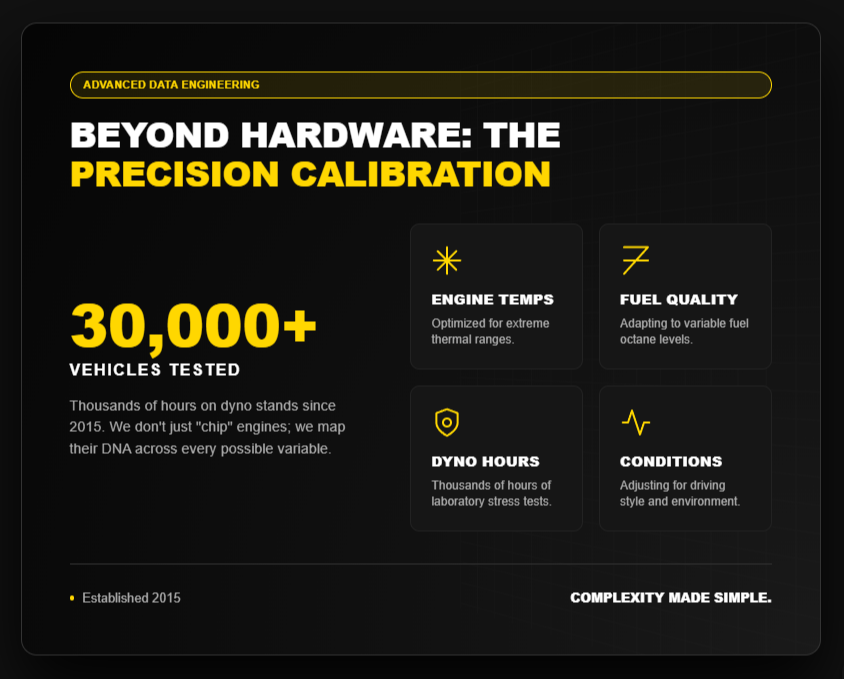
Real-time adjustment algorithms that modify sensor signals based on current operating conditions. Engine cold? Different adjustments than when it’s at operating temperature. Low fuel quality detected? Different fuel mapping than premium fuel.
Safety parameters that prevent the module from requesting power increases when conditions aren’t safe. Oil temperature too high? Throttle the power back. Coolant temperature spiking? Reduce boost pressure.
None of that shows up in the physical circuit board. It’s all software, and that software represents years of engineering work.
Critics love to say tuning boxes «deceive» the ECU. Well, yeah. So does OBD tuning. So does literally every form of performance modification.
All chip tuning works by changing what the ECU thinks is happening. OBD tuning rewrites the parameters stored in ECU memory. External modules modify sensor signals before they reach the ECU. Different methods, same fundamental approach – making the engine behave differently than the factory intended.
The word «deception» makes it sound shady, but it’s just how engine tuning works. Your factory ECU is programmed with conservative fuel maps that prioritize warranty claims and global market compatibility over performance. Tuning changes those parameters to unlock what the hardware can actually handle.
Both methods «deceive» the stock system into running differently. That’s the whole point. The question isn’t whether deception happens – it’s which method does it more safely and reversibly.
| Factor | External Module (GAN) | ECU Remapping |
| Factory ECU modified | No | Yes |
| Warranty preservation | Yes (removable, no trace) | No (detectable by dealers) |
| Safety systems active | Yes (factory protection intact) | Often disabled or modified |
| Reversibility | 100% (unplug and done) | Risky (reflashing can brick ECU) |
| Adjustability | Multiple modes via app | Fixed tune (changes need paid reflash) |
Based on testing more than 30,000 vehicles, external modules actually maintain more safety features than ECU remapping because the factory ECU keeps running its protection algorithms.
Here’s where the critics really get it wrong. They claim tuning boxes don’t receive feedback, implying the ECU is operating blind. That’s backwards.
The factory ECU continues managing the engine exactly like it always did. It receives all the same feedback from all the same sensors – oxygen sensors, knock sensors, temperature sensors, pressure sensors. The ECU is still monitoring everything and making constant adjustments.
What changed? The sensor values it’s receiving are modified by the tuning module. But the ECU’s response algorithms – the ones the manufacturer spent millions developing – are still active and still working.
Actually, this is safer than ECU remapping, where those protection algorithms often get disabled or modified. With an external module, if your engine starts knocking, the factory ECU detects it and pulls timing. If oil pressure drops, the factory ECU limits power. All the safety systems that manufacturers built in? Still functioning.
The tuning module does receive feedback – it sees real-time sensor signals and adjusts its modifications based on current conditions. Modern modules from GAN use closed-loop control, meaning they constantly adapt based on what’s actually happening in the engine.
Let’s get specific about what happens inside a tuning module’s software, because this is where the real engineering lives.
The module reads sensor signals in real-time – boost pressure, air temperature, throttle position, fuel pressure. It compares these values against its calibration maps (built from thousands of hours testing that specific engine). Based on current conditions, it calculates optimal modifications to unlock more power while staying within safe mechanical limits.
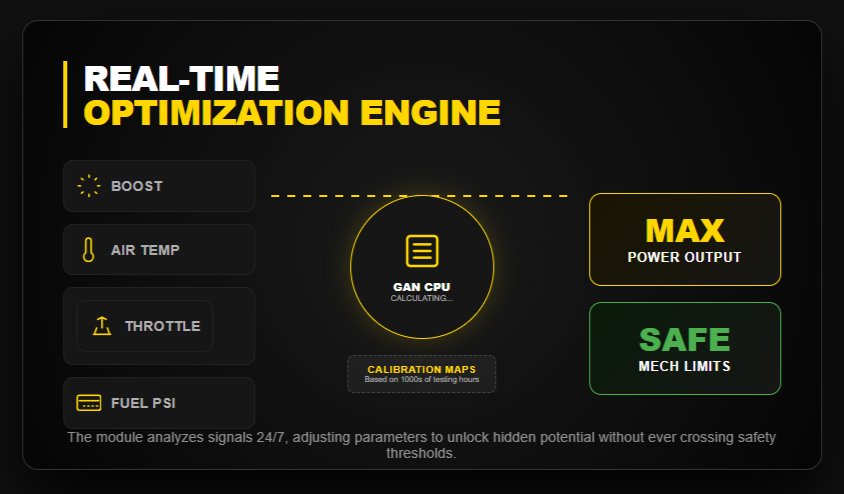
For example: your turbocharger is capable of 2.0 bar boost pressure, but the factory limits it to 1.5 bar. The module reads the boost sensor showing 1.5 bar, modifies the signal to tell the ECU it’s reading 1.3 bar, which causes the ECU to request more boost (since it thinks there’s headroom). The actual boost rises to 1.8 bar, still well below the turbo’s mechanical limit.
But here’s the critical part: if oil temperature climbs too high, or coolant temperature spikes, or fuel quality drops (detected by knock sensors), the module’s algorithm reduces how much it modifies the signal. Less modification = less power increase = engine protection.
Engineers with over 20 years of calibration experience spent years developing these algorithms. Calling that «simple» or «not innovative» completely misses what’s actually happening.
OBD tuning advocates love to trash-talk external modules because they’re competing for the same customers. But the actual comparison comes down to what you value.
If you’re building a heavily modified race car with upgraded turbos, bigger injectors, and custom exhaust – ECU remapping might make sense. You’re so far past stock that the factory ECU’s parameters don’t apply anymore.
For everyone else driving a street car? External modules offer better warranty protection, complete reversibility, adjustable power levels, and preserved safety systems. Plus you avoid the risk of bricking your ECU during the flashing process.
GAN modules tested on 30,000+ vehicles show the same performance gains as good ECU remapping (up to 30% on turbocharged engines), but you can remove the module before dealer visits with zero trace. Can’t do that with a reflashed ECU.
The «deception» argument is just marketing from competitors. Both methods change how the engine runs. One does it reversibly while keeping factory protections active. The other does it permanently and often disables safety systems.
Pretty clear which one makes more sense for most people.
Your car’s engine isn’t running at full capacity. Never has been. Manufacturers deliberately program engines to produce less power than they’re actually capable of, and there are some pretty specific reasons why.
This isn’t some conspiracy theory – it’s basic automotive economics and engineering. Let me show you what’s really going on.
Modern cars are packed with sensors. Coolant temperature, air pressure, throttle position, oxygen levels – dozens of them feeding data to your ECU every millisecond. The ECU takes all that information and decides how much fuel to inject, when to fire the spark plugs, how much boost pressure to allow.
Chip tuning intercepts signals between these sensors and the ECU. A tuning module reads the sensor data, modifies it based on what your engine can actually handle (not what the factory decided to limit it to), then sends the adjusted information to the ECU.
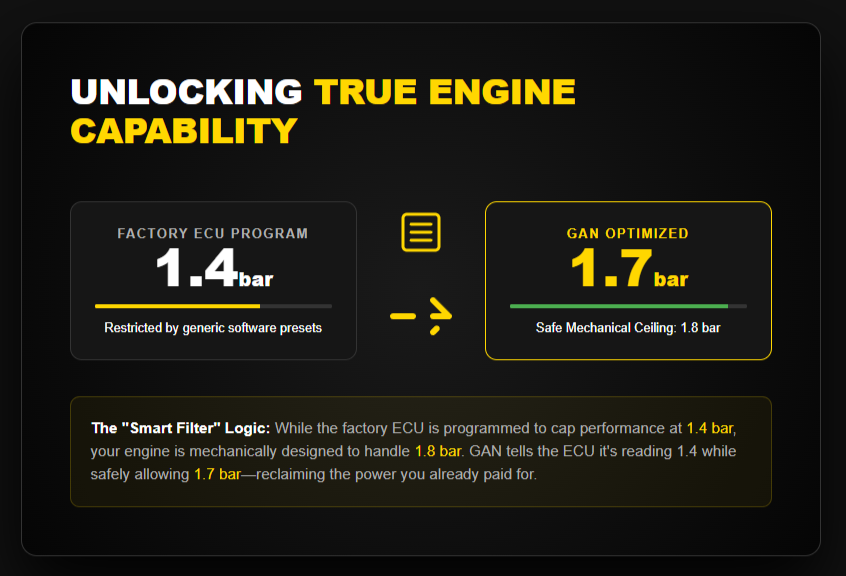
Think of it like this: your engine could handle running at 1.8 bar of boost pressure, but the factory programmed the ECU to max out at 1.4 bar. A tuning chip tells the ECU «hey, the sensor is reading 1.4 bar» when it’s actually allowing 1.7 bar. The engine produces more power because it’s finally being used closer to its actual capability.
Car companies could absolutely tune engines to maximum power from the factory. They choose not to. Here’s why.
Look at Volkswagen’s 2.0 TDI diesel. You’ll find it in the VW T5, Skoda Superb, VW Passat CC, and Audi A6. Exact same physical engine. But the power output ranges from 140 horsepower to 177 horsepower depending on the badge on the front. That’s just ECU programming creating an entire model lineup.
| Vehicle Model | Engine | Factory Power | Factory Torque | Actual Capability |
| VW T5 | 2.0 TDI | 140 HP | 340 Nm | Up to 180 HP / 440 Nm |
| Skoda Superb | 2.0 TDI | 140 HP | 320 Nm | Up to 180 HP / 440 Nm |
| VW Passat CC | 2.0 TDI | 170 HP | 350 Nm | Up to 220 HP / 450 Nm |
| Audi A6 | 2.0 TDI | 177 HP | 380 Nm | Up to 230 HP / 480 Nm |
GAN’s testing on over 30,000 vehicles confirms these engines easily handle the higher numbers with proper tuning.
Manufacturers protect engines from what they call «abuse scenarios.» Someone buys a turbocharged car, never lets it warm up properly, floors it in second gear from cold starts, uses cheap fuel, skips oil changes. The engine needs to survive this treatment under warranty.
Factory ECU programming includes massive safety margins. If the engine could theoretically handle 400 Nm of torque continuously, manufacturers might limit it to 320 Nm just to be safe. That 80 Nm buffer? Pure protection against worst-case scenarios that most drivers will never encounter.
Climate adaptation is another factor. Engines behave differently at -30°C in Norway versus +45°C in the Middle East. Rather than create region-specific tunes (expensive), manufacturers program one conservative map that works everywhere.
Here’s what engineers with over 20 years of calibration experience will tell you: modern engines are massively over-engineered compared to their factory power outputs. A turbocharger rated for 2.2 bar might be limited to 1.5 bar. Fuel injectors capable of 2000 bar get capped at 1600 bar. The hardware can handle way more than the software allows.
This one’s purely about not cannibalizing your own sales. BMW’s 2.0-liter turbocharged four-cylinder could easily be tuned to match their 3.0-liter six-cylinder in power. The turbo four is actually more efficient and lighter.
So why doesn’t BMW do it? Because then nobody would buy the more expensive six-cylinder models. Marketing departments lose their minds at the idea of a cheaper car outperforming a premium one.
Same story across every manufacturer. The hardware gap between engine tiers is getting smaller, but the software gap keeps them differentiated. That’s where chip tuning becomes interesting – you’re buying the budget model and unlocking performance that manufacturers deliberately restricted.
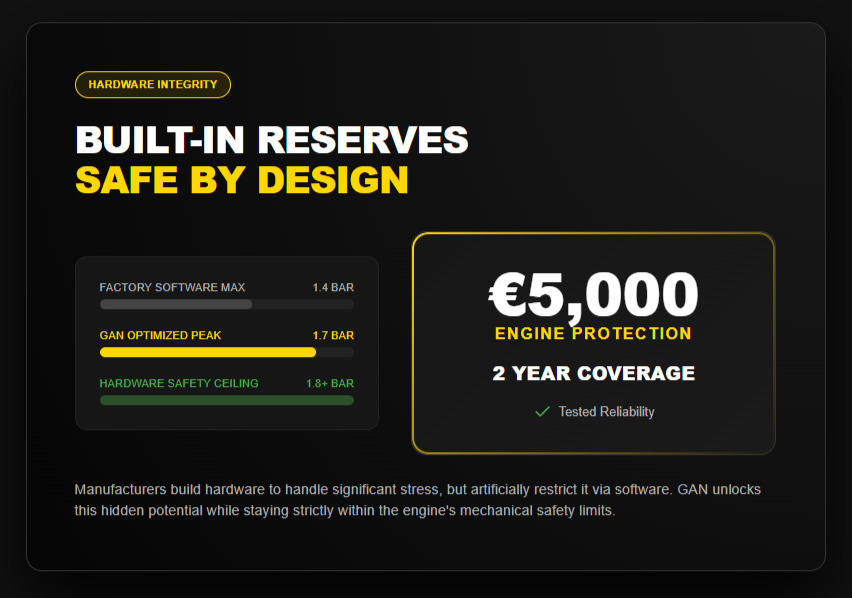
The chip tuning industry exists entirely because manufacturers deliberately undertune engines. If cars came from the factory running at their mechanical limits, there’d be nothing to unlock.
GAN’s been doing this since 2015 across 8 countries, and the pattern is consistent: turbocharged engines typically have 25-35% power headroom built into the hardware, while naturally aspirated engines have 10-15% headroom. Manufacturers use maybe 70-80% of the available capability.
Real gains from unlocking factory restrictions (tested on 30,000+ vehicles):
The difference between turbocharged and naturally aspirated gains? Turbos are even more restricted by manufacturers because they’re easier to damage if abused. That means more headroom for proper tuning to unlock.
Car companies program engines conservatively for valid reasons – global markets, warranty costs, model differentiation, maintenance intervals. But that conservatism leaves a lot of performance sitting unused in your engine.
Chip tuning works because it removes arbitrary software limits while respecting the actual mechanical limits of your hardware. You’re not forcing the engine beyond what it was built to handle. You’re just using what was always there.
The manufacturers know this. They’re doing the same thing when they create «sport» packages or higher trim levels – just charging you a lot more for it.
Think about it. Back in the 1980s, getting more power from your car meant pulling out the ECU, desoldering chips, and hoping you didn’t brick the whole system. Fast forward to 2026, and you’ve got plug-and-play modules adding 30% to turbocharged engines. GAN’s tested this on over 30,000 vehicles since 2015, so we’re not talking theory anymore.
The big question everyone asks? Is chip tuning actually safe, or is it just marketing talk dressed up as technology?
BMW engineers were messing around with electronic control units back in 1939. Yeah, 1939 – way before computers were even a thing in most people’s minds. That first microcomputer-based system handled fuel injection timing and ignition synchronization. Funny thing is, modern chip tuning still works on the same basic principles.
The real action started in the 1980s when racing engineers figured out they could reprogram EPROM chips to squeeze more horsepower out of competition cars. Then OBD-II came along in the 1990s, which basically opened up engine data across all manufacturers. Game changer. By 2015, GAN had launched modules you could control from your phone.
What changed everything was this shift from permanent ECU mods to external modules. You could just unplug them whenever you wanted. Testing on more than 30,000 cars showed these boxes kept warranties intact while actually delivering the power gains they promised.
Nicolas Joseph Cugnot built a steam-powered vehicle in 1769. Top speed? 4.5 km/h. Your grandma on a walker could probably beat it in a race. The breakthrough that actually mattered came in 1886 – Karl Benz and his first gasoline-powered car. That internal combustion engine architecture? We’re still tuning the same basic design today.
Chip tuning works by tweaking three things: how much fuel gets injected and when, turbocharger boost pressure (if your car has one), and ignition timing. Simple concept, but the results add up fast.
| Engine Type | GAN GT Power Gain | GAN GA+ Power Gain | Torque Increase |
| Turbocharged | Up to +30% | Up to +12% | Up to +30% |
| Naturally aspirated | Up to +12% | Up to +12% | Up to +15% |
| Diesel | Up to +30% | Up to +15% | Up to +35% |
GAN modules intercept signals between your engine sensors and the ECU, modifying them in real-time. Your factory programming stays untouched.
Old-school chip tuning was a nightmare. You’d spend hours pulling the ECU apart, desoldering the EPROM chip, reprogramming it, putting it all back together. And kiss your warranty goodbye the moment you started.
Now look at what we’ve got in 2026. Installation? Ten to fifteen minutes, tops. You can pull the module out whenever you want – no permanent changes. The housing is military-grade IP67 waterproof instead of exposed circuits that hate moisture. GAN throws in an engine guarantee up to €5,000 instead of you being on your own if something breaks. Plus you get five different modes you control from your phone, not one fixed program you’re stuck with.
Engineers who’ve been calibrating engines for over 20 years will tell you the same thing: external modules cut out the biggest risk, which is corrupted ECU software turning your engine computer into an expensive paperweight.
Time to clear up some stuff that gets repeated way too often.
Wrong. External modules like GAN don’t void warranties because you can pull them out and they leave zero trace in ECU memory. Traditional ECU flashing? Yeah, that voids warranties. Big difference. This myth stuck around because back in the 1980s and 90s, all tuning was permanent ECU mods.
Actually no. GAN’s data from 30,000+ vehicles shows fuel economy improvements up to 15% if you keep driving the same way. Turbocharged engines hit their target power at lower RPMs. Sure, if you start driving like you’re late for everything after the tune, you’ll burn more fuel. But the tech itself makes combustion more efficient.
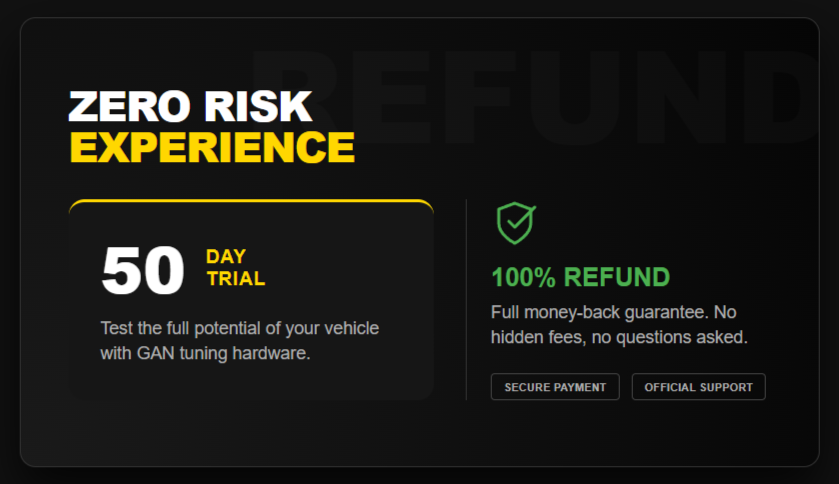
Modern modules stay inside manufacturer-safe limits – below redline and maximum cylinder pressure. GAN puts their money where their mouth is with a 50-day test period and up to €5,000 engine protection guarantee for 2 years. The engines that got damaged were from bad tunes by people who didn’t know what they were doing, not from professional development tested in 8 countries.

Germany’s automotive engineering culture ate this stuff up from the start. English-speaking markets? Not so much. People were skeptical about messing with ECU modifications. That changed when plug-and-play tech showed up and you didn’t need to be an engineer anymore.
GAN’s been doing this since 2015, and what they’ve learned is that modern modules need exactly zero technical knowledge. Find your OBD-II port (your vehicle manual shows where it is), connect the module – takes about 15 minutes – download the app, pick between Eco mode, Sport mode, or set up your own custom profile. Done.
You get 5 free reprogramming sessions with GAN modules. Your driving needs change? Just update the calibration. Try doing that with an ECU flash – you’re paying the dealer every single time you want adjustments.
Both, but they work differently. Turbocharged engines can see up to 30% power gains because the module optimizes boost pressure. Naturally aspirated engines get up to 12% through better ignition timing and fuel mapping. You’ll feel the difference most when you’re accelerating in the mid-range.
Yep. External modules leave absolutely nothing in ECU diagnostic memory. Your ECU has no idea a module was ever there. ECU remapping leaves software version traces that dealers can spot during diagnostics.
Three things make chip tuning way easier now than when it started in the 1980s.
OBD-II came out in 1996 and created universal port access. No more custom wiring jobs for every different manufacturer. Then smartphones changed the game – you’re monitoring performance and switching modes through an app instead of installing physical switches on your dashboard. And here’s the kicker: 50-day trial periods with full refunds. You can actually test the claims before you commit, which was impossible back when ECU mods were permanent.
Engineers with more than 20 years calibrating engines say current modules are the safest way to add power. Matters a lot if you live somewhere with strict emissions rules and need to be able to reverse everything.
Here’s how it breaks down between ECU remapping and external modules. Flashing might squeeze out 2-3% more power at the absolute maximum. But external modules give you adjustability, keep your warranty intact, and you’re not locked into anything permanent.
« Previous Page

Contact us via WhatsApp