


Suspension tuning is always a compromise between handling, comfort and road legality. A 30–40 mm drop with a properly matched spring-and-damper setup reduces body roll, sharpens steering response and improves high-speed stability. A coilover kit gives you precise ride height adjustment. A strut bar increases the torsional stiffness of the front end. Each step requires the right documentation — and, in most cases, a type approval or inspection sign-off.
Why does suspension tuning make sense — and where do you start?
The factory suspension is engineered for the widest possible audience: maximum comfort, tolerance for varying speeds and load conditions. That’s an intentional compromise. When engine output increases — through a tuning module or other means — the factory suspension calibration often no longer matches the new dynamic demands. The car rolls more in corners, responds sluggishly to steering inputs and wanders during quick lane changes at motorway speeds.
Proper suspension tuning addresses exactly this: it brings the chassis in line with the car’s actual power output and real-world speeds. The goal isn’t “as low as possible” — it’s “optimally set up for the task.”
Lowering springs vs coilovers: what’s the real difference?
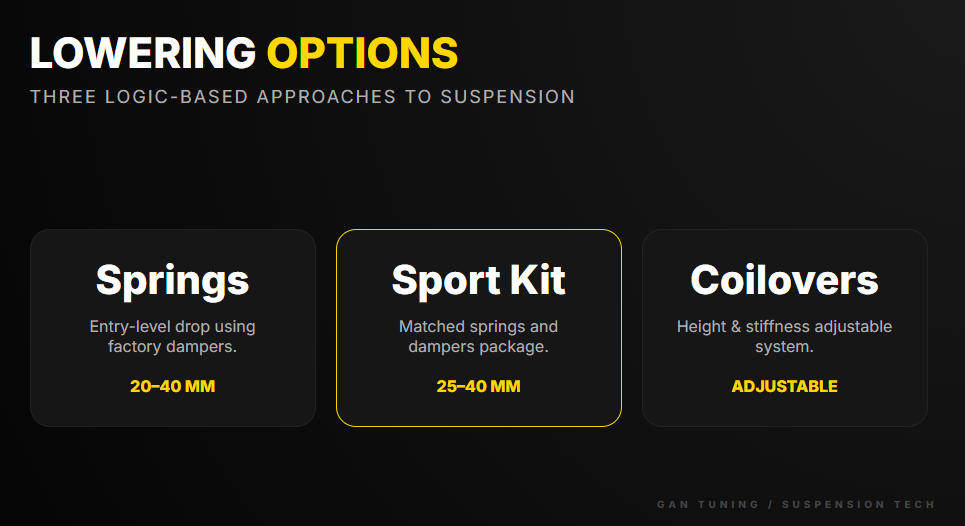
There are three main options for lowering a car, and each follows its own logic.
Lowering springs (Tieferlegungsfedern)
The most common starting point. Shorter, stiffer springs are fitted to standard or uprated dampers. According to data from Bilstein, fitting stiff springs to worn factory dampers compromises both comfort and control — the damper simply can’t keep up with the sharper rebound rate. The rule is straightforward: if your dampers have covered 80,000 km or more, replace them at the same time as the springs.
Drop: typically 20–40 mm depending on the model. Entry cost is low. Most serious manufacturers (H&R, Eibach, Bilstein) supply the required type approval documentation with the kit. The downside is fixed ride height — there is no adjustment.
Sport suspension kit — a matched package
Springs and dampers from the same manufacturer, optimised for a specific drop figure. The key word is “matched”: the damper’s rebound and compression rates are calculated specifically for the stiffness and travel of those springs. The result is more predictable and consistent than mixing any spring with any damper.
This is the best option for a daily driver: 25–40 mm drop, predictable behaviour, no unpleasant surprises in everyday use.
Coilovers (threaded body suspension)
A height-adjustable system, often with separate damper stiffness adjustment. A coilover guide will tell you this is the most flexible option on the market: you can set the ride height precisely for the situation — a little higher for winter and daily driving, lower for track days or show events.
Coilovers require careful setup within the ranges specified in the type approval documentation. After any significant adjustment, a four-wheel alignment check is mandatory. A coilover kit gives you maximum flexibility, but it also demands maximum responsibility in how you use it.
| Parameter | Lowering Springs | Sport Kit | Coilovers |
| Drop | 20–40 mm (fixed) | 20–40 mm (fixed) | 20–80 mm (adjustable) |
| Height adjustment | No | No | Yes |
| Stiffness adjustment | No | No | Often yes |
| Compatibility | With standard/sport dampers | Paired only | Complete set |
| Type approval | Often included | Often included | Required, model-specific |
| Price | Low–medium | Medium | Medium–high |
| Ideal for | Daily driver | Daily + sport | Track, show, fine-tuning |
The suspension is the logical next step after engine tuning. GÄN Tuning Büro has specialised in power upgrades for turbocharged and naturally aspirated engines since 2015 — over 30,000 vehicles across 8 countries. Want to know what’s possible for your car’s dynamics? → Find the right GÄN tuning module for your car
Strut bar benefits: what does a strut brace actually do?
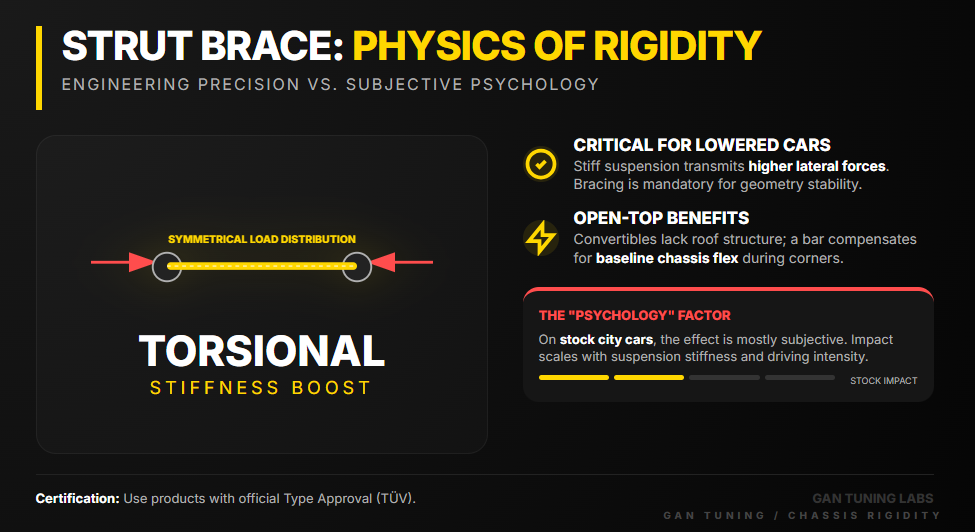
A strut bar is a rigid cross-brace connecting the two front strut towers. The physics is direct: as the car corners, large lateral forces are transmitted through the suspension struts. Without additional bracing, the strut towers can flex slightly relative to each other — the suspension geometry shifts, steering precision drops and feedback becomes vague.
The strut bar distributes these loads symmetrically between the left and right towers, increasing the torsional stiffness of the front end of the body. The practical result: more precise steering response, more stable suspension geometry under hard use and less long-term wear on the strut top mounts.
When a strut bar makes a measurable difference
The effect is most noticeable in three scenarios. First, on a lowered and stiffened car: a harder suspension transmits loads to the body more intensely, so the additional rigidity from the brace is felt more clearly. Second, on a convertible or open-top body: the baseline torsional stiffness is inherently lower than on a coupé or hatchback with a full roof structure. Third, on a powerful car in fast corners: when lateral forces are systematically high — on a track day, at motorway on-ramps — the strut bar helps keep behaviour predictable.
When a strut bar is more psychology than engineering
On a standard, unmodified car with factory suspension used in urban traffic and relaxed motorway driving — the difference will most likely remain subjective. The automotive engineering community is honest about this: the effect of a strut bar scales with suspension stiffness and the intensity of use. On a stock car it’s questionable. On a lowered, stiffened and tuned car it becomes a different conversation.
From a type approval perspective, a strut bar is a structural modification. The safe approach is to use products that come with the appropriate type approval documentation. Most quality manufacturers (Eibach, H&R, Strutbrace) supply their braces with the necessary paperwork.
Legal requirements and vehicle inspections: what you need to know
Any suspension modification falls under safety-relevant components. This means strict documentation requirements in every European market.
Type approval documents: what’s the difference?
General type approval (equivalent to ABE) — a blanket approval for a specific component type. Buy it, fit it, carry the document in the car. No additional inspection required.
Component expert report (Teilegutachten equivalent) — a technical assessment tied to a specific vehicle type and model. After installation, a visit to an approved inspection centre is required, along with an official entry in the vehicle registration documents. Without this step, the car’s operating permit is effectively voided — which has direct consequences for insurance cover in the event of an accident.
Ground clearance: how much is legally required?
There is no single European standard that specifies a minimum clearance figure in millimetres. However, inspection bodies across Europe apply a common practical test: the vehicle must be able to pass over a fixed obstacle (typically 800 mm wide, 110 mm high) without hard structural components making contact. In practice, this means a minimum of approximately 110 mm of clearance for metal components.
Most markets also have specific rules on the minimum height of front and rear number plates above ground level, as well as headlamp height requirements. These are worth verifying for your country before a deep drop.
Insurance and illegal suspension modifications
Illegal suspension work without proper documentation can be treated by your insurer as an undeclared increase in risk. In the event of a claim, the insurer may reduce the payout or seek recovery. This is a concrete, financial argument for doing everything with the correct paperwork — not a philosophical one.
Suspension and engine work best as a system. The GÄN GT tuning module increases turbocharged engine power by up to 25%, torque by up to 25% and reduces fuel consumption by up to 15%. IP67-rated housing, 5 operating modes, smartphone control. Removable in 60 seconds without a trace in the ECU — manufacturer warranty stays intact. Engine warranty up to €5,000 for 2 years — the only one in the segment with real financial coverage. → Learn more about GÄN GT at gantuning.com
What to check before you touch the suspension: a practical checklist
Most problems with suspension tuning don’t come from the components themselves — they come from poor preparation and incompatible combinations. Fitting multiple systems at once (suspension plus wheels plus brakes) also creates additional complexity, since inspection bodies typically assess each combination separately.
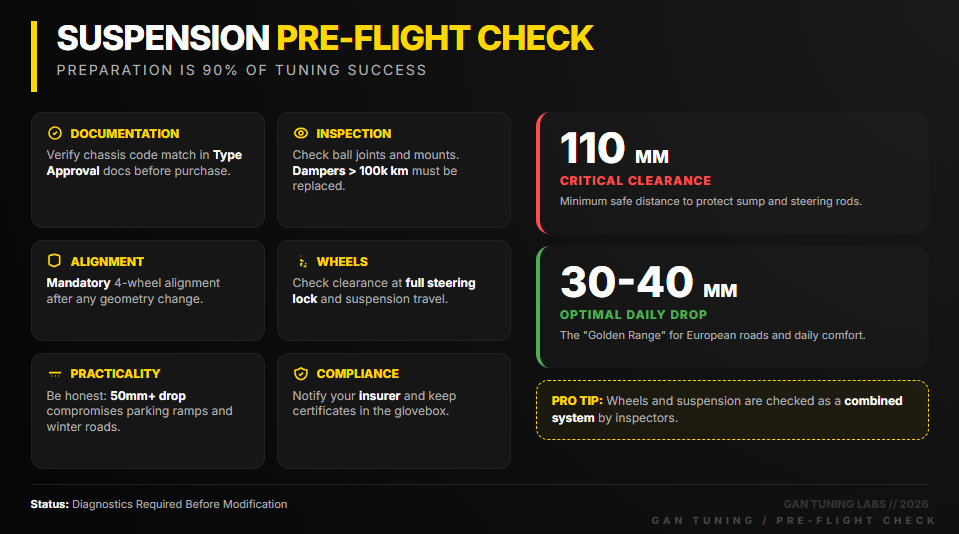
Verify documentation before purchasing. Confirm that the springs, coilover kit or strut bar carry the correct type approval for your specific vehicle. The chassis code in the documentation must match your car.
Check the condition of existing components. There is no point fitting stiff lowering springs to dampers with 100,000+ km on them. Inspect first: ball joints, bushings, top mounts. Issues that surface after a spring change were almost always there before — the new setup just makes them obvious.
Assess remaining suspension travel and ground clearance. After fitting, confirm there is sufficient travel before the bump stops, and that hard components (sump, exhaust, steering rods) do not approach the ground dangerously. The 110 mm obstacle test is not just for inspectors — it protects your car on steep car park ramps.
Four-wheel alignment is non-negotiable. After any significant suspension change, have the geometry set on a professional alignment rig. With extreme drops, the standard adjustment range may not be sufficient — adjustable control arms or additional correction components may be needed to return the geometry to specification.
Wheels and suspension together require separate attention. If you are changing both the suspension and the wheels at the same time, inspection bodies will check clearances to arches, wheel wells and brake hoses through full suspension travel and full steering lock. Wide wheels plus a lowered car is not an additive calculation — it is a standalone engineering task that requires its own documentation.
Inform your insurer and keep documents in the car. Notify your insurer of significant suspension changes. Carry the type approval documents and inspection certificate in the glovebox — it resolves questions immediately at roadside checks and periodic inspections.
Be honest about everyday use. Lowering a car by 50 mm or more is a genuine compromise. Multi-storey car parks with steep entries, winter roads, poor surface quality — everything becomes harder. The sensible range for a daily driver in European conditions is 30–40 mm.
Common myths about suspension tuning
Myth: “Lower always means better handling”
The facts: up to a point, lowering a car does reduce the centre of gravity and cut body roll. But beyond approximately 50 mm — without parallel geometry correction, stiffer anti-roll bars and a ground clearance check — the effect reverses: limited suspension travel, harsh impacts over bumps, incorrect camber angles and accelerated tyre wear. Experienced suspension specialists consistently cite 30–40 mm as the sensible range for road use. Below that, you are making a trade in favour of appearance.
Myth: “Stiff springs plus stock dampers equals a sport suspension”
The facts: the stock damper is calibrated for the stock spring rate. A stiffer spring produces a sharper rebound that the original damper cannot control. The result is poor comfort and poor control at the same time. A matched kit solves this problem — mixing unrelated components does not.
Myth: “If it passed the inspection, it’s legal”
The facts: the inspection covers the car as presented on that date. If a further modification was made after the inspection without updating the registration documents, the operating permit is still considered void. In the event of an accident, an insurer will check current compliance — not the date on the last inspection sticker.
Frequently asked questions
Do I need an inspection after fitting lowering springs?
It depends on the documentation. If the springs come with a general type approval, no additional inspection is required — keep the document in the car. If only a component expert report is supplied, a visit to an approved inspection centre and an official entry in the vehicle paperwork is mandatory. Without this, the operating permit is formally invalid.
Can I fit a coilover kit myself, or do I need a workshop?
The physical installation is possible at home if you have a lift and the right tools. However, a four-wheel alignment on a professional rig is required afterwards — that cannot be done at home. Add to that the inspection visit if you only have a component expert report. In practice, most people go to a specialist workshop to handle installation, geometry and paperwork in one visit.
Will suspension tuning affect my manufacturer’s warranty?
Potentially yes, if the dealer can demonstrate a link between the suspension modification and a specific failure. Legal installation with proper type approval documentation reduces this risk — the component is officially approved. Illegal modifications without documentation are a direct risk to both dealer warranty and insurance cover.
The takeaway: a system approach, not just lowering a car
Suspension tuning works as a system, not a collection of isolated parts. The correct sequence is: engine first, then brakes and chassis, then wheels. Lowering a car for the sake of lowering it is about photographs. Lowering a car for real-world dynamics — with the right documentation, proper geometry and a matched setup — is about driving.
The sensible range for everyday European roads is 30–40 mm with a matched kit. Proper type approval documentation is mandatory, as is a four-wheel alignment after installation. A strut bar makes sense where body loads are genuinely high.
In short: good suspension tuning starts with engineering — not with centimetres to the tarmac.
Want to upgrade your car properly — engine and chassis in the right order? GÄN Tuning Büro offers a 50-day test drive of the tuning module with a full money-back guarantee — the longest trial period in the segment. Engine warranty up to €5,000 for 2 years. Developed and manufactured in Germany since 2015. →Test GÄN risk-free for 50 days
Articoli utili sul chip tuning:
Most chip tuning articles are written by companies selling tuning services. They highlight benefits and downplay risks because they want your money. This article is different. I’m going to explain what chip tuning actually does, compare the two main methods honestly, and discuss the real risks to warranties and engine longevity. What you do with […]

A car vinyl wrap is one of the most popular ways to transform your vehicle’s appearance without any permanent consequences for the paintwork: a full colour change takes roughly a week, costs significantly less than a quality respray, and — when removed properly — leaves the factory paint almost untouched underneath. Full professional vehicle wrap […]

An aerodynamic body kit starts delivering measurable technical effect at around 100–120 km/h. At motorway speeds, a properly engineered kit improves axle downforce, lane stability, and — in purpose-designed, CFD-calculated cases — reduces fuel consumption by up to ~5%. Most generic “wide-body” kits, however, increase drag and fuel consumption because they add frontal area without […]


Contact us via WhatsApp