


Turning your steering wheel to full lock is perfectly legal and mechanically possible — but holding it there for more than a few seconds causes measurable wear to your power steering system. In hydraulic setups, oil pressure spikes to its maximum, the pump runs at full load, and seals along with the steering rack degrade significantly faster than under normal operating conditions.
Why does pressure spike so sharply at full lock?
Anyone who has held the wheel at full lock while waiting to squeeze into a parking space has probably heard a faint whine or hum coming from under the bonnet. That sound is not random. The hydraulic pump reaches its highest pressure precisely when the steering is turned all the way to one side — at that point, the entire flow of fluid is directed into the working chamber with nowhere to go back directly.
The result: the power steering pump has to sustain maximum output without any movement to relieve the load. Fluid circulates under peak pressure through valves, hoses and seals that were never designed to operate continuously in that state.
In practice this means: a brief flick to full lock while manoeuvring is not a problem. Holding the wheel at full lock for five, ten or more seconds, however, puts real strain on the system.
There is also a thermal factor that tends to be overlooked. Hydraulic fluid heats up rapidly under sustained load — and without the car moving, that heat has nowhere to dissipate. Within just a few minutes, fluid temperature rises noticeably, viscosity drops and its lubricating properties deteriorate. Experienced mechanics consistently point to this effect as one of the most common yet least recognised causes of premature steering wear.
What actually happens to the steering rack and power steering system at full lock?
The mechanical consequences are well documented.According to Auto Bild, steering on a stationary vehicle places the greatest single load on the steering rack — second only to the so-called kerb-push test, and made worse by high-grip road surfaces.
Here is what happens when you hold full lock steering on a stationary or very slowly moving car:
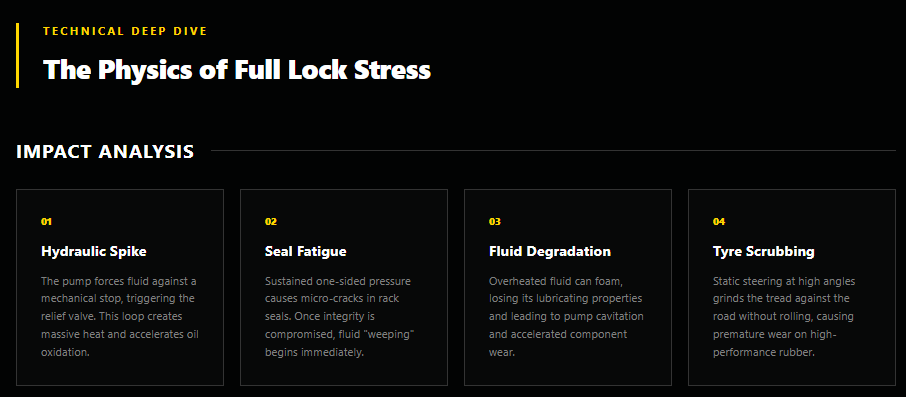
1. Pressure spike in the hydraulic circuit The pump keeps pushing fluid even though the rack has nowhere left to travel. Oil is diverted back through the pressure relief valve — an energetically wasteful loop that generates heat and accelerates fluid ageing.
2. Wear on seals and rack gaiters Holding the wheel all the way to the stop for an extended period puts sustained one-sided pressure on the rack seals. These are the first components to suffer, and once they start to weep, fluid loss follows quickly.
3. No direct return path for the fluid The pump’s full output is forced into the working chamber. The fluid overheats, can foam under extreme conditions, and loses its lubricating properties. Over time, micro-cracks develop in seals — cracks that will eventually become leaks.
4. Tyre wear A less obvious side effect: when you steer on the spot, the tyres scrub against the road surface without rolling. This accelerates tread wear noticeably — particularly on high-grip summer tyres.
Hydraulic, electrohydraulic or electric: does the type of system make a difference?
Short answer: yes — but not as much as most people assume.
| System type | Risk at full lock | Recommendation |
| Hydraulic (conventional) | High — pump under continuous load | Hold for 1–2 sec. max |
| Electrohydraulic | High — same underlying principles | Hold for 1–2 sec. max |
| Electric (EPS) | Lower — no hydraulic pressure | Still: keep it brief |
With electric and electromechanical power steering, the consequences are less severe because there is no hydraulic pump involved. That said, the electric motor still operates under increased load when the wheels are hard against the mechanical stop and the driver continues to apply steering force.
The core issue remains the same regardless of system type: applying force against a mechanical stop is not an operating condition that steering systems are designed to sustain continuously.
Keeping your car in good mechanical shape goes beyond the steering. Drawing on experience tuning over 30,000 vehicles since 2015, GAN explains how an external tuning module works — and why it leaves your manufacturer warranty completely intact. →Learn more about GAN Tuning
What long-term damage can occur — and what does it cost to fix?
Experienced mechanics see the consequences regularly: weeping rack gaiters, worn-out steering racks, failed power steering pumps. What stands out in practice is that a disproportionate share of these faults occur on cars used predominantly in urban environments — where parking, tight turning circles and steering wheel full lock manoeuvres are simply part of daily life.
The most common failure patterns:
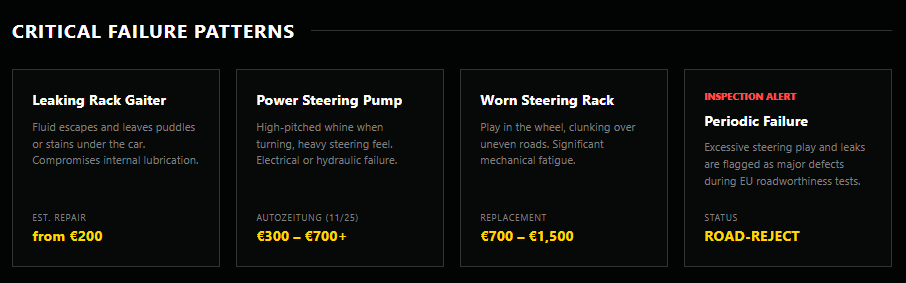
- Leaking rack gaiter — fluid escapes and leaves puddles or stains under the car. Repair costs: from around €200, rising sharply if a full rack replacement is needed.
- Failed power steering pump — a high-pitched whine when turning, heavy steering feel. According to Autozeitung, parts and labour combined can run to several hundred euros (as of November 2025).
- Worn steering rack — play in the wheel, clunking over uneven roads. Replacement often falls between €700 and €1,500 depending on the vehicle.
- MOT or roadworthiness failures — excessive steering play and fluid leaks are flagged as defects during periodic vehicle inspections across Europe.
To put it plainly: a few seconds of carelessness at full lock, repeated year after year, can produce a four-figure repair bill.
What makes it particularly insidious is that the damage accumulates invisibly. A car with 80,000 km on the clock may show no symptoms at all, even though the seals are already beginning to break down. Fluid loss typically surfaces somewhere between 110,000 and 130,000 km — and often from several points at once. The link to driving habits is rarely made in hindsight, because years can pass between cause and visible fault.
Anyone buying a used car should make a point of checking three things: are there any traces of fluid around the steering rack? How does the wheel feel during slow parking manoeuvres? Is there any whine or squeal at full lock? Those three questions alone can protect against an expensive mistake.
Myth: “Full lock steering isn’t an issue on modern cars”
This misconception persists — especially among drivers of newer vehicles fitted with electric power steering. The reality is more nuanced.
What is true: Modern EPS systems include protective mechanisms. The control unit detects when the rack has reached its stop and automatically reduces assistance. This does make the situation less damaging than in a purely hydraulic system — but it does not make it harmless.
What is not true: The assumption that you can hold the steering wheel all the way to the lock indefinitely. The electric motor still heats up, the steering rack mechanics remain under load, and vehicles with electrohydraulic setups — where an electric motor drives a hydraulic pump — share the same fundamental problem as conventional hydraulic systems.
The guidance from most vehicle manufacturers is consistent: brief full lock is acceptable; holding it there is not.
Want to keep your car in top condition and get more from the engine at the same time? The GAN GT module for turbocharged engines raises power and torque by up to 25% — with no modification to the ECU software. Your manufacturer warranty stays fully intact, and the module can be removed without trace in 60 seconds. →GAN GT vs GA+: see the comparison
What should you do differently when parking and manoeuvring?
One small habit change that takes significant strain off your steering system:
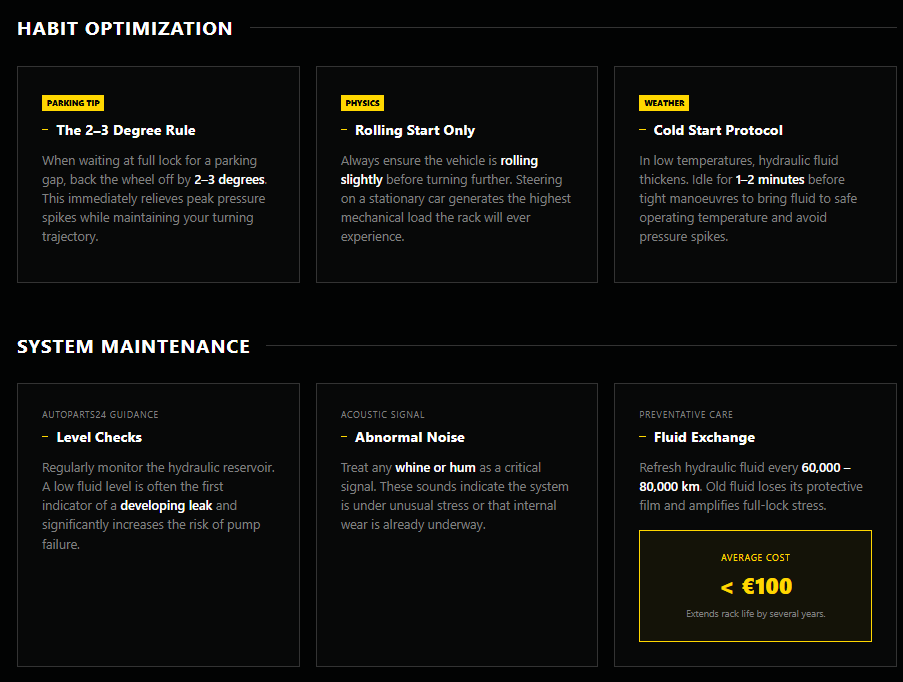
While waiting for a parking gap: If you are sitting with the wheel at full lock waiting for a space to clear, turn the wheel back 2–3 degrees away from the stop. That is enough to drop the peak pressure without affecting your ability to complete the manoeuvre.
When reversing or manoeuvring: Always let the car roll slightly before turning further. Steering on a stationary car is the combination that loads the rack most heavily — not the angle of lock itself.
On cars with hydraulic power steering:According to Autoparts24, fluid level in the reservoir should be checked regularly — a low level may indicate a developing leak and meaningfully increases wear risk.
Take noises seriously: A whine or hum when turning the wheel is not normal operating noise — it is a signal that the system is under unusual stress or that wear is already underway.
Change the power steering fluid regularly: On hydraulic systems, most manufacturers recommend a fluid change every 60,000–80,000 km. Old, dark fluid provides less protection, amplifies the stress caused by power steering full lock manoeuvres, and accelerates wear on both the pump and seals. A fluid change typically costs under €100 — and can push a rack replacement several years further into the future.
Be especially careful in cold weather: In low temperatures, hydraulic fluid is thicker, and the pressure spike at full lock is even higher than in summer. Turning the wheel all the way to the stop in the first few minutes after a cold start loads the system twice over — once from the cold start itself, once from the pressure spike. Letting the engine idle for one to two minutes is enough to bring the fluid up to operating temperature before attempting tight manoeuvres.
Frequently asked questions about full lock steering (FAQ)
Question: Is it safe to turn the steering wheel to full lock when parking? Answer: Yes — briefly, it is technically fine. The damage occurs when you hold the wheel at the stop for several seconds while continuing to apply steering force. The rule of thumb: do not hold full lock for more than one to two seconds at a time.
Question: Does this apply to cars with electric power steering? Answer: Partly. Electric systems (EPS) are more resilient because there is no hydraulic pressure involved. However, the electric motor still operates under increased load at full lock. On electrohydraulic systems — still fitted to many cars built before 2015–2018 — the same restrictions apply as on conventional hydraulic setups. When in doubt: hold briefly, then ease back.
Question: How do I know if my steering rack is already damaged? Answer: Common signs are play in the steering wheel, knocking or clunking over rough surfaces, a whine when turning, and fluid stains under the car. Any of these symptoms warrants an immediate inspection — a worn steering rack affects both handling precision and roadworthiness.
Question: Is steering on a stationary car worse than full lock alone? Answer: Yes, noticeably so. The combination of a stationary vehicle and full lock is the single most demanding operating condition for a steering rack. The rack has to develop maximum force with no rolling movement to distribute the load. Simply letting the car roll slightly first reduces the stress considerably — even at the same steering angle.
Bottom line: Turning your steering wheel all the way to full lock is fine. Holding it there is what costs your steering rack years of service life. Understanding the mechanics behind it takes about two minutes — and can save you a repair bill that would ruin anyone’s week. That simple.
Not sure whether a tuning module is right for your specific car? The GAN module comes with a 50-day risk-free trial period — the longest money-back window in the segment. On top of that, a 2-year engine warranty covering up to €5,000 provides the kind of financial protection you will not find from any other tuning product on the market. →Start your 50-day risk-free trial


Contact us via WhatsApp