





Does AC use more gas — and by how much?
That’s the central question. And it doesn’t have a single answer — it depends entirely on speed.
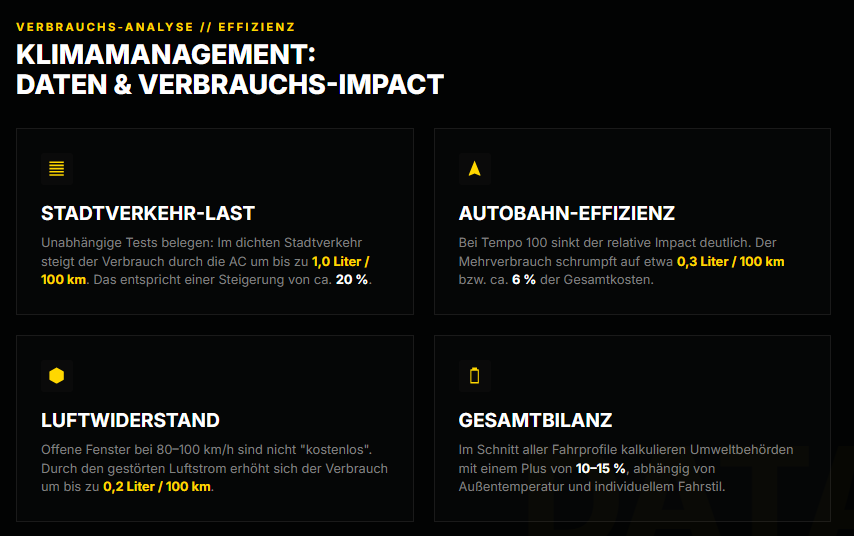
Independent automotive tests show that running the AC in city traffic can add up to 1 litre per 100 km to your fuel consumption — roughly a 20% increase. At motorway speeds around 100 km/h, that figure drops sharply: the penalty shrinks to around 0.3 litres per 100 km, or about 6%.
Environmental agency data consistently puts the average air conditioning fuel consumption increase at 10–15%, varying with outside temperature, vehicle class, and how you’re driving.
What catches most people off guard: open windows at speed aren’t free either. At 80–100 km/h, open side windows generate measurable aerodynamic drag — adding up to 0.2 litres per 100 km to your fuel bill.
The short version: at higher speeds, the gap between AC vs open windows gas mileage is tiny — and frequently reverses in favour of the AC.
| Speed | Better choice | Why |
| Below 50 km/h | Windows down | AC costs noticeably more here |
| 50–80 km/h | Situation-dependent | Consumption difference is negligible |
| Above 80 km/h | AC on, windows up | Aerodynamics make open windows costlier |
Windows down or AC: which is actually safer?
There’s a clear answer here — and it surprises most people.
Research shows that at cabin temperatures above 27 °C, driver concentration measurably deteriorates. That’s not a comfort issue — it’s a safety issue. Particularly on fast-moving roads where reaction time is everything.
Open windows don’t cool the cabin. They just move the air around — and in hot weather, that air is already hot. Add in the significant wind noise above 80 km/h, which builds up into real fatigue on long stretches, and the picture becomes clear. Air conditioning holds the cabin temperature steady, keeps noise down, and maintains alertness. That matters most on long trips with children, or on back-to-back motorway legs without a proper break.
Something many drivers underestimate: a car parked in the sun heats up fast. Interior temperatures of 50–60 °C in direct sunlight are common across Europe in summer. The practical fix — open all windows first, let the hot air out, then switch the AC on. It takes under a minute, reduces strain on the compressor, and cools the cabin faster.
What does AC actually do to your engine — myth vs. reality
The myth: “Air conditioning kills the engine.” It sounds like hard-earned wisdom. It isn’t.
Modern compressors run at variable load. They adjust to demand and are managed by the engine’s own electronics. The load is engineered into the system from the start — no manufacturer builds a climate system that damages its own engine. Current compressor technology uses significantly less energy than older-generation units.
Here’s what experienced mechanics actually say: the real risk runs the other way. Leaving the AC unused for months allows seals to dry out and refrigerant to leak — which leads to expensive repairs down the line. The standing recommendation among automotive professionals is to run the AC regularly, even in winter when temperatures are above +5 °C, to keep seals lubricated and the system functional.
Simple as that: regular use extends the life of the system. Leaving it idle shortens it.
Air conditioning fuel consumption in city driving — where can you actually save?
City driving is where AC hits hardest. Up to 20% extra fuel consumption happens right here — stop-start traffic, frequent acceleration, engine constantly working at partial load. This is also where a bit of awareness makes a real difference.
Comparative tests show: at outside temperatures below 22 °C, skipping the AC and going windows down genuinely saves fuel in city conditions. Once it climbs past 25 °C, the calculation gets more complex — heat impairs driver performance, and that’s a real cost too.
A practical, field-tested approach:
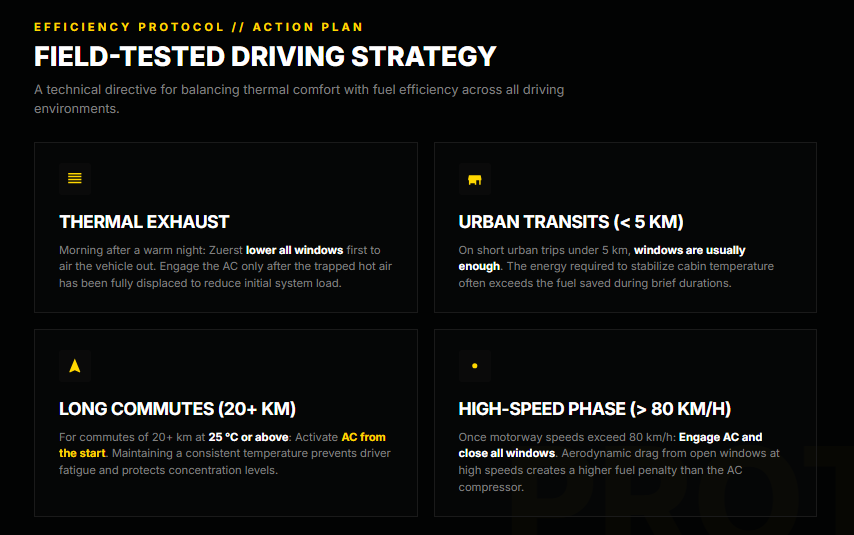
Morning after a warm night → windows down first, air the car out, then AC
Short urban trips under 5 km → windows are usually enough
Commute of 20+ km at 25 °C or above → AC from the start
Motorway driving above 80 km/h → AC on, windows closed
What often gets overlooked: the fuel penalty from running the AC can be partially offset by smarter engine management. Driving with more torque available at lower revs means fewer downshifts, smoother acceleration, and lower consumption overall — regardless of whether the AC is running. Based on data from over 30,000 vehicles, the GAN Tuning module demonstrates exactly this in real-world driving: higher low-end torque means earlier gear changes and measurably less fuel used, with or without the AC. More at gantuning.com/gan-gt
Electric vehicles: AC costs more here, and it shows
EV drivers play by slightly different rules — and with electric cars becoming increasingly common across Europe, this is worth knowing.
Tests show that a typical EV air conditioning system draws around 1.3–1.5 kW continuously. Over eight hours of driving, that translates to roughly 16% of battery capacity. Noticeable — but manageable, as long as it’s factored into route planning.
For EV drivers, the windows vs AC logic applies with a bit more weight on both sides: at lower speeds and moderate temperatures, windows down is the smarter call. In summer heat on the motorway, switch to AC and close the windows — the aerodynamic loss from open windows will exceed the energy cost of the compressor.
How does chiptuning affect AC efficiency?
It’s rarely discussed in technical circles — but for any driver running a tuning module, it’s a genuinely practical question.
The AC puts the heaviest load on the engine precisely when the engine is already running at partial capacity: urban traffic, pulling away from lights, accelerating from a standstill. More torque available at those moments means the AC’s impact on engine behaviour becomes far less noticeable.
The GAN GT module — developed for turbocharged petrol and diesel engines — increases torque by up to 25%. In practice: the engine pulls sooner, gear changes come earlier, and partial-load efficiency improves. That directly offsets part of the extra fuel consumption caused by running the AC.
Technically, GAN GT works like this: it doesn’t touch the ECU software. Instead, it communicates with the boost pressure sensor (on turbo petrol engines) and the rail pressure sensor (on Common Rail diesels). The ECU receives a modified signal and raises output — within the safety parameters set by the manufacturer.
| Feature | GAN GT | Standard ECU remap |
| Power increase | up to 25% | up to 25% |
| Fuel saving | up to 15% | variable |
| Manufacturer warranty | preserved | often voided |
| Removal time | 60 seconds | not possible |
| Engine warranty | 2 years, up to €5,000 | none |
| Trial period | 50 days, money back | 14–30 days |
For anyone looking to reduce base fuel consumption — independently of the AC vs windows question — GAN GT offers a technically sound solution that leaves no trace when removed. Find your vehicle at gantuning.com
AC and manufacturer warranty: what holds, what doesn’t
A question that comes up regularly in workshop conversations: can modifications to a vehicle void the manufacturer’s warranty?
For the AC system itself — no, provided no structural changes are made. Regular use and maintenance (filter changes, refrigerant checks) are fully warranty-compliant and, in fact, recommended.
With chiptuning, it’s more nuanced. A conventional ECU remap can put the warranty at risk if the modification is detectable. The GAN module doesn’t alter the ECU software — it can be removed in 60 seconds before any dealership visit. No mechanical traces, no firmware counter reset. The manufacturer’s warranty stays intact.

On top of that, GAN provides its own two-year engine warranty with financial coverage up to €5,000 — the only company in the segment offering this level of concrete protection. That’s not a marketing line; it’s a contractual commitment. Warranty details at gantuning.com/gan-gt
Common questions about AC and fuel consumption
Q: Is it worth switching the AC off in a traffic jam?
A: In a jam, the engine is already at idle or near-idle load. The AC draws relatively little here because the engine itself is barely consuming fuel. What does make sense is switching it off a few minutes before a full stop — the residual cool air holds for a while. In dense stop-start traffic, the saving from switching off is usually minimal.
Q: At what outside temperature does running the AC make sense?
A: From a purely practical standpoint, around 18–20 °C — when driving comfort and concentration start to suffer. For the engine, it’s entirely unproblematic. From a safety perspective, the meaningful threshold starts at around 27 °C cabin temperature, where driver alertness measurably declines.
Q: Does switching the AC on immediately at engine start damage anything?
A: No. Modern vehicles are designed for exactly that. That said, if the car has been sitting in the sun, the smarter move is to open the windows first and let the hot air escape — it reduces the load on the compressor and gets the cabin to temperature faster.
What engine tuning has to do with AC efficiency — an underrated connection
Looks like two different topics at first. It isn’t.
Data across more than 30,000 vehicles reveals a consistent pattern: engines with an optimised low-rev torque curve handle the additional AC load without the same abrupt load spikes. Smoother engine operation, more stable fuel flow, less strain overall.
That’s exactly what the GAN GT module targets. Five driving modes — Dynamic, Eco, Sport, Stock, and Custom — allow precise adaptation to different driving situations. In Eco mode, fuel consumption drops by up to 15%. That includes journeys with the AC running.
For drivers covering long daily distances with the climate control on, that adds up to a measurable annual saving. https://www.gantuning.com/
The verdict: AC vs open windows comes down to speed
The decision is simpler than most people think — once you understand the physics.
Below 50 km/h: windows down. The AC uses meaningfully more fuel than the aerodynamic cost of open windows at low speed.
Above 80 km/h: AC on, windows up. Aerodynamics flip the equation.
For driving safety: almost always AC — especially at temperatures above 25 °C.
For the engine: regular use is better than months of sitting idle.
For drivers who also want to reduce their vehicle’s base fuel consumption, the GAN GT module offers a field-tested solution: up to 25% more power, up to 15% less fuel, a 50-day no-risk return window, and a two-year engine warranty with up to €5,000 in coverage.
Try it risk-free for 50 days → gantuning.com/bestellen | Find your vehicle at gantuning.com | Read the FAQ at gantuning.com/faq
Sources: ADAC automotive testing (adac.de), European environmental agency data, GAN Tuning technical documentation (gantuning.de)