


Tint percentage is the single most misunderstood term in car window tinting. Across Europe, regulations permit significant darkening on rear windows — typically down to VLT 5 % — while prohibiting any additional film on the windscreen and front side windows. The minimum legal VLT for front glass is 70 % in most markets. Getting this wrong risks failing your periodic technical inspection (PTI) and can void your insurance after an accident.
What tint percentage actually means — and why most people get it backwards
The confusion starts with two terms that measure opposite things.
Tint shade refers to how much light a film blocks. A film labelled “20 % tint” blocks 20 % of light and lets 80 % through.
VLT (Visible Light Transmission) is the inverse — how much light passes through. This is what PTI inspectors measure and what road traffic regulations refer to. A film with VLT 20 % is dark: it lets through only one in five photons. A film with VLT 80 % is barely visible.
In practice: when someone asks for “35 % tint”, always clarify — do they mean 35 % blockage (VLT 65 %) or 35 % transmission (VLT 35 %)? The difference is significant, especially at a technical inspection.
How different tint percentage values look in real life:
| Film VLT | Visual impression | Typical application |
| 70–80 % | Almost transparent | Only legal option for front windows |
| 50 % | Lightly tinted | Rear side windows, subtle effect |
| 35 % | Noticeably dark | Rear side windows, popular choice |
| 20 % | Dark, “privacy” effect | Rear sides and rear glass |
| 5–10 % | Near-opaque | Rear glass only, with exterior mirrors |
Window tinting laws in Europe: what is actually permitted?
Window tinting laws across Europe share a consistent principle: windows that define the driver’s field of vision must be transparent, light-transmitting and non-reflective. In practice this means the windscreen and both front side windows. Additional tinting film on these is either prohibited outright or restricted to a narrow strip at the top of the windscreen.
The permitted zones — exact limits
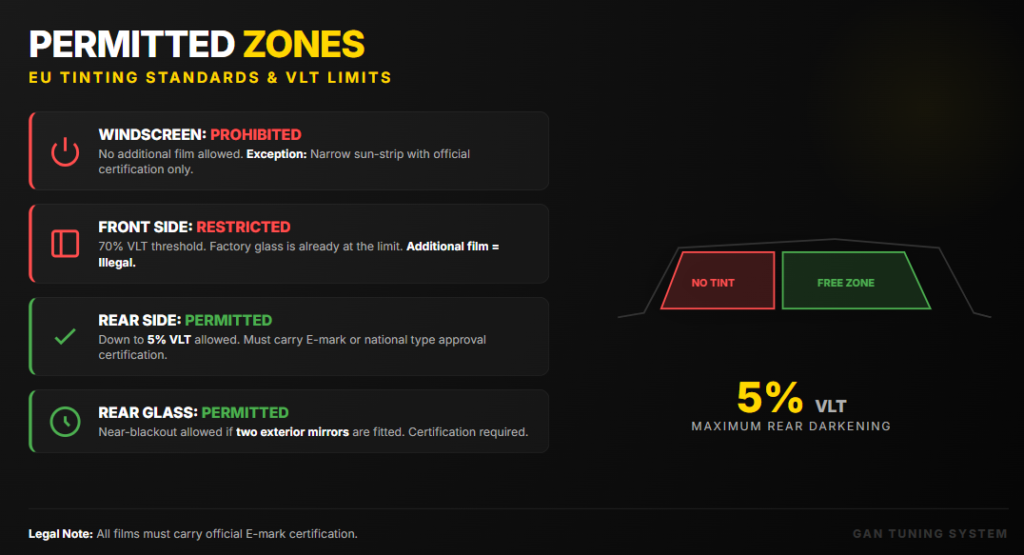
Windscreen: additional darkening film is prohibited in virtually all European markets. A narrow sun-strip along the top edge is the only exception in some countries — local regulations apply, and the film must carry official certification.
Front side windows (ahead of the B-pillar): any darkening film is prohibited. Factory glass already sits close to the 70 % VLT threshold — additional film almost always breaches it.
Rear side windows (behind the B-pillar): tinting is permitted across Europe. Significant darkening is allowed — down to VLT 5 % in many countries — provided the film carries official certification (type approval, E-mark with test number, or national equivalent).
Rear glass: tinting to near-blackout levels is permitted in most European markets, provided two exterior mirrors are fitted and the film holds the relevant certification.
Certification: the document that makes tinting legal
Official certification — a national type approval, ABG (Allgemeine Bauartgenehmigung) in German-speaking markets, or equivalent — is the legal foundation for any rear-window tinting. Without it, even film on legally permitted windows may be flagged at PTI. According to legal tinting requirement data, documentation must be kept in the vehicle at all times.
Quality films come with certification marking. Cheap, unbranded films without documentation are a direct path to PTI failure.
Fines and consequences
Based on data from bussgeldkatalog.org and wh-fahrzeugstyling.de:
- Driving with restricted visibility — €10
- Missing certification document at a check — €10
- Breach of vehicle requirements — €25
- Endangering road safety — €90 + penalty point on driving record
The worst outcome is loss of roadworthiness approval — meaning the insurer may refuse to pay out after an accident, and the car is taken off the road until the violation is fixed.
Types of car window tint: which film is actually the best window tint?
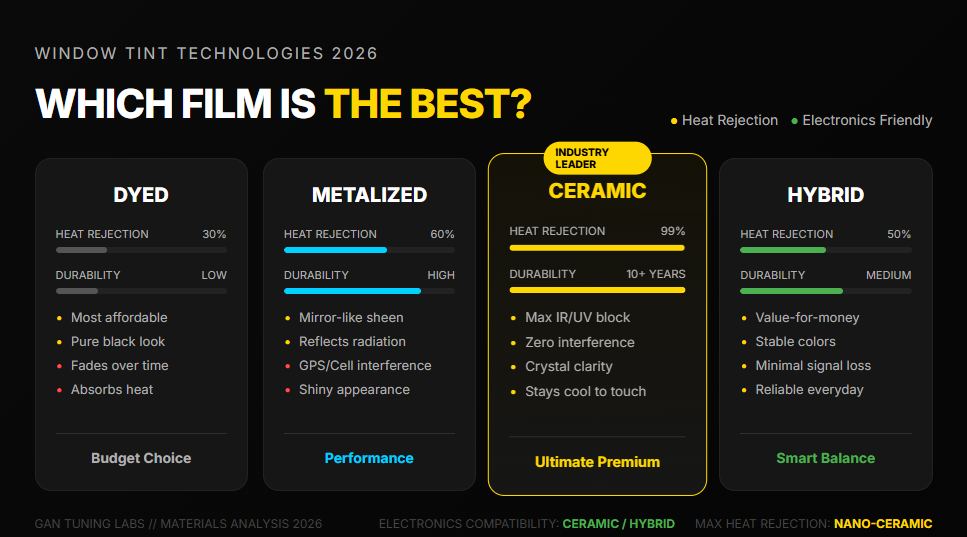
Four technologies dominate the car window tint market in 2026. The choice is a question of priorities: price, heat rejection, appearance, or electronics compatibility.
Dyed films
The most affordable option. A dye layer absorbs light and reduces brightness. Glare reduction — good. Heat rejection — moderate, since the film absorbs heat rather than reflecting it. Dyes fade over time, especially under direct sun. Bubbling and peeling are more common than with other types.
Suitable for a basic darkening effect on a tight budget. Not the best choice for premium interiors or regular long-distance driving.
Metalized films
A metallic layer reflects solar radiation rather than absorbing it — delivering stronger heat rejection than dyed films. Characteristic look: a mirror-like sheen on the outside. Key drawback: the metallic layer weakens GPS, Bluetooth, keyless entry and toll system signals. Worth weighing up carefully on modern vehicles with extensive telematics.
Nano-ceramic films
The top of the car window tint market. A nano-ceramic layer blocks up to 99 % of UV radiation and reflects a substantial share of infrared radiation — heat — while keeping a relatively light visual tint. A ceramic film at VLT 50 % delivers better heat rejection than a metalized film at VLT 20 %. According to ceramic film manufacturer data, quality solutions block up to 70 % of solar heat load. No electronics interference. Service life — 10+ years with professional installation.
For cars that have had engine tuning and regularly sit in traffic or cover long distances, ceramic is the most rational choice: cabin comfort improves and electronics work without disruption.
Hybrid films
A combination of dyed and metalized layers — better heat rejection than purely dyed films, less interference with electronics than fully metalized ones. According to specialist sources on film types, hybrid films hold a consistent value-for-money position for most everyday vehicles. A sound choice for anyone who doesn’t want to pay for ceramic but values reliability.
So what is the best window tint? For long-distance driving and UV protection: nano-ceramic. For a tight budget with acceptable performance: hybrid. For pure appearance with no electronics concerns: metalized. Dyed film only makes sense as a short-term, low-cost solution.
Window tinting is one step in a broader vehicle upgrade. GÄN Tuning Büro has been working on performance tuning since 2015, optimising over 30,000 vehicles across 8 countries. Want to find out what else can be improved on your car? → Find your GÄN tuning module
What car window tinting actually delivers: facts without the marketing
Tinting is about comfort and protection — not performance or dynamics.
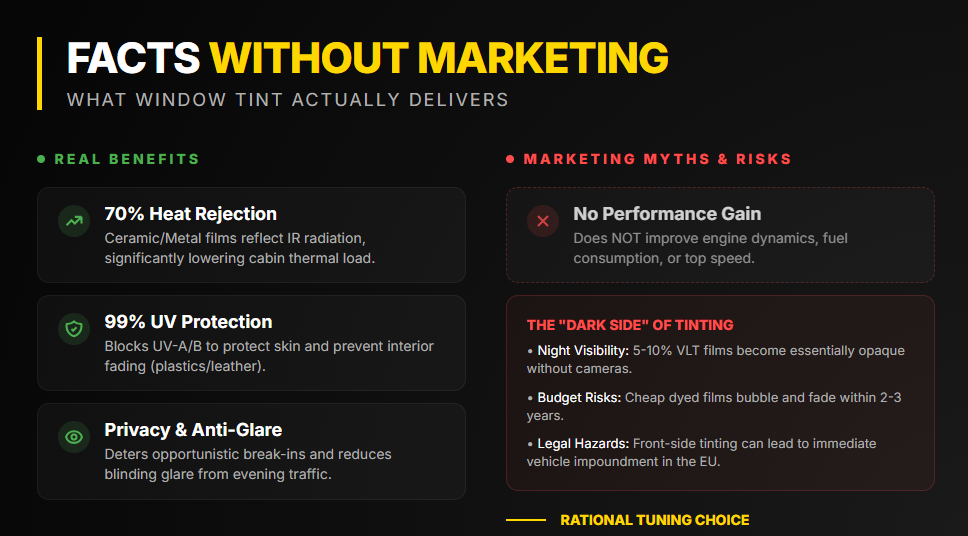
Heat rejection. Quality ceramic and metalized films reduce cabin thermal load by up to 70 % by reflecting infrared radiation. In a dark interior with leather seats on long highway runs, this is clearly noticeable.
UV protection. Quality films filter up to 99 % of UV-A and UV-B radiation — protecting skin and preventing fading of dashboard, upholstery and plastics.
Privacy. Tinted rear windows make the boot contents significantly harder to see from outside — a practical deterrent against opportunistic break-ins.
Glare reduction. Against oncoming headlights, especially in the evening and during lane changes — a noticeable effect on long distances.
What tinting does not deliver: no improvement in dynamics, fuel consumption or engine performance. Worth knowing before paying for a package with no real benefit.
Downsides exist too. Darker films on rear windows reduce rearward visibility during manoeuvres — especially at night. Films at VLT 5–10 % are essentially opaque in reverse without a camera. Cheap dyed films bubble, fade and look worse after 2–3 years than no tinting at all.
If the car has already had engine tuning, tinting the rear windows is the logical next step — more power means more motorway time, and cabin thermal comfort becomes increasingly worthwhile. The GÄN GT module for turbocharged engines increases power by up to 25 %, torque by up to 25 %, and reduces fuel consumption by up to 15 %. IP67 housing, 5 modes, smartphone control. Removable in 60 seconds with no trace in the ECU — manufacturer warranty preserved. → Explore GÄN GT
Which tint percentage and film type suits which driver?
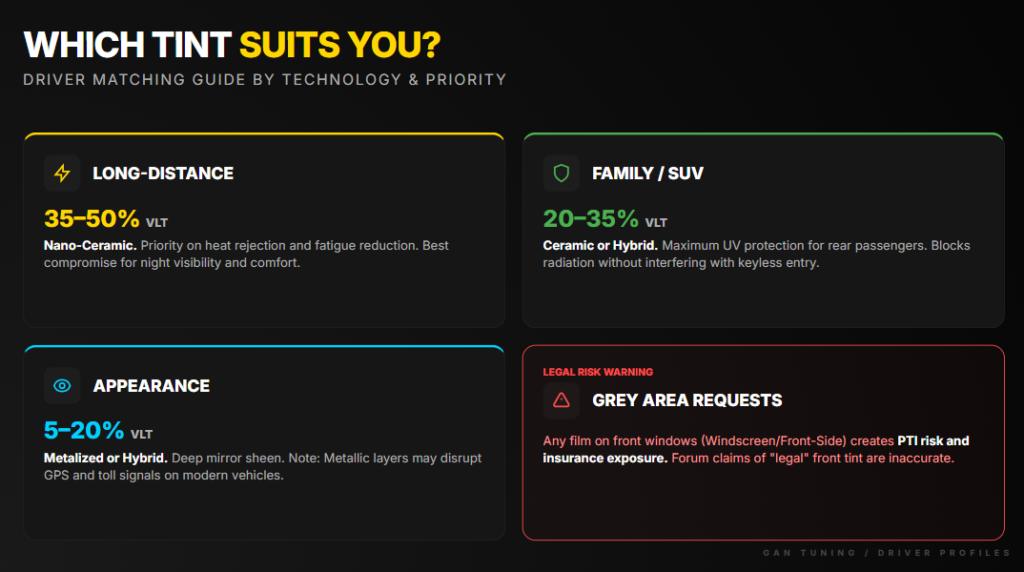
Long-distance commuters — motorway driving daily
Priority: heat rejection and fatigue reduction. Ceramic film at VLT 35–50 % on rear side windows. Minimal compromise on night visibility, clear improvement in cabin comfort on long runs. Metalized films — use with caution if GPS and keyless entry are heavily used.
Family car / SUV
Focus: UV protection for rear passengers and children, reduced heat on rear seats. Darker ceramic or hybrid at VLT 20–35 % for the rear. Important: the same darkening level cannot legally be applied to front windows in any European market.
Appearance-focused drivers
Metalized or hybrid films in a dark shade on the rear glass. Purposeful look, within the rules. A clear heads-up about the metallic layer’s effect on GPS, toll systems and keyless entry is worth giving before installation.
“Grey area” requests
Online forums regularly surface supposedly “legal” ways to tint front windows. Road traffic attorneys across Europe interpret the relevant regulations consistently: any additional darkening film on the windscreen or front side windows creates PTI risk and insurance exposure — regardless of how many forum users claim to have been driving that way for years without incident.
Three myths about window tinting that cost money
Myth: “Darker tint percentage always means better heat protection”
Reality: Heat rejection is determined by a film’s ability to reflect infrared radiation — not by how dark it looks. A quality ceramic film at VLT 50 % outperforms a cheap dyed film at VLT 20 % on heat rejection. Dark and effective are not synonyms.
Myth: “Factory privacy glass is the same as added tinting film”
Reality: Factory dark glass is tinted in the mass of the glass itself and is certified by the manufacturer — already recorded in the vehicle documentation. Applying additional film on top of it on front windows breaches the legal VLT threshold.
Myth: “Professional installation automatically makes it legal”
Reality: No. Even professionally installed film on front windows remains non-compliant. Legality is determined by where the film is applied and whether it carries certification — not by the quality of the installation work.
Questions and answers
Q: Does a car need a PTI inspection after tinting?
A: When only rear side windows and rear glass are tinted with certified film, no separate PTI appointment is required in most European markets — carrying the documentation is sufficient. If film was installed without certification or on prohibited windows, a remediation order follows. At the next scheduled PTI, the inspector checks compliance with local regulations.
Q: Is self-installation legal?
A: DIY installation is not prohibited. The film must still carry appropriate certification and be applied only to permitted windows. Main practical risks: uneven application, bubbling, VLT going off-spec due to layering, and complications at inspection.
Q: Does window tinting affect car insurance?
A: Only when the tinting breaks the rules. Non-compliant film — prohibited windows or missing certification — gives the insurer grounds to reduce or refuse a payout after an accident, citing undeclared modification of the vehicle’s technical condition. Legal tinting on permitted windows with correct certification does not affect insurance.
Practical decision framework: car window tint guide for European drivers
Six steps that eliminate all the risk:
- Define permitted zones — rear side windows and rear glass only. Front windows: no.
- Choose film type — ceramic for maximum comfort and longevity, hybrid for the best budget balance, metalized with awareness of the electronics trade-off.
- Verify certification — the film must carry official type approval (E-mark and test number, or national equivalent).
- Choose the right tint percentage — VLT 35–50 % for daytime comfort with preserved night visibility, VLT 20 % for a privacy effect, VLT 5–10 % for rear glass only.
- Professional installation with documentation — installation warranty plus certification document in the car at all times.
- Leave the front windows alone — no exceptions, no grey areas.
In short: the right car window tint with the right tint percentage is a practical, legal upgrade — done on permitted windows, with certified film, by someone who knows the regulations.
Want to upgrade your car systematically — not just the looks, but the performance too? GÄN Tuning Büro offers a tuning module with engine warranty up to €5,000 for 2 years — the only financially backed coverage in the industry. 50-day test drive with a full money-back guarantee. Engineered and manufactured in Germany since 2015. → Order your GÄN test drive — 50 days, risk-free
Articoli utili sul chip tuning:
Naturally aspirated engines gain less from chip tuning than turbocharged engines. That’s just physics. You’ll see around 10-12% power increase, maybe 15% torque increase at best. But that 10-12% is still worth having. Let me explain what’s actually possible with naturally aspirated engines and why the gains are limited compared to turbocharged motors. What Makes […]

An aerodynamic body kit starts delivering measurable technical effect at around 100–120 km/h. At motorway speeds, a properly engineered kit improves axle downforce, lane stability, and — in purpose-designed, CFD-calculated cases — reduces fuel consumption by up to ~5%. Most generic “wide-body” kits, however, increase drag and fuel consumption because they add frontal area without […]

A car vinyl wrap is one of the most popular ways to transform your vehicle’s appearance without any permanent consequences for the paintwork: a full colour change takes roughly a week, costs significantly less than a quality respray, and — when removed properly — leaves the factory paint almost untouched underneath. Full professional vehicle wrap […]


Contact us via WhatsApp