


A proper car audio upgrade is built in three stages: front speakers with door sound deadening, then a subwoofer, then a DSP amplifier. This sequence delivers results — random component swaps do not. In 2026, it’s critical to preserve the manufacturer warranty and the full functionality of factory systems like BMW iDrive, VW MIB, and Mercedes MBUX.
Why Most Car Audio Upgrades End in Disappointment
The standard mistake is buying “something louder” and installing it at random. The result is predictable: money spent, sound unchanged, and the install visible to the naked eye.
A smart car audio upgrade in 2026 follows a different logic: front speakers and door sound deadening first, then a subwoofer, then an amplifier with DSP. Only in this sequence does the system begin to work as a unified whole.
For European car owners, three additional things matter. First — a clean install with no visible traces inside the cabin. Second — preserving all onboard electronics functions (iDrive, MIB, MBUX). Third — the dealer warranty must not be affected. According to Future Market Insights, the European car audio market is among the most mature globally — and it’s precisely the premium segment, with its high integration requirements, that’s driving growth.

How to Choose the Best Car Speakers: What Actually Affects Sound
The Front Stage Is the Priority — Not “Surround Sound”
When building a car sound system, money goes into the front speakers first. Rear speakers are background fill for back-seat passengers — nothing more.
Practical configurations for modern cars:
- 2-way front stage: 165–200 mm midbass in the doors + tweeter in the A-pillars or mirror triangles. This is the minimum sensible setup with a noticeable result.
- 3-way front stage: adds a dedicated midrange driver. This is the exact scheme OEM manufacturers use in top-spec VAG, BMW, and Mercedes configurations. Relevant for premium-level SQ builds.
According to SpeakerDriver, OEM manufacturers across Europe are actively moving to 2- and 3-way systems even in base trim levels — this is shifting the aftermarket tuning focus toward “improve the front + add a sub + DSP” rather than a complete rebuild from scratch.
Three Parameters to Look at First
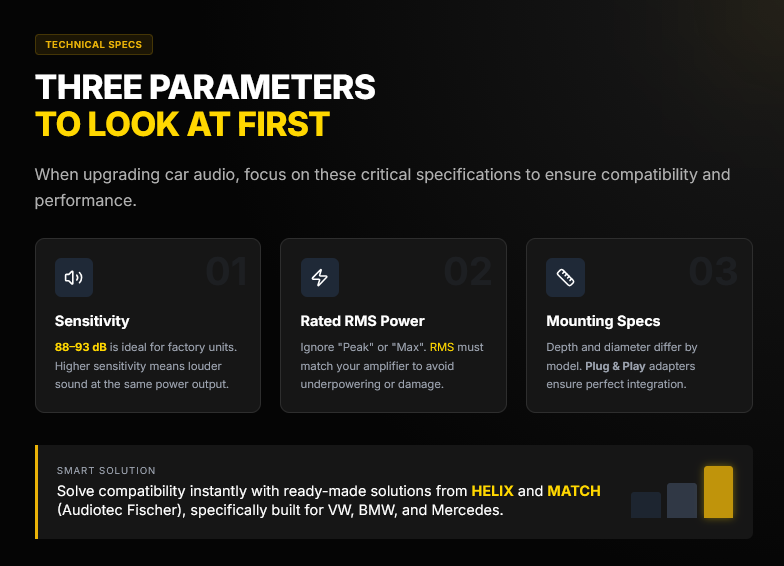
- Sensitivity (dB/W/m): the higher it is, the louder the speaker at the same amplifier output. For most cars with a factory head unit, 88–93 dB is sufficient. Below that — you’ll need a serious amplifier.
- Rated RMS power: not “peak,” not “max power” — RMS only. It must match the amplifier’s output power. A mismatch in either direction means either underpowering or a damaged speaker.
- Mounting depth and diameter: compatibility with your specific car model is not optional. This is solved with ready-made Plug & Play adapters — specifically, the HELIX and MATCH lineups from Audiotec Fischer, built for VW Group, BMW, and Mercedes models.
Installation Matters Just as Much as the Speaker Itself
Even an expensive speaker set will underperform without proper acoustic door preparation.
Three mandatory steps:
- Sound deadening on the door metal — eliminates resonances.
- Sealing the service openings — creates a “quasi-closed” volume for the midbass.
- Rigid mounting of the speaker to the metal or quality spacer rings — no play, no flex.
Tweeter height and angle have a fundamental impact on the soundstage. A-pillar placement is preferable to mirror mounts: the sound arrives closer to the listener’s axis, and the stage sits higher and more precisely defined.
Car tuning is about more than sound. GÄN Tuning Büro has been developing engine tuning modules since 2015, with over 30,000 cars tuned across 8 countries. Want to find out whether there’s a GÄN solution for your car? →Find your module at gantuning.com
Subwoofer: Do You Need One, and How to Choose the Right One
Why a Subwoofer in a Modern Car
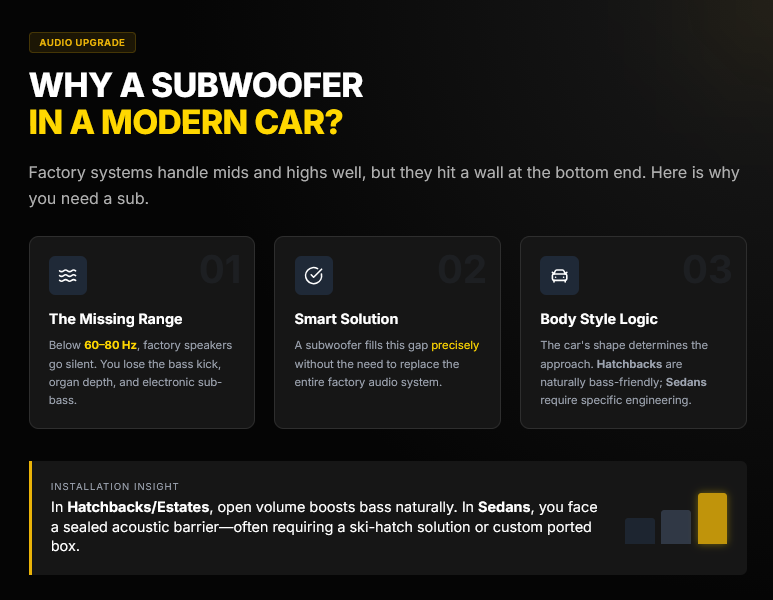
Factory audio systems in modern cars — even in non-base configurations — handle midrange and high frequencies quite well. The problem is almost always the same: below 60–80 Hz, there’s nothing. That’s where the kick of a bass guitar lives, the lower register of an organ, the sub-bass of electronic music.
A subwoofer fills that gap precisely — without requiring a full system replacement.
Body style directly determines the approach: in a hatchback or estate, the open volume between the boot and the cabin works in favor of bass, making subwoofer integration more straightforward. In a sedan — a sealed enclosure in the boot, accounting for the ski hatch or folding rear seat.
Solution Types: What to Choose for Your Specific Goal
- Classic driver in a sealed enclosure — controlled, tight bass. Works well at motorway speeds, where tyre noise creates a parasitic background. The standard for SQ systems.
- Ported enclosure — more output at the same power, but requires precise calculation of the volume and port. Design errors result in “slow,” bloated bass — a typical problem with cheap off-the-shelf boxes.
- Stealth enclosure in the boot side panel — a popular premium format for drivers who don’t want to sacrifice boot space. Takes up minimal room and integrates cleanly into the trim.
- Compact active sub under the seat or floor — relevant for EVs and tight spaces. Doesn’t deliver extreme output, but meaningfully improves the low register. According to6W Research, the growth of the EV segment across Europe is directly driving demand for compact, integrated audio solutions.
Power: Real Numbers, Not “Peak” Promises
For comfortable everyday SQ use in a typical car — 300–500 W RMS. That’s more than enough with headroom to spare. SPL competition builds require 1,000+ W, but that’s a different story with different goals and a different price tag.
Always look at RMS. The “max power” or “peak” figures on the packaging are marketing, not engineering.
Amplifier: Class, Power, and OEM Integration
Amplifier Classes: What’s Relevant in 2026
- Class AB — a solid balance of quality and efficiency (around 60% efficiency). The classic choice for front channels in SQ systems. Sounds natural, but runs warm and requires ventilation.
- Class D — up to 90% efficiency, compact dimensions, minimal heat output. Optimal for the subwoofer channel and multi-channel solutions in tight spaces. In EVs — effectively the standard: high efficiency directly impacts range.
In 2026, Class D — in DSP amplifiers and mono subwoofer blocks — is becoming the primary choice across the European market. The reason is simple: space in modern cars is limited, and EVs demand careful attention to the energy budget.
Power: How Much Do You Actually Need
For a typical SQ build:
- Front stage: 2 × 75–150 W RMS per channel. At speaker sensitivity of 90+ dB — more than sufficient.
- Subwoofer: 300–500 W RMS for everyday driving.
Practical configurations: a 5- or 6-channel amplifier, or a combination of “DSP amplifier for the front + Class D mono block for the sub.” The second option offers more flexibility when dialing in the tune.
OEM Integration — The Critical Point
This is the key question for most modern cars. Factory systems — BMW iDrive, VW MIB, Mercedes MBUX — operate through digital buses and complex signal processing within the built-in amplifier. You simply can’t tap into the signal without losing functionality.
The solution: specialized DSP amplifiers with high-level inputs and model-specific adapters. The HELIX and MATCH lineups (Audiotec Fischer) offer ready-made Plug & Play solutions with presets for VW Group, BMW, and Mercedes. This approach preserves all factory functions — steering wheel controls, driver assists, parking sensors — and doesn’t touch the wiring or the dealer warranty.
While you’re thinking about an audio upgrade, it’s worth checking your engine’s potential at the same time. The GÄN GT tuning module for turbocharged engines increases power by up to 25% and torque by up to 25%, while reducing fuel consumption by up to 15%. IP67-rated housing, smartphone control, 5 operating modes. The module removes in 60 seconds with no trace left in the ECU — the manufacturer warranty is preserved. →Learn more about GÄN GT
Comparison Table: Car Audio Setup by Level
| Parameter | Entry-Level Upgrade | Mid-Range SQ Build | Premium SQ |
| Front speakers | OEM speaker swap, no amplifier | 2-way kit + door treatment | 3-way Plug & Play system for your model |
| Subwoofer | Active sub under seat | 10″ in sealed enclosure, boot side | 12″ stealth enclosure, Class D mono block |
| Amplifier | Built into active sub | 4-channel AB/D + mono block | DSP amplifier + mono block, full integration |
| DSP tuning | None / manual EQ | Basic via amplifier software | Professional, tuned for cabin and driving style |
| OEM compatibility | Partial | Depends on adapters | Full, no function loss |
| Warranty impact | Risk when touching wiring | Low with Plug & Play adapters | None |
Three Myths About Car Stereo Upgrades That Cost You Money
Myth: “The More Powerful the Amplifier, the Better the Sound”
Sound is determined by speaker quality, door sound deadening, and DSP tuning. An overdriven amplifier clips the signal and physically destroys speakers. A properly matched 75-watt channel sounds better than a thoughtlessly installed 300-watt one.
Myth: “A Subwoofer Will Ruin the Factory Sound”
A properly tuned subwoofer with a crossover point around 80 Hz and correct phase alignment is not audible as a separate source. It simply fills in the low end that was missing. Without it, the system sounds flat.
Myth: “An Audio Upgrade Automatically Voids the Dealer Warranty”
This depends entirely on the installation method. Plug & Play adapters and DSP solutions that don’t touch the factory wiring give the dealer no formal grounds to deny warranty service. The same principle applies to performance tuning: GÄN uses modules that don’t modify the ECU software and remove in 60 seconds — no traces, no flash counter reset.

Questions & Answers
Q: Where do I start if my budget is limited?
Start with door sound deadening and quality front speakers. This delivers the greatest acoustic gain per euro spent. A good 2-way kit with properly prepared doors will transform the sound more noticeably than any new head unit.
Q: Do I need to replace the factory head unit on a BMW or VW?
In most cases — no. DSP amplifiers with high-level inputs and model-specific Plug & Play adapters let you keep all factory functionality — navigation, voice control, driver assists — while significantly improving the sound.
Q: How does the approach to car audio change in electric vehicles?
Three key differences. The absence of engine noise exposes acoustic shortcomings — the bar for speaker quality rises. Weight matters: compact Class D amplifiers are preferable. And energy efficiency — amplifier efficiency directly affects range. According toFuture Market Insights, EVs have become one of the key growth drivers for aftermarket car audio in Europe in 2025–2026.
Example Configuration for a Hatchback or Sedan in 2026
A working “premium daily” system for a VW Golf, BMW 3 Series, or Audi A3:
- Front stage: 2- or 3-way Plug & Play kit for the specific model (HELIX/MATCH or Rainbow Audio), door sound deadening and sealing. Power: 75–120 W RMS per channel.
- Subwoofer: 10–12″ in a compact sealed enclosure on the boot side, or a flat active sub — depending on body style. Power: 300–400 W RMS.
- Amplifier: Class D DSP amplifier (4–6 channels) for the front stage + Class D mono block for the sub.
- Tuning: Professional DSP calibration for the cabin, accounting for motorway speeds, tyre noise, and musical preferences.
The system installs without touching the factory wiring. All onboard electronics functions are preserved. Dealer warranty — untouched.
The Bottom Line: The Right Car Audio Setup Algorithm for 2026
- Define your goal — SQ comfort or maximum output. For most European drivers — almost always the former.
- Check compatibility — factory head unit type, availability of Plug & Play adapters for your model.
- Start with the front stage — sound deadening + 2-way speaker kit. This accounts for 70% of the result.
- Add a subwoofer — format and type based on body style and available boot space.
- Choose an amplifier — Class D for the sub, AB or D for the front, DSP is mandatory for OEM integration.
- Professional tuning — the final step that makes the system truly yours.
In short: great sound in your car isn’t about the price of the components. It’s about a systematic approach, proper installation, and tuning calibrated to your specific cabin.
Want to upgrade your car comprehensively — both sound and performance? GÄN Tuning Büro offers a tuning module backed by an engine warranty of up to €5,000 for 2 years — the only one in the segment with financial coverage. 50-day test drive with full money-back guarantee. Developed and manufactured in Germany. → Order a risk-free GÄN test drive
Articoli utili sul chip tuning:

An aerodynamic body kit starts delivering measurable technical effect at around 100–120 km/h. At motorway speeds, a properly engineered kit improves axle downforce, lane stability, and — in purpose-designed, CFD-calculated cases — reduces fuel consumption by up to ~5%. Most generic “wide-body” kits, however, increase drag and fuel consumption because they add frontal area without […]
Most chip tuning articles are written by companies selling tuning services. They highlight benefits and downplay risks because they want your money. This article is different. I’m going to explain what chip tuning actually does, compare the two main methods honestly, and discuss the real risks to warranties and engine longevity. What you do with […]
Everyone asks this question before installing a tuning module: will my fuel consumption go up or down? The honest answer is – it depends entirely on how you drive. Install a chip and keep driving like you did before? You’ll probably use 10-15% less fuel. Install the same chip and start using all that extra […]


Contact us via WhatsApp